Opening the book…
Objectives
After completing this section, you should be able to
- use the Hückel 4n + 2 rule to explain the stability of the cyclopentadienyl anion, the cycloheptatrienyl cation and similar species.
- use the Hückel 4n + 2 rule to determine whether or not a given unsaturated cyclic hydrocarbon anion or cation is aromatic.
- draw the resonance contributors for the cyclopentadienyl anion, cation and radical, and similar species.
Charged Aromatic Compounds
Carbanions and carbocations may also show aromatic stabilization. Some examples are:
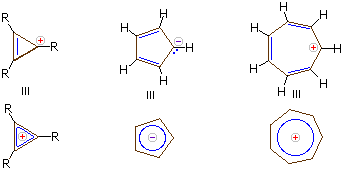
The three-membered ring cation has 2 \(\pi\)-electrons and is surprisingly stable, considering its ring strain. Cyclopentadiene is as acidic as ethanol, reflecting the stability of its 6 π-electron conjugate base. Salts of cycloheptatrienyl cation (tropylium ion) are stable in water solution, again reflecting the stability of this 6 \(\pi\)-electron cation.
Exercises
Draw the resonance structures for cycloheptatriene anion. Are all bonds equivalent? How many lines (signals) would you see in a H1 NMR?
- Answer
-
All protons and carbons are the same, so therefore each spectrum will only have one signal in the proton NMR.

The following reaction occurs readily. Propose a reason why this occurs?

- Answer
-
The ring becomes aromatic with the addition of two electrons. Thereby obeying the 4n+2 rule.
Contributors and Attributions
Dr. Dietmar Kennepohl FCIC (Professor of Chemistry, Athabasca University)
Prof. Steven Farmer (Sonoma State University)
William Reusch, Professor Emeritus (Michigan State U.), Virtual Textbook of Organic Chemistry
15.4: Aromatic Ions is shared under a CC BY-NC-SA 4.0 license and was authored, remixed, and/or curated by LibreTexts.
The book could not be loaded just now.