Opening the book…
This page explains what acid anhydrides are and looks at their simple physical properties such as boiling points. It introduces their chemical reactivity in a general way. A carboxylic acid such as ethanoic acid has the structure:

If you took two ethanoic acid molecules and removed a molecule of water between them you would get the acid anhydride, ethanoic anhydride (old name: acetic anhydride).

You can actually make ethanoic anhydride by dehydrating ethanoic acid, but it is normally made in a more efficient, round-about way
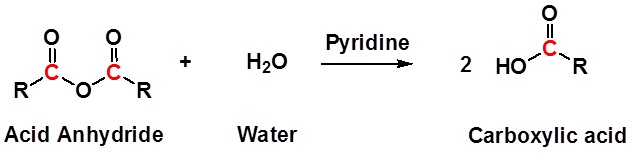
Acid Anhydrides react with water to form carboxylic acids
General Reaction
| Example 1: |
|---|
 |
Mechanism
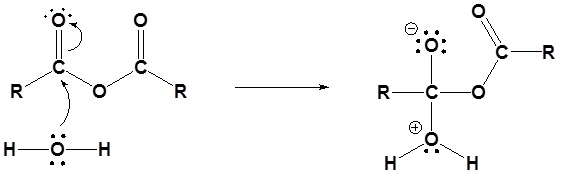
1) Nucleophilic Attack by the water molcule
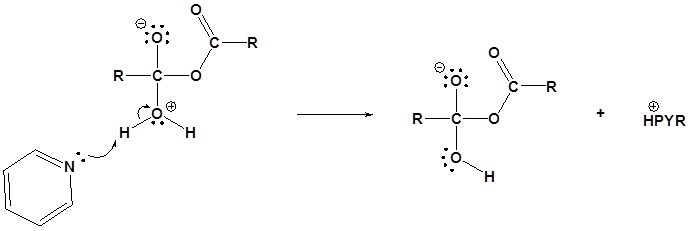
2) Deprotonation by pyridine
3) Leaving group removal
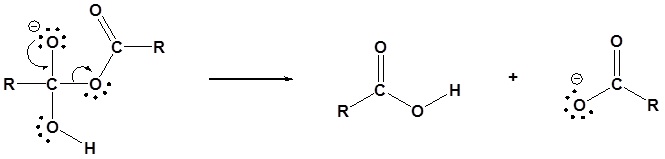
4) Protonation of the carboxylate

Acid Anhydrides react with alcohols to form esters
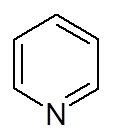
Reactions of anhydrides use Pyridine as a solvent

| Example 1: |
|---|
 |
Mechanism
1) Nucleophilic Attack by the Alcohol
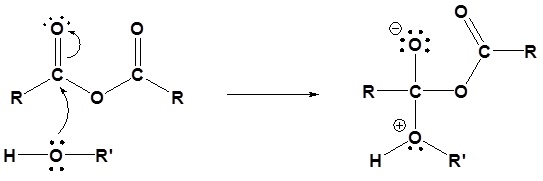
2) Deprotonation by pyridine
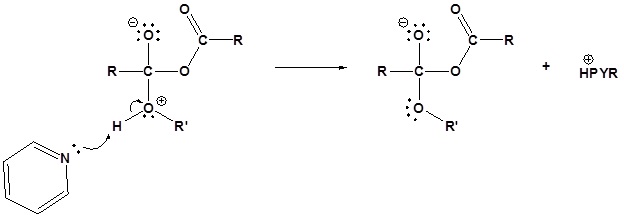
3) Leaving group removal
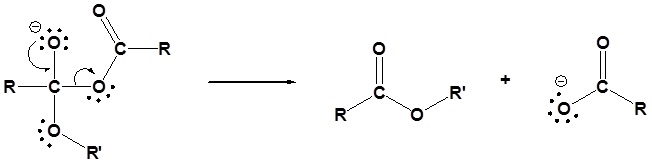
4) Protonation of the carboxylate

Acid Anhydrides react with amines to form amides
General Reaction

| Example 1: |
|---|
 |
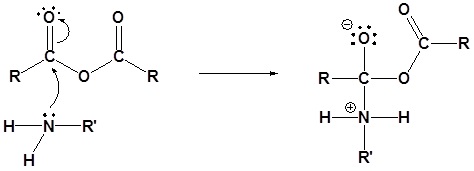
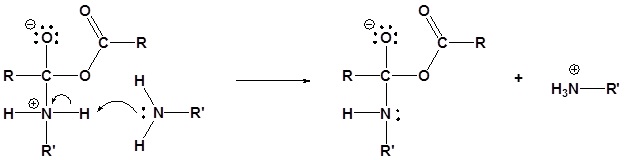
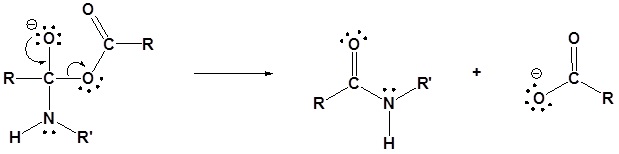
Mechanism
1) Nucleophilic Attack by the Amine
2) Deprotonation by the amine
3) Leaving group removal
Contributors
Prof. Steven Farmer (Sonoma State University)
- Layne A. Morsch - University of Illinois Springfield
This page titled 22.8 Reactions of Anhydrides was last modified on Wed, 05 Jun 2019 18:45:45 GMT and is shared under a CC BY-NC-SA 4.0 license and was authored, remixed, and/or curated by Layne Morsch.
The book could not be loaded just now.