Opening the book…
Organometallic reagents and carbon dioxide

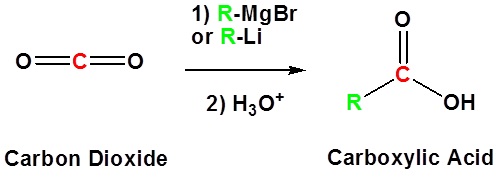
Grignard reagents react with carbon dioxide in two stages. In the first, you get an addition of the Grignard reagent to the carbon dioxide. Dry carbon dioxide is bubbled through a solution of the Grignard reagent in ethoxyethane, made as described above. For example:

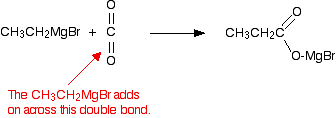
The product is then hydrolyzed (reacted with water) in the presence of a dilute acid. Typically, you would add dilute sulphuric acid or dilute hydrochloric acid to the solution formed by the reaction with the CO2. A carboxylic acid is produced with one more carbon than the original Grignard reagent. The usually quoted equation is (without the red bits):
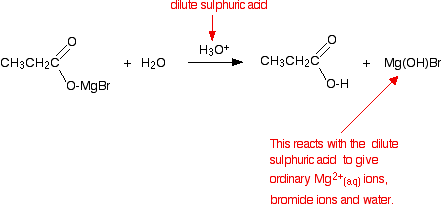
Almost all sources quote the formation of a basic halide such as Mg(OH)Br as the other product of the reaction. That's actually misleading because these compounds react with dilute acids. What you end up with would be a mixture of ordinary hydrated magnesium ions, halide ions and sulfate or chloride ions - depending on which dilute acid you added.
This page titled 20.13 Reaction of Organometallic Reagents with CO2 was last modified on Wed, 05 Jun 2019 18:45:44 GMT and is shared under a CC BY-NC-SA 4.0 license and was authored, remixed, and/or curated by Layne Morsch.
The book could not be loaded just now.