Opening the book…
Esters can be cleaved back into a carboxylic acid and an alcohol by reaction with water and a catalytic amount of acid.
General Reaction
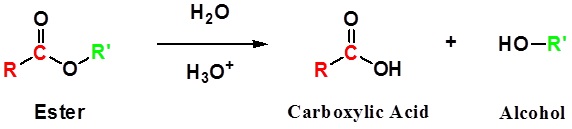
| Example 1: |
|---|
 |
Mechanism
1) Protonation of the Carbonyl
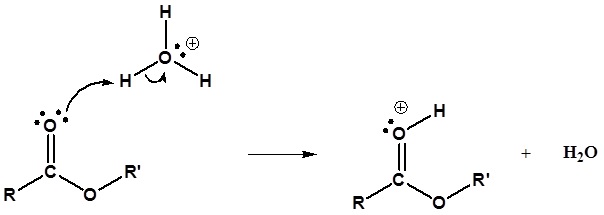
2) Nucleophilic attack by water
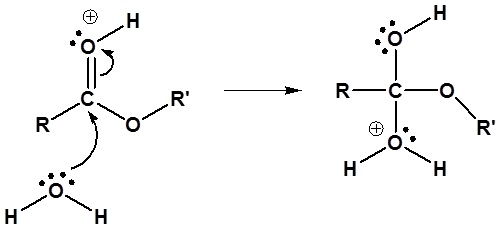
3) Proton transfer
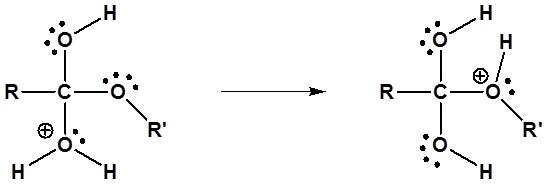
4) Leaving group removal
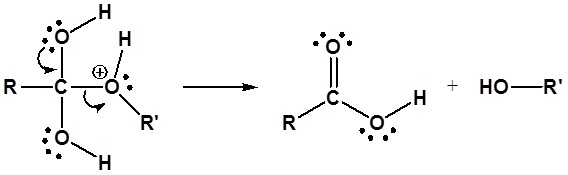
The resulting carbonyl is deprotonated by water to reform H3O+ and yield the neutral carboxylic acid.
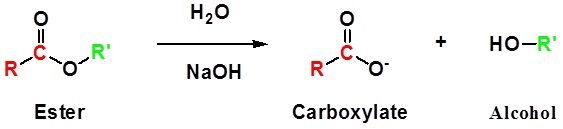
Esters can be cleaved back into a carboxylic acid and an alcohol by reaction with water and a base
The reaction is called a saponification from the Latin sapo which means soap. The name comes from the fact that soap used to me made by the ester hydrolysis of fats. Due to the basic conditions a carboxylate ion is made rather than a carboxylic acid.
General reaction
| Example 1: |
|---|
 |
Mechanism
1) Nucleophilic attack by hydroxide
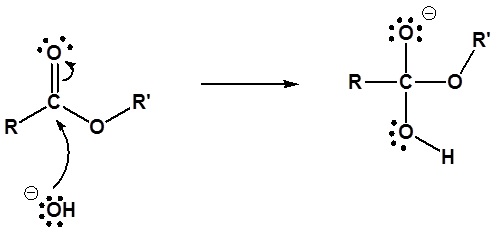
2) Leaving group removal
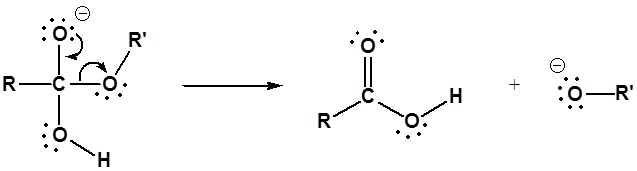
3) Deprotonation

Contributors
Prof. Steven Farmer (Sonoma State University)
- Layne A. Morsch - University of Illinois Springfield
This page titled 22.10: Reactions of Esters was last modified on Wed, 05 Jun 2019 18:45:45 GMT and is shared under a CC BY-NC-SA 4.0 license and was authored, remixed, and/or curated by Layne Morsch.
The book could not be loaded just now.