Opening the book…
The halogens chlorine and bromine add rapidly to a wide variety of alkenes without inducing the kinds of structural rearrangements (carbocation shifts) noted for strong acids - this is because a discreet carbocation intermediate does not form in these reactions. The stereoselectivity of halogen additions is strongly anti, as shown in many of the following examples.
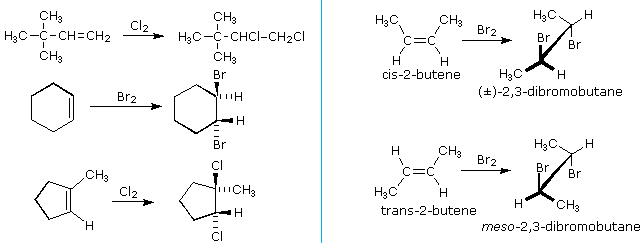
We can account both for the high stereoselectivity and the lack of rearrangement in these reactions by proposing a stabilizing interaction between the developing carbocation center and the electron rich halogen atom on the adjacent carbon. This interaction delocalizes the positive charge on the intermediate and blocks halide ion attack from the syn-location.

The stabilization provided by the halogen-carbocation bonding makes rearrangement unlikely, and in a few cases three-membered cyclic halonium cations have been isolated and identified as true intermediates. A resonance description of such a bromonium ion intermediate is shown below. The positive charge is delocalized over all the atoms of the ring, but should be concentrated at the more substituted carbon (where positive charge is more stable), and this is the site to which the nucleophile will bond.

Contributors
William Reusch, Professor Emeritus (Michigan State U.), Virtual Textbook of Organic Chemistry
This page titled 10.12: Stereochemistry of Halogenation was last modified on Tue, 02 Nov 2021 04:06:54 GMT and is shared under a CC BY-NC-SA 4.0 license and was authored, remixed, and/or curated by Layne Morsch.
The book could not be loaded just now.