Opening the book…
Reaction: Halogenation of Alkynes
Summary:

- Stereoslectivity: anti addition
- Reaction proceeds via cyclic halonium ion
Addition of Br2
- The addition of Br2 to an alkyne is analogous to adding Br2 to an alkene.
- Once Br2 approaches the nucleophilic alkyne, it becomes polarized.
- The \(\pi\) electrons, from the triple bond, can now attack the polarized bromine forming a C-Br bond and displacing the bromine ion.
- Now, you will get an intermediate electrophilic carbocation, which will immediately react with the bromine ion giving you the dibromo product.
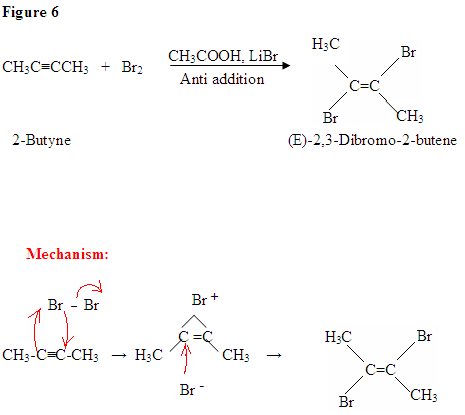
First, you see the polarized Br2 being attacked by the \(\pi\) electrons. Once you form the C-Br bond, the other bromine is released as a bromine ion. The intermediate here is a bromonium ion, which is electrophilic and reacts with the bromine ion giving you the dibromo product.
Contributors
- Prof. Hilton Weiss (Bard College)
- Aleksandra Milman
This page titled 11.8: Addition of Halogen to Alkynes was last modified on Wed, 05 Jun 2019 18:45:42 GMT and is shared under a CC BY-NC-SA 4.0 license and was authored, remixed, and/or curated by Layne Morsch.
The book could not be loaded just now.