Opening the book…
Learning Objective
- interpret and draw reaction energy diagrams for dehydrohalogenation of R-X’s
- propose mechanisms for a dehydrohalogenation reactions -
- predict the products and specify the reagents for alkene synthesis from dehydrohalogenation of R-X’s
- predict and explain the stereochemistry of E2 eliminations to form alkenes, especially from cyclohexanes
Alkene Synthesis by Elimination of Alkyl Halides is discussed in detail in chapter 7 sections 13 - 18. The major learning objectives are summarized briefly in this section.
Alkene Synthesis by Elimination of Alkyl Halides
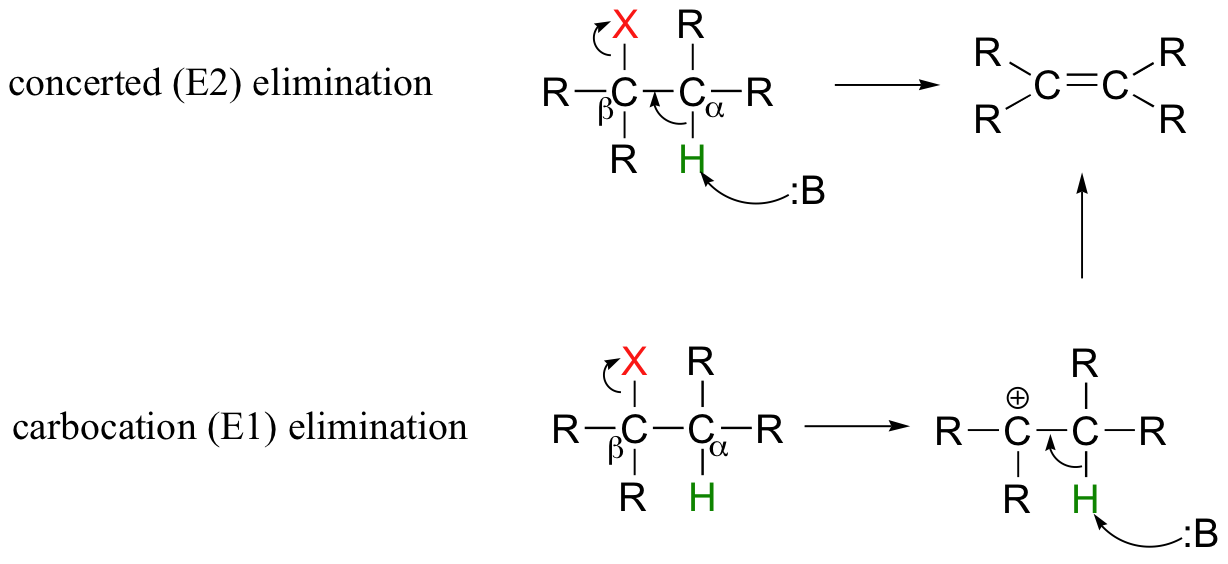
When considering whether an elimination reaction is likely to occur via an E1 or E2 mechanism, we really need to consider three factors:
- 1) The base: strong bases favor the E2 mechanism, whereas, E1 mechanisms only require a weak base.
- 2) The solvent: good ionizing xolvents (polar protic) favor the E1 mechanism by stabilizing the carbocation intermediate.
- 3) The alkyl halide: primary alkyl halides have the only structure useful in distinguishing between the E2 and E1 pathways. Since primary carbocations do not form, only the E2 mechanism is possible.
| Reaction Parameter | E2 | E1 |
|---|---|---|
| alkyl halide structure | tertiary > secondary > primary | tertiary > secondary >>>> primary |
| nucleophile | high concentration of a strong base | weak base |
| mechanism | 1-step | 2-step |
| rate limiting step | anti-coplanar bimolecular transition state | carbocation formation |
| rate law | rate = k[R-X][Base] | rate = k[R-X] |
| stereochemisty | retained configuration | mixed configuration |
| solvent | not important | polar protic |
7.7: Alkene Synthesis by Elimination of Alkyl Halides is shared under a CC BY-NC-SA 4.0 license and was authored, remixed, and/or curated by LibreTexts.
The book could not be loaded just now.