Opening the book…
Aldehydes and ketones can be converted to a hydrazine derivative by reaction with hydrazine. These "hydrazones" can be further converted to the corresponding alkane by reaction with base and heat. These two steps can be combined into one reaction called the Wolff-Kishner Reduction which represents a general method for converting aldehydes and ketones into alkanes. Typically a high boiling point solvent, such as ethylene glycol, is used to provide the high temperatures needed for this reaction to occur. Note! Nitrogen gas is produced as part of this reaction.
Reaction of Aldehydes or Ketones with Hydrazine Produces a Hydrazone

Reaction with a Base and Heat Converts a Hydrazone to an Alkane
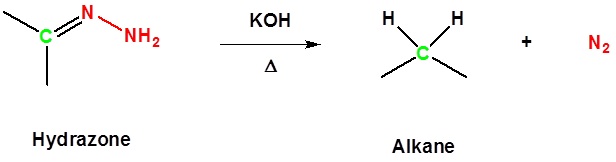
Both Reactions Together Produces the Wolff-Kishner Reduction

The Wolff-Kishner reaction for cyclopentanone is shown below.

Mechanism of the Wolff-Kishner Reduction
1) Deprotonation of Nitrogen

2) Protonation of the Carbon
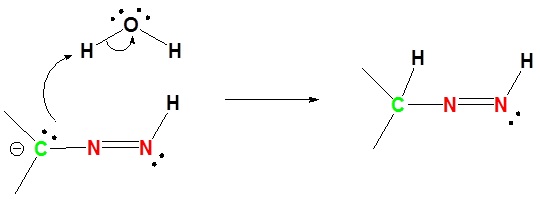
3) Deprotonation of Nitrogen

4) Protonation of Carbon

Exercise
17. Draw the products for the following reactions.

- Answer
-
17.
Contributors and Attributions
Dr. Dietmar Kennepohl FCIC (Professor of Chemistry, Athabasca University)
Prof. Steven Farmer (Sonoma State University)
18.10: Nucleophilic Addition of Hydrazine (Wolff-Kishner Reaction) is shared under a CC BY-NC-SA 4.0 license and was authored, remixed, and/or curated by LibreTexts.
The book could not be loaded just now.