Opening the book…
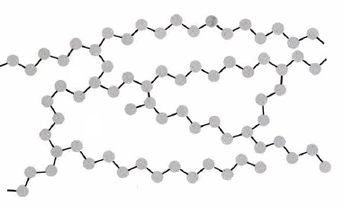
The formation of covalent bonds which hold portions of several polymer chains together is called cross-linking. Extensive cross-linking results in a random three-dimensional network of interconnected chains, as shown in the figure. As one might expect, extensive cross-linking produces a substance which has more rigidity, hardness, and a higher melting point than the equivalent polymer without cross-linking. Almost all the hard and rigid plastics we use are cross-linked. These include Bakelite, which is used in many electric plugs and sockets, melamine, which is used in plastic crockery, and epoxy resin glues.
Below is a video of the formation of Polyurethane Foam.
Polyether polyol, a blowing agent, which adds a gas to the mixture to produce a foam, silicone surfactant, and a catalyst is mixed with a second liquid contains a polyfunctional isocyanate. The polyol and the polyfunctional isocyanate react to form polyurethane - a very hard substance when dried. The general reaction is shown below:

In the reaction in the video, each R1 group has multiple isocyanate groups; the reactants are polyfunctional. Thus there is a high degree of cross-linking in the polyurethane. This causes the foam to become rigid after cooling.
This page titled 5.10: Cross-Linking was last modified on Tue, 06 Aug 2019 05:42:34 GMT and is shared under a CC BY-NC-SA 4.0 license and was authored, remixed, and/or curated by Ed Vitz, John W. Moore, Justin Shorb, Xavier Prat-Resina, Tim Wendorff, and Adam Hahn.
The book could not be loaded just now.