Opening the book…
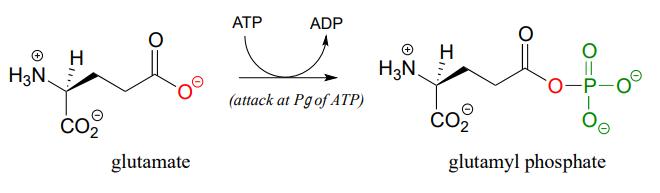
Thus far we have seen hydroxyl oxygens and phosphate oxygens acting as nucleophilic accepting groups in ATP-dependent phosphate transfer reactions. Carboxylate oxygens can also accept phosphate groups from ATP. This typically happens in two different ways. First, the carboxylate can attack the g-phosphate of ATP to accept phosphate, generates a species known as an 'acyl phosphate'. An example is the first part of the reaction catalyzed by glutamine synthase (EC 6.3.1.2):
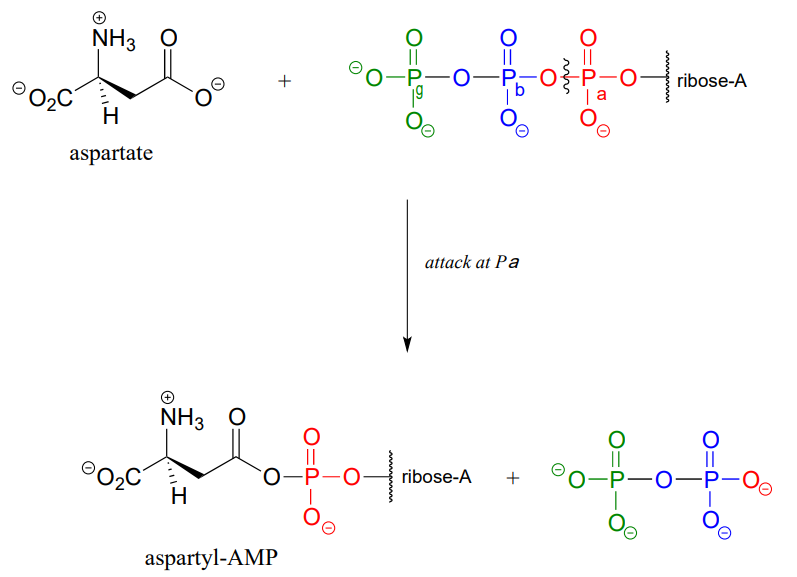
Alternatively, carboxylate groups are often converted into a species referred to as an 'acyl-AMP' . Here, the carboxylate oxygen attacks the \(\alpha \)-phosphate of ATP leading to release of inorganic pyrophosphate. An example is the first part of the reaction catalyzed by the enzyme asparagine synthetase: (EC 6.3.5.4):
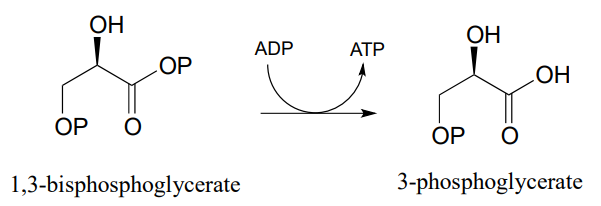
Draw a curved-arrow mechanism for the phosphate transfer reaction shown below (EC 2.7.2.3), which is from the glycolysis pathway. Note that ADP is on the reactant side and ATP is a product (the opposite of what we have seen so far). Hint: What functional group is the nucleophile? What functional group is the leaving group?
This page titled 9.6: Phosphorylation of Carboxylates was last modified on Wed, 20 Jul 2022 14:01:18 GMT and is shared under a CC BY-NC-SA 4.0 license and was authored, remixed, and/or curated by Tim Soderberg via source content that was edited to the style and standards of the LibreTexts platform.
The book could not be loaded just now.