Opening the book…
Synthetic biology combines many fields, and the techniques used are not particular to synthetic biology. Much like the process of solving other engineering problems, the process of creating a useful biological system has designing, building, testing, and improving phases. Once a design or statement of the desired properties of a biological system are created, the problem becomes finding the proper biological components to build such a system.
BioCompiler [1] is a tool developed to allow the programming of biological circuits using a high-level programming language. One can write programs in a language similar to LISP and compile their program into a biological circuit. BioCompiler uses a process similar to that of a compiler for a programming language. It uses a human-written program as a high-level description of the genetic circuit, then generates a formal description of the program. From there, it looks up abstract genetic regulatory network pieces that can be combined to create the genetic circuit and goes through its library of DNA parts to find appropriate sequences to match the functionality of the abstract genetic regulatory network pieces. Assembly instructions can then be generated for creating cells with the appropriate genetic regulatory network.
Figure 26.5: An example of a BioCompiler program and the process of actualizing it (credit to Ron Weiss)
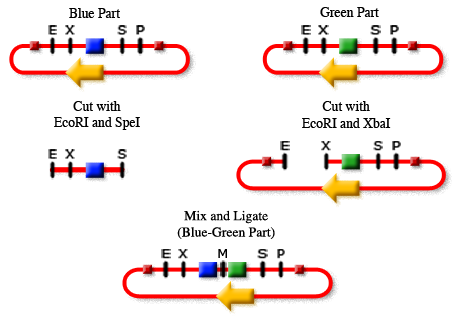
BioBrick standard biologic parts (biobricks.org)are another tool used in synthetic biology. Similar to the parts in the Registry of Standard Biological Parts, BioBrick standard biological parts are DNA sequences of defined structure and function. Each BioBrick part is a DNA sequence held together in a circular plasmid. At either end of the BioBrick contains a known and well-defined sequence with restriction enzymes that can cut open the plasmid at known positions. This allows for the creation of larger BioBrick parts by chaining together smaller ones. Some competitors in the iGEM competition used BioBrick systems to develop an E. coli line that produced scents such as banana or mint.
25.3: Tools and Techniques is shared under a not declared license and was authored, remixed, and/or curated by LibreTexts.
The book could not be loaded just now.