Opening the book…
The seven characteristics that Mendel evaluated in his pea plants were each expressed as one of two versions, or traits. Mendel deduced from his results that each individual had two discrete copies of the characteristic that are passed individually to offspring. We now call those two copies genes, which are carried on chromosomes. The reason we have two copies of each gene is that we inherit one from each parent. In fact, it is the chromosomes we inherit and the two copies of each gene are located on paired chromosomes. Recall that in meiosis these chromosomes are separated out into haploid gametes. This separation, or segregation, of the homologous chromosomes means also that only one of the copies of the gene gets moved into a gamete. The offspring are formed when that gamete unites with one from another parent and the two copies of each gene (and chromosome) are restored.
For cases in which a single gene controls a single characteristic, a diploid organism has two genetic copies that may or may not encode the same version of that characteristic. For example, one individual may carry a gene that determines white flower color and a gene that determines violet flower color. Gene variants that arise by mutation and exist at the same relative locations on homologous chromosomes are called alleles. Mendel examined the inheritance of genes with just two allele forms, but it is common to encounter more than two alleles for any given gene in a natural population.
Phenotypes and Genotypes
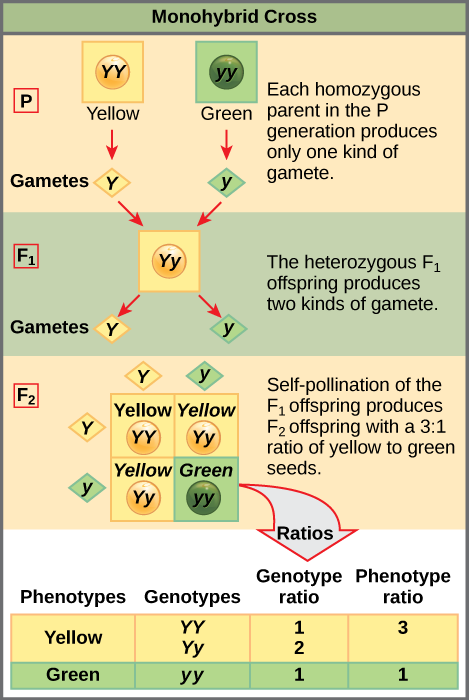
Two alleles for a given gene in a diploid organism are expressed and interact to produce physical characteristics. The observable traits expressed by an organism are referred to as its phenotype. An organism’s underlying genetic makeup, consisting of both the physically visible and the non-expressed alleles, is called its genotype. Mendel’s hybridization experiments demonstrate the difference between phenotype and genotype. For example, the phenotypes that Mendel observed in his crosses between pea plants with differing traits are connected to the diploid genotypes of the plants in the P, F1, and F2 generations. We will use a second trait that Mendel investigated, seed color, as an example. Seed color is governed by a single gene with two alleles. The yellow-seed allele is dominant and the green-seed allele is recessive. When true-breeding plants were cross-fertilized, in which one parent had yellow seeds and one had green seeds, all of the F1hybrid offspring had yellow seeds. That is, the hybrid offspring were phenotypically identical to the true-breeding parent with yellow seeds. However, we know that the allele donated by the parent with green seeds was not simply lost because it reappeared in some of the F2 offspring (Figure 8.4). Therefore, the F1 plants must have been genotypically different from the parent with yellow seeds.
The P plants that Mendel used in his experiments were each homozygous for the trait he was studying. Diploid organisms that are homozygous for a gene have two identical alleles, one on each of their homologous chromosomes. The genotype is often written as YY or yy, for which each letter represents one of the two alleles in the genotype. The dominant allele is capitalized and the recessive allele is lower case. The letter used for the gene (seed color in this case) is usually related to the dominant trait (yellow allele, in this case, or “Y”). Mendel’s parental pea plants always bred true because both produced gametes carried the same allele. When P plants with contrasting traits were cross-fertilized, all of the offspring were heterozygous for the contrasting trait, meaning their genotype had different alleles for the gene being examined. For example, the F1 yellow plants that received a Y allele from their yellow parent and a y allele from their green parent had the genotype Yy.

Law of Dominance
Our discussion of homozygous and heterozygous organisms brings us to why the F1 heterozygous offspring were identical to one of the parents, rather than expressing both alleles. In all seven pea-plant characteristics, one of the two contrasting alleles was dominant, and the other was recessive. Mendel called the dominant allele the expressed unit factor; the recessive allele was referred to as the latent unit factor. We now know that these so-called unit factors are actually genes on homologous chromosomes. For a gene that is expressed in a dominant and recessive pattern, homozygous dominant and heterozygous organisms will look identical (that is, they will have different genotypes but the same phenotype), and the recessive allele will only be observed in homozygous recessive individuals (Table 8.1).
| Table 8.1 Correspondence between Genotype and Phenotype for a Dominant-Recessive Characteristic. | |||
|---|---|---|---|
| Homozygous | Heterozygous | Homozygous | |
| Genotype | YY | Yy | yy |
| Phenotype | yellow | yellow | green |
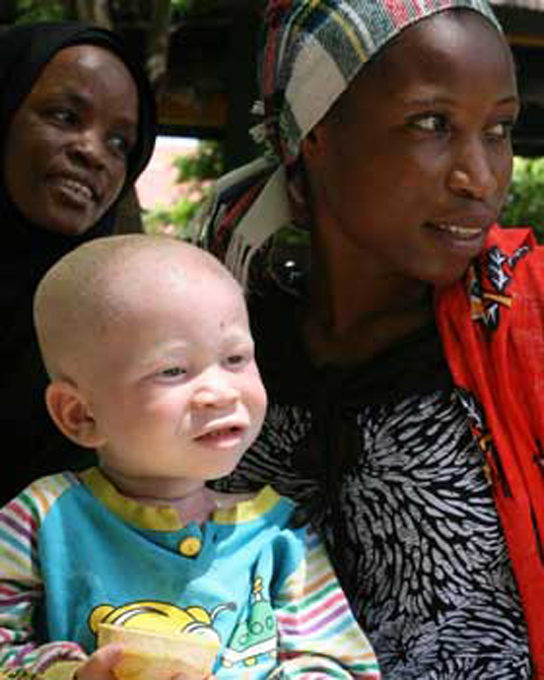
Mendel’s law of dominance states that in a heterozygote, one trait will conceal the presence of another trait for the same characteristic. For example, when crossing true-breeding violet-flowered plants with true-breeding white-flowered plants, all of the offspring were violet-flowered, even though they all had one allele for violet and one allele for white. Rather than both alleles contributing to a phenotype, the dominant allele will be expressed exclusively. The recessive allele will remain latent, but will be transmitted to offspring in the same manner as that by which the dominant allele is transmitted. The recessive trait will only be expressed by offspring that have two copies of this allele (Figure 8.5), and these offspring will breed true when self-crossed.
Monohybrid Cross and the Punnett Square
When fertilization occurs between two true-breeding parents that differ by only the characteristic being studied, the process is called a monohybrid cross, and the resulting offspring are called monohybrids. Mendel performed seven types of monohybrid crosses, each involving contrasting traits for different characteristics. Out of these crosses, all of the F1 offspring had the phenotype of one parent, and the F2 offspring had a 3:1 phenotypic ratio. On the basis of these results, Mendel postulated that each parent in the monohybrid cross contributed one of two paired unit factors to each offspring, and every possible combination of unit factors was equally likely.
The results of Mendel’s research can be explained in terms of probabilities, which are mathematical measures of likelihood. The probability of an event is calculated by the number of times the event occurs divided by the total number of opportunities for the event to occur. A probability of one (100 percent) for some event indicates that it is guaranteed to occur, whereas a probability of zero (0 percent) indicates that it is guaranteed to not occur, and a probability of 0.5 (50 percent) means it has an equal chance of occurring or not occurring.
To demonstrate this with a monohybrid cross, consider the case of true-breeding pea plants with yellow versus green seeds. The dominant seed color is yellow; therefore, the parental genotypes were YY for the plants with yellow seeds and yy for the plants with green seeds. A Punnett square, devised by the British geneticist Reginald Punnett, is useful for determining probabilities because it is drawn to predict all possible outcomes of all possible random fertilization events and their expected frequencies. Figure 8.7) shows a Punnett square for a cross between a plant with yellow peas and one with green peas. To prepare a Punnett square, all possible combinations of the parental alleles (the genotypes of the gametes) are listed along the top (for one parent) and side (for the other parent) of a grid. The combinations of egg and sperm gametes are then made in the boxes in the table on the basis of which alleles are combining. Each box then represents the diploid genotype of a zygote, or fertilized egg. Because each possibility is equally likely, genotypic ratios can be determined from a Punnett square. If the pattern of inheritance (dominant and recessive) is known, the phenotypic ratios can be inferred as well. For a monohybrid cross of two true-breeding parents, each parent contributes one type of allele. In this case, only one genotype is possible in the F1 offspring. All offspring are Yy and have yellow seeds.
When the F1 offspring are crossed with each other, each has an equal probability of contributing either a Y or a y to the F2 offspring. The result is a 1 in 4 (25 percent) probability of both parents contributing a Y, resulting in an offspring with a yellow phenotype; a 25 percent probability of parent A contributing a Y and parent B a y, resulting in offspring with a yellow phenotype; a 25 percent probability of parent A contributing a y and parent B a Y, also resulting in a yellow phenotype; and a (25 percent) probability of both parents contributing a y, resulting in a green phenotype. When counting all four possible outcomes, there is a 3 in 4 probability of offspring having the yellow phenotype and a 1 in 4 probability of offspring having the green phenotype. This explains why the results of Mendel’s F2 generation occurred in a 3:1 phenotypic ratio. Using large numbers of crosses, Mendel was able to calculate probabilities, found that they fit the model of inheritance, and use these to predict the outcomes of other crosses.
Law of Segregation
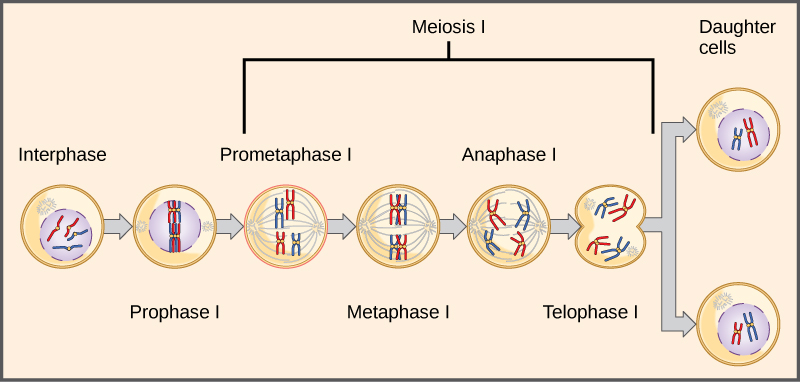
Observing that true-breeding pea plants with contrasting traits gave rise to F1 generations that all expressed the dominant trait and F2 generations that expressed the dominant and recessive traits in a 3:1 ratio, Mendel proposed the law of segregation. This law states that paired unit factors (genes) must segregate equally into gametes such that offspring have an equal likelihood of inheriting either factor. For the F2 generation of a monohybrid cross, the following three possible combinations of genotypes result: homozygous dominant, heterozygous, or homozygous recessive. Because heterozygotes could arise from two different pathways (receiving one dominant and one recessive allele from either parent), and because heterozygotes and homozygous dominant individuals are phenotypically identical, the law supports Mendel’s observed 3:1 phenotypic ratio. The equal segregation of alleles is the reason we can apply the Punnett square to accurately predict the offspring of parents with known genotypes. The physical basis of Mendel’s law of segregation is the first division of meiosis in which the homologous chromosomes with their different versions of each gene are segregated into daughter nuclei. This process was not understood by the scientific community during Mendel’s lifetime (Figure 8.6).
Test Cross
Beyond predicting the offspring of a cross between known homozygous or heterozygous parents, Mendel also developed a way to determine whether an organism that expressed a dominant trait was a heterozygote or a homozygote. Called the test cross, this technique is still used by plant and animal breeders. In a test cross, the dominant-expressing organism is crossed with an organism that is homozygous recessive for the same characteristic. If the dominant-expressing organism is a homozygote, then all F1 offspring will be heterozygotes expressing the dominant trait (Figure 8.7). Alternatively, if the dominant-expressing organism is a heterozygote, the F1 offspring will exhibit a 1:1 ratio of heterozygotes and recessive homozygotes. The test cross further validates Mendel’s postulate that pairs of unit factors segregate equally.
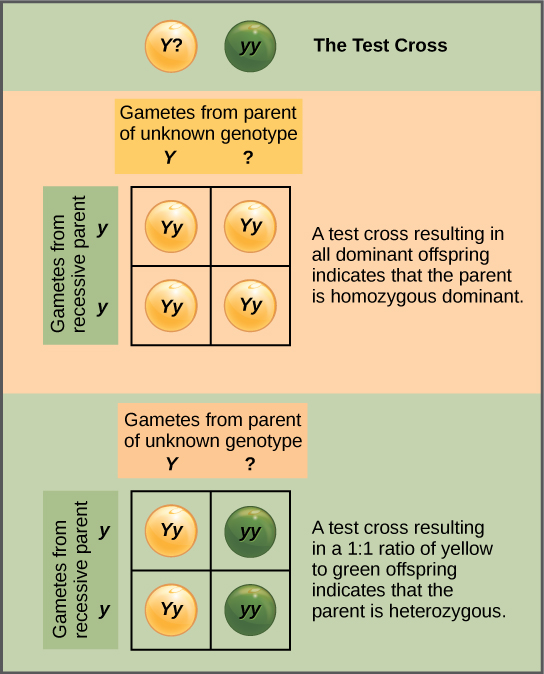
In pea plants, round peas (R) are dominant to wrinkled peas (r). You do a test cross between a pea plant with wrinkled peas (genotype rr) and a plant of unknown genotype that has round peas. You end up with three plants, all which have round peas. From this data, can you tell if the parent plant is homozygous dominant or heterozygous?
Law of Independent Assortment
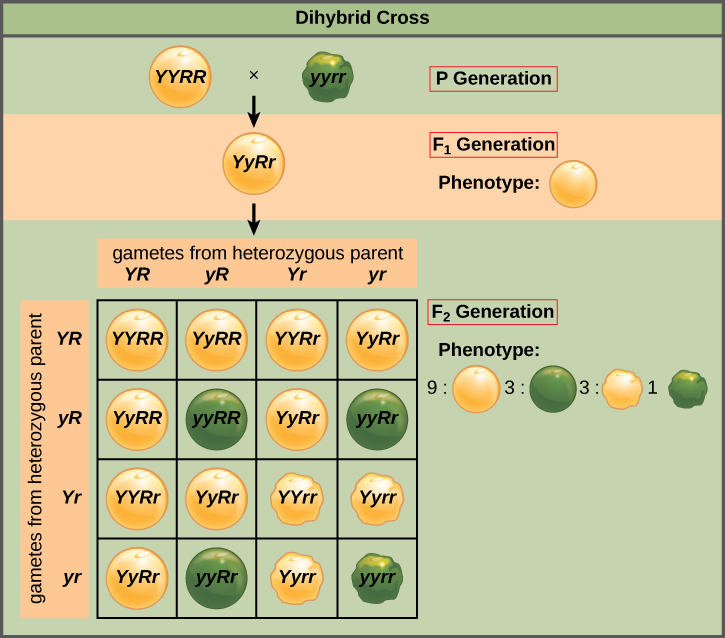
Mendel’s law of independent assortment states that genes do not influence each other with regard to the sorting of alleles into gametes, and every possible combination of alleles for every gene is equally likely to occur. Independent assortment of genes can be illustrated by the dihybrid cross, a cross between two true-breeding parents that express different traits for two characteristics. Consider the characteristics of seed color and seed texture for two pea plants, one that has wrinkled, green seeds (rryy) and another that has round, yellow seeds (RRYY). Because each parent is homozygous, the law of segregation indicates that the gametes for the wrinkled–green plant all are ry, and the gametes for the round–yellow plant are all RY. Therefore, the F1 generation of offspring all are RrYy (Figure 8.9).
In pea plants, purple flowers (P) are dominant to white (p), and yellow peas (Y) are dominant to green (y). What are the possible genotypes and phenotypes for a cross between PpYY and ppYy pea plants? How many squares would you need to complete a Punnett square analysis of this cross?
The gametes produced by the F1 individuals must have one allele from each of the two genes. For example, a gamete could get an R allele for the seed shape gene and either a Y or a y allele for the seed color gene. It cannot get both an R and an r allele; each gamete can have only one allele per gene. The law of independent assortment states that a gamete into which an r allele is sorted would be equally likely to contain either a Y or a y allele. Thus, there are four equally likely gametes that can be formed when the RrYy heterozygote is self-crossed, as follows: RY, rY, Ry, and ry. Arranging these gametes along the top and left of a 4 × 4 Punnett square (Figure 8.9) gives us 16 equally likely genotypic combinations. From these genotypes, we find a phenotypic ratio of 9 round–yellow:3 round–green:3 wrinkled–yellow:1 wrinkled–green (Figure 8.9). These are the offspring ratios we would expect, assuming we performed the crosses with a large enough sample size.
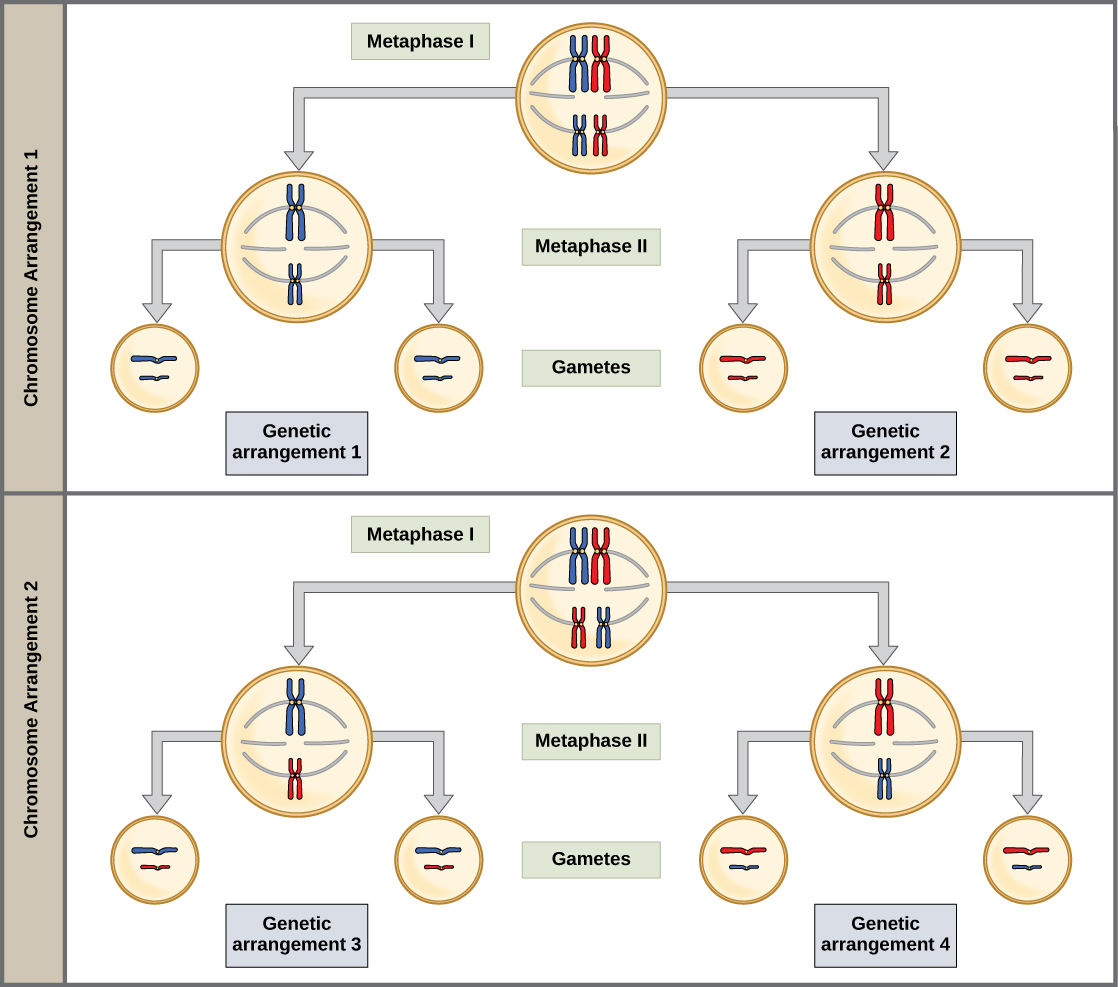
The physical basis for the law of independent assortment also lies in meiosis I, in which the different homologous pairs line up in random orientations. Each gamete can contain any combination of paternal and maternal chromosomes (and therefore the genes on them) because the orientation of tetrads on the metaphase plane is random (Figure 8.10).
Key Terms
Gene
A unit of heredity consisting of a DNA sequence that influences a specific trait.
Allele
An alternative version of a gene found at the same location (locus) on homologous chromosomes.
Phenotype
The observable physical or biochemical characteristics of an organism.
Genotype
The genetic makeup of an organism, consisting of the alleles it possesses.
Homozygous
Having two identical alleles for a particular gene.
Heterozygous
Having two different alleles for a particular gene.
Dominant Allele
An allele that is expressed in the phenotype when at least one copy is present.
Recessive Allele
An allele that is expressed only when two copies are present.
Law of Dominance
Mendel's principle stating that in a heterozygous individual, the dominant allele masks the expression of the recessive allele.
Monohybrid Cross
A genetic cross involving one gene or one characteristic.
Punnett Square
A diagram used to predict the possible genotypes and phenotypes of offspring from a genetic cross.
Probability
The mathematical likelihood that a particular event will occur.
Genotypic Ratio
The ratio of the different genotypes expected among offspring from a genetic cross.
Phenotypic Ratio
The ratio of the different observable traits expected among offspring from a genetic cross.
Law of Segregation
Mendel's first law, stating that the two alleles for a gene separate during gamete formation so that each gamete receives only one allele.
Test Cross
A cross between an individual displaying the dominant phenotype and a homozygous recessive individual to determine the unknown genotype.
Dihybrid Cross
A genetic cross involving two different genes or characteristics.
Law of Independent Assortment
Mendel's second law, stating that alleles of different genes assort independently into gametes during meiosis, provided the genes are not genetically linked.
Independent Assortment
The random distribution of homologous chromosome pairs during meiosis I, producing different combinations of maternal and paternal chromosomes in gametes.
Check Your Understanding
- What is the difference between a gene and an allele?
- Explain the difference between genotype and phenotype.
- Compare homozygous and heterozygous genotypes.
- Why can two organisms have the same phenotype but different genotypes?
- What is the difference between a dominant allele and a recessive allele?
- State Mendel's Law of Dominance.
- Why does a recessive trait disappear in the F₁ generation but reappear in the F₂ generation?
- Can a heterozygous individual express a recessive phenotype? Explain your answer.
- What is a monohybrid cross?
- What information does a Punnett square provide?
- A heterozygous tall pea plant (Tt) is crossed with a homozygous recessive short plant (tt). Predict the genotypic and phenotypic ratios of the offspring.
- What is the difference between a genotypic ratio and a phenotypic ratio?
- Why are Punnett squares based on probabilities rather than certainties?
- State Mendel's Law of Segregation.
- How does meiosis provide the biological basis for the Law of Segregation?
- Why does each gamete contain only one allele for each gene?
- Explain why Mendel consistently observed a 3:1 phenotypic ratio in the F₂ generation of monohybrid crosses.
- What is the purpose of a test cross?
- Why is a homozygous recessive individual always used in a test cross?
- How can the results of a test cross reveal whether an individual with a dominant phenotype is homozygous or heterozygous?
- What is a dihybrid cross?
- State Mendel's Law of Independent Assortment.
- How does meiosis explain the Law of Independent Assortment?
- Why can a dihybrid heterozygote produce four different types of gametes?
- Explain how the classic 9:3:3:1 phenotypic ratio is produced in a dihybrid cross.
- Under what circumstances does the Law of Independent Assortment not apply?
Comprehensive Chapter Review
- Explain the relationship between genes, alleles, genotype, and phenotype.
- Compare homozygous and heterozygous genotypes.
- Describe how Mendel's Law of Dominance explains the appearance of the F₁ generation.
- Explain how the Law of Segregation accounts for the 3:1 phenotypic ratio observed in monohybrid crosses.
- Construct a Punnett square for a cross between two heterozygous individuals (Aa × Aa) and determine the expected genotypic and phenotypic ratios.
- Explain why Punnett squares predict probabilities rather than the exact outcomes of individual crosses.
- Describe the purpose of a test cross and explain how it can distinguish between homozygous dominant and heterozygous individuals.
- Compare monohybrid and dihybrid crosses.
- Explain how independent assortment increases genetic variation among offspring.
- Why is the orientation of homologous chromosome pairs during metaphase I essential for Mendel's Law of Independent Assortment?
- A plant with genotype TtRr is crossed with another TtRr plant.
- How many different gametes can each parent produce?
- What phenotypic ratio would you expect among the offspring?
- Which Mendelian law explains this ratio?
- Explain how the processes of meiosis provide the physical basis for both the Law of Segregation and the Law of Independent Assortment.
Contributors and Attributions
Samantha Fowler (Clayton State University), Rebecca Roush (Sandhills Community College), James Wise (Hampton University). Original content by OpenStax (CC BY 4.0; Access for free at https://cnx.org/contents/b3c1e1d2-83...4-e119a8aafbdd).
This page titled 3.1.2: Laws of Inheritance was last modified on Thu, 20 Aug 2026 01:22:09 GMT and is shared under a CC BY 4.0 license and was authored, remixed, and/or curated by OpenStax.
The book could not be loaded just now.