Opening the book…
Learning Objectives Associated with SQ2026_BIO2_Diaz/Namekawa_Reading_02
|
|---|
Functional groups

A functional group is a specific group of atoms within a molecule responsible for a characteristic of that molecule. Many biologically active molecules contain one or more functional groups. We will review the major functional groups found in biological molecules. These include: hydroxyl, methyl, carbonyl, carboxyl, amino, sulfanyl (aka. thiol), and phosphate (see Figure 1).

Figure 1. The functional groups shown here are found in many different biological molecules. "R" represents any other atom or extension of the molecule.Attribution: Marc T. Facciotti (own work adapted from previous image of unknown source)
A functional group may take part in a variety of chemical reactions. We depict some important functional groups commonly found in biological molecules above: hydroxyl, methyl, carbonyl, carboxyl, amino, sulfanyl (aka. thiol), and phosphate. These groups play an important role in the formation of molecules like DNA, proteins, carbohydrates, and lipids. Functional groups can sometimes have polar or nonpolar properties depending on their atomic composition and organization. The term polar describes something that has a property that is not symmetric about it — it can have different poles (more or less of something at different places). With bonds and molecules, the property we care about is usually the distribution of electrons and therefore the electric charge between the atoms. In a nonpolar bond or molecule, electrons and charge will be relatively evenly distributed. In a polar bond or molecule, electrons will concentrate in some areas more than others. An example of a nonpolar group is the methane molecule. Among the polar functional groups is the carboxyl group found in amino acids, some amino acid side chains, and the fatty acids that form triglycerides and phospholipids.
Nonpolar functional groups
Methyl R-CH3
The methyl group is the only nonpolar functional group in our class list above. The methyl group comprises a carbon atom bound to three hydrogen atoms. In this class, we will treat these C-H bonds as effectively nonpolar covalent bonds. This means that methyl groups cannot form hydrogen bonds and will not interact with polar compounds such as water.
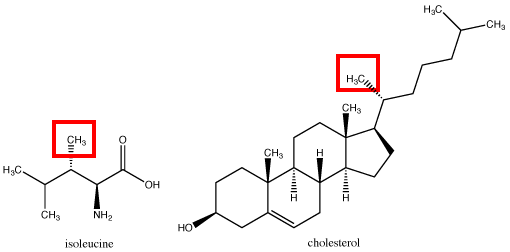
Figure 2. The amino acid isoleucine is on the left, and cholesterol is on the right. Each has a methyl group circled in red. Attribution: created by Marc T. Facciotti (own work adapted from Erin Easlon)
A variety of biologically relevant compounds contain methyl groups like those highlighted above. Sometimes, the compound can have a methyl group but still be a polar compound overall because of the presence of other functional groups with polar properties (see the discussion on polar functional groups below).
As we learn more about other functional groups, we will add to the list of nonpolar functional groups. Stay alert!
Polar functional groups
Hydroxyl R-OH
A hydroxyl (alcohol group) is an -OH group covalently bonded to another atom. In biomolecules, the hydroxyl group is often (but not always) bound to a carbon atom, as depicted below. The oxygen atom is much more electronegative than either the hydrogen or the carbon, which will cause the electrons in the covalent bonds to spend more time around the oxygen than around the C or H. Therefore, the O-H and O-C bonds in the hydroxyl group will be polar covalent bonds. Figure 3 depicts the partial charges, δ+ and δ-, associated with the hydroxyl group.
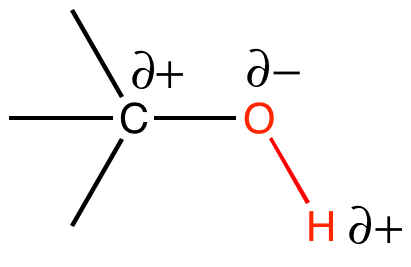
Figure 3. The hydroxyl functional group shown here consists of an oxygen atom bound to a carbon atom and a hydrogen atom. These bonds are polar covalent, meaning the electron involved in forming the bonds is not shared equally between the C-O and O-H bonds. Attribution: created by Marc T. Facciotti (own work)
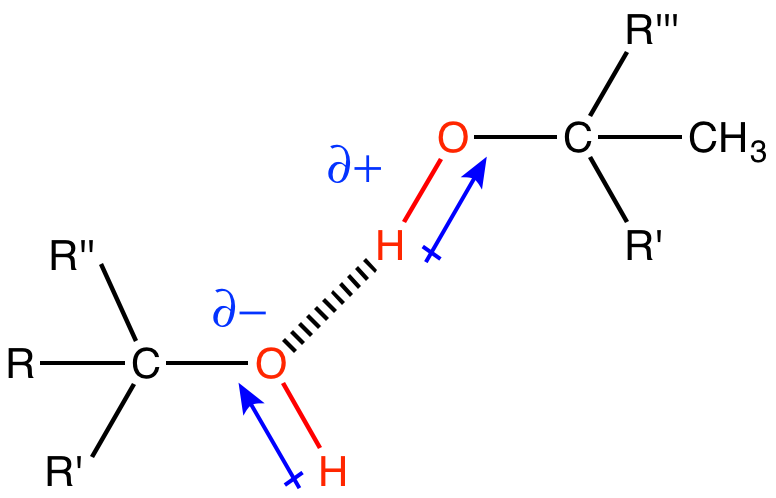
Figure 4. The hydroxyl functional groups can form hydrogen bonds, shown as a dashed line. The hydrogen bond will form between the δ - of the oxygen atom and the δ + of the hydrogen atom. Dipoles are shown in blue arrows. Attribution: Marc T. Facciotti (original work)
Hydroxyl groups are very common in biological molecules. Hydroxyl groups appear on carbohydrates (A), on some amino acids (B), and on nucleic acids (C). Can you find any hydroxyl group(s) in the phospholipid in (D)?

Figure 5. Hydroxyl groups appear on carbohydrates (A, glucose), some amino acids (B, Serine), and nucleotides (C, adenosine triphosphate). D is a phospholipid. Attribution: created by Marc T. Facciotti (own work)
Carboxyl R-COOH
Carboxylic acid is a combination of a carbonyl group and a hydroxyl group attached to the same carbon, resulting in new characteristics. The carboxyl group can ionize, which means it can act as an acid and release the hydrogen atom from the hydroxyl group as a free proton (H+). This results in a delocalized negative charge on the remaining oxygen atoms. Carboxyl groups can switch back and forth between protonated (R-COOH) and deprotonated (R-COO-) states depending on the pH of the solution.
The carboxyl group is very versatile. In its protonated state, it can form hydrogen bonds with other polar compounds. In its deprotonated state, it can form ionic bonds with other positively charged compounds. This will have several biological consequences that will be explored more when we discuss enzymes.
Can you identify all the carboxyl groups on the macromolecules shown above in Figure 5?
Amino R-NH3
The amino group consists of a nitrogen atom attached by single bonds to hydrogen atoms. An organic compound that contains an amino group is called an amine. Like oxygen, nitrogen is also more electronegative than both carbon and hydrogen, which results in the amino group displaying some polar character.
Amino groups can also act as bases, which means that the nitrogen atom can bond to a fourth hydrogen atom, as shown in Figure 6. Once this occurs, the nitrogen atom gains a positive charge and can now take part in ionic bonds.
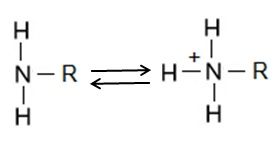
Figure 6. The amine functional group can exist in a deprotonated or protonated state. When protonated, the nitrogen atom is bound to three hydrogen atoms and has a positive charge. The deprotonated form of this group is neutral. This images shows an unbalanced reaction - the source of the extra proton can be from a variety of sources. Attribution: created by Erin Easlon (own work)
Phosphate R-PO42-
A phosphate group is a phosphorus atom covalently bound to four oxygen atoms and contains one P=O bond and three P-O− bonds. The oxygen atoms are more electronegative than the phosphorous atom, resulting in polar covalent bonds. Therefore, these oxygen atoms can form hydrogen bonds with nearby hydrogen atoms that also have a δ+(hydrogen atoms bound to another electronegative atom). Phosphate groups also contain a negative charge and can take part in ionic bonds.
Phosphate groups are common in nucleic acids and on phospholipids (the term "phospho" referring to the phosphate group on the lipid). In Figure 7 are images of a nucleotide, deoxyadenosine monophosphate (left), and a phosphoserine (right).

Figure 7. A nucleotide, deoxyadenosine monophosphate, is on the left, and phosphoserine is on the right. Each has a phosphate group circled in red. Attribution: created by Marc T. Facciotti (own work)
You may also find it useful to get used to thinking about these molecules in three dimensions. The interactive figures below (try spinning the molecules) depict the two molecules above, deoxyadenosine monophosphate and phosphoserine as three-dimensional models. Getting used to three-dimensional representations of biomolecules and interacting with these models can help you form more detailed mental models of what biomolecules look like and how they might interact in "real life".
| Deoxyadenosine monophosphate | Phosphoserine |
|---|---|
Possible NB Discussion  Point
Which functional group is actually composed of two other functional groups? After naming the functional groups, discuss how the replacement of the functional groups adjacent to each other results in a new functional group with some amazing properties.
Water

Water is a unique substance whose special properties are intimately tied to the processes of life. Life originally evolved in a watery (ie., "aqueous") environment, and most of an organism’s cellular chemistry and metabolism occur inside the water-solvated contents of the cell. Water solvates or "wets" the cell and the molecules in it, plays a key role as a reactant or product in an innumerable number of biochemical reactions, and mediates the interactions between molecules in and out of the cell. Many of water’s important properties derive from the molecule's polar nature, which derives from the asymmetric arrangement of its polar covalent bonds between hydrogen and oxygen.
When starting the study of biology, the ubiquitous role of water in nearly all biological processes is easy to overlook by getting caught up in the details of specific processes, proteins, the roles of nucleic acids, and in your excitement for molecular machines (it'll happen). It turns out, however, that water plays key roles in all of those processes and we will need to stay continuously aware of the role that water is playing if we are to develop a more functional understanding. Be on the lookout and also pay attention when your instructor points this out.
In a liquid state, individual water molecules interact with one another through a network of dynamic hydrogen bonds that are being constantly forming and breaking. Water also interacts with other molecules that have charged functional groups and/or functional groups with hydrogen bond donors or acceptors. A substance with sufficient polar or charged character may dissolve or be highly miscible(opens in new window) in water and is referred to as being hydrophilic (hydro- = “water”; -philic = “loving”). Molecules with more nonpolar characters such as oils and fats do not interact well with water and separate from it rather than dissolve in it. We call these nonpolar compounds hydrophobic (hydro- = “water”; -phobic = “fearing”). We will consider some of the energetic components of these types of reactions in other another chapter.
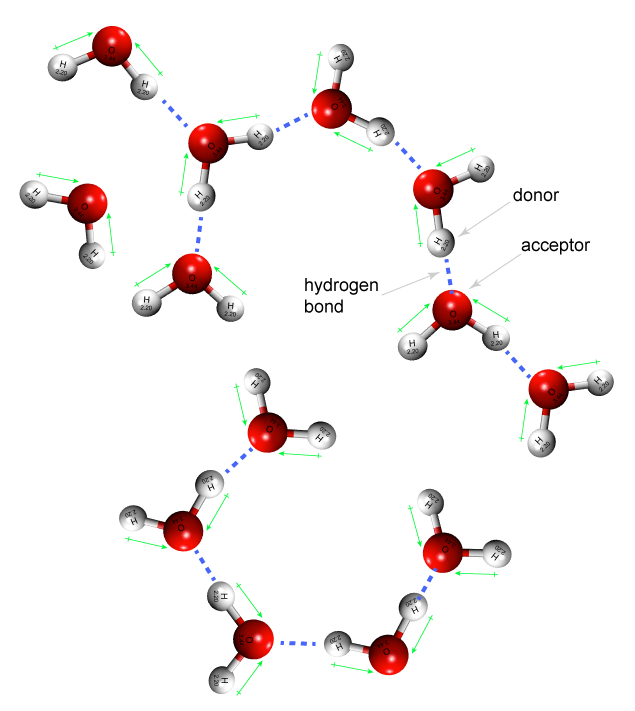
Figure 8. In a liquid state water forms a dynamic network of hydrogen bonds between individual molecules. Shown are one donor-acceptor pair. Attribution: Marc T. Facciotti (original work)
Water's solvent properties
Since water is a polar molecule with slightly positive and slightly negative charges, ions and polar molecules can readily dissolve in it. Therefore, we refer to water as a solvent of other polar molecules and ionic compounds. Charges (or partial charges) associated with these molecules (the solutes) will interact electrostatically with water’s partial charges. Polar bonds with the potential to donate or accept hydrogen bonds will form hydrogen bonds with water. Water molecules that interact directly with individual solute molecules will have their motions slightly constrained as will other nearby molecules. We refer to the layer or partially constrained waters surrounding a solute particle as a hydration layer, hydration shell or sphere of hydration.
When ionic salts are added to water, the individual ions interact with the polar regions of the water molecules, and the ionic bonds are likely disrupted in the process called dissociation. Dissociation occurs when atoms or groups of atoms break off from molecules and form ions. Consider table salt (NaCl, or sodium chloride). A dry block of NaCl is held together by ionic bonds and is difficult to dissociate. When NaCl crystals are added to water, however, the molecules of NaCl dissociate into Na+ and Cl– ions, and spheres of hydration form around the ions. The positively charged sodium ion is surrounded by the partially negative charge of the water molecule’s oxygen. The negatively charged chloride ion is surrounded by the partially positive charge of the hydrogen on the water molecule. One may imagine a model in which the ionic bonds in the crystal are "traded" for many smaller scale ionic bonds with the polar groups on water molecules.

Figure 9. When table salt (NaCl) is mixed in water, spheres of hydration are formed around the ions. This figure depicts a sodium ion (dark blue sphere) and a chloride ion (light blue sphere) solvated in a "sea" of water. Note how the dipoles of the water molecules surrounding the ions are aligned such that complementary charges/partial charges are associating with one another (i.e., the partial positive charges on the water molecules align with the negative chloride ion whereas the partial negative charges on the oxygen of water align with the positively charged sodium ion). Attribution: Ting Wang - UC Davis (original work modified by Marc T. Facciotti)
Possible NB Discussion Point
A pharmaceutical company wants to develop a new antibiotic that is more water soluble than an existing antibiotic. Their strategy will be to add various functional groups to the existing antibiotic and then test the water solubility of the resulting antibiotic. The scientists are trying to decide which functional group(s) to try first. Which one(s) would you recommend and why?
Tags recommended by the template: article:topic
Reading_02 is shared under a CC BY 3.0 license and was authored, remixed, and/or curated by LibreTexts.
The book could not be loaded just now.