Opening the book…
Symbiosis
Some interactions are brief, such as a hawk catching a mouse. Others involve species living in close association for long periods of time. These long-term relationships are called symbiosis ("living together"). In a symbiotic relationship, at least one species benefits. Depending on the interaction, the other species may be harmed (parasitism), unaffected (commensalism), or benefited (mutualism). Some scientists use the term symbiosis for any close relationship between species, while others reserve it for relationships in which the organisms physically live on, in, or very close to one another.
Parasitism occurs when one organism (the parasite) benefits while another organism (the host) is harmed (figure \(\PageIndex{a}\)). Parasites obtain food, nutrients, or shelter from their hosts, often weakening them in the process. Unlike predators, parasites usually do not kill their hosts quickly because they depend on them for survival. Some parasites live on the outside of their host, such as fleas and ticks, while others live inside the host, such as tapeworms and roundworms. Parasitism is common in many groups of organisms, including animals, plants, fungi, bacteria, and viruses. Understanding parasitic relationships helps ecologists explain how species influence one another and how populations and communities are regulated over time.

For example, lichens are a mutualistic symbiosis between a fungus and a photosynthetic alga or bacterium (\PageIndex{b}\)). The photosynthetic partner provides food, while the fungus provides protection and helps retain water. Another example is the relationship between remoras and sharks (\PageIndex{c}\)). Remoras gain food and transportation, while the shark is generally unaffected, making this a commensal relationship.
 Figure \(\PageIndex{b}\): Lichen is a fungus that has symbiotic photosynthetic algae living in close association. Image modification of work by Cory Zanker.
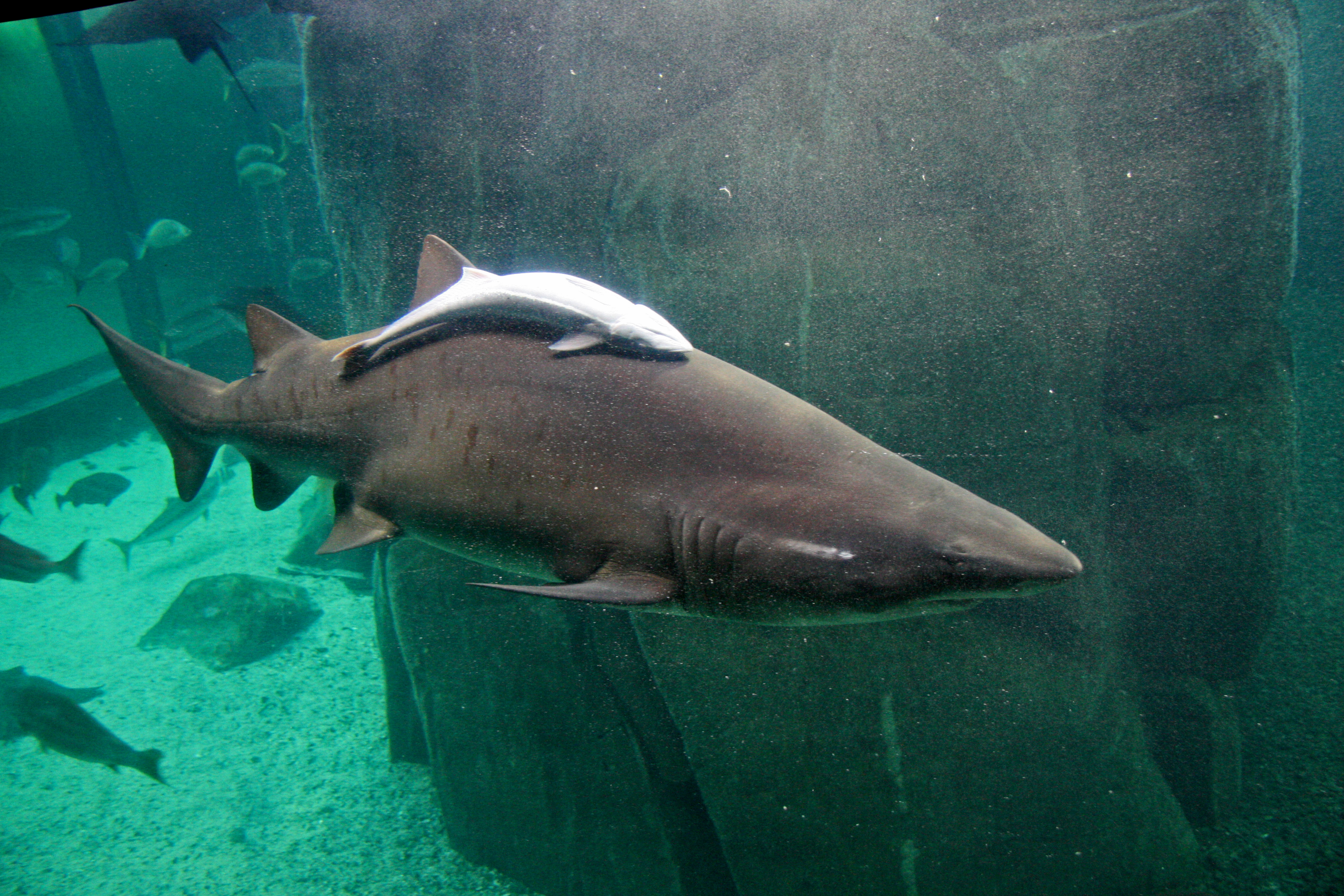
There are many examples of symbiosis in nature. Corals contain photosynthetic microorganisms that provide food through photosynthesis in exchange for shelter. Mycorrhizae are partnerships between fungi and plant roots in which the fungus helps the plant absorb water and nutrients while receiving sugars from the plant. Humans also have symbiotic relationships with many microorganisms that live on and inside our bodies. For example, bacteria in the human gut help digest food and produce certain vitamins.
Understanding these interactions helps ecologists explain how species influence one another and how communities are structured and maintained over time.
Attribution
This page was heavily revised and rewritten by Erin Rempala and contains adapted content from 6.1.4 Symbiosis and 6.1.1.3 Parasitism originally authored by Melissa Ha and Rachel Schleiger and is licensed CC BY-NC-SA 4.0.
Modified by Melissa Ha from the following sources:
- Symbiosis from Biology by John W. Kimball (licensed under CC-BY(opens in new window))
- Community Ecology from Environmental Biology by Matthew R. Fisher's (licensed under CC-BY(opens in new window))
This page titled 3.2.1.1: Symbiosis was last modified on Tue, 28 Jul 2026 13:25:29 GMT and is shared under a CC BY-NC-SA 4.0 license and was authored, remixed, and/or curated by Erin Rempala.
The book could not be loaded just now.