Opening the book…
Mining, Extraction, and Energy Production
Before fossil fuels can be used, they must be extracted from the Earth. The extraction method depends on the type and location of the fossil fuel. Coal is mined from rock layers, whereas oil and natural gas are obtained through drilling. Once extracted, fossil fuels are transported and used to generate electricity, power vehicles, heat buildings, and manufacture a variety of products.
Coal
Coal Mining
Coal is extracted using two general methods: surface mining and subsurface mining.
Surface mining is used when coal deposits are located near the Earth's surface. Large machines remove soil and rock, known as overburden, to expose coal seams (figure \(\PageIndex{a}\)).
Two common forms of surface mining are:
- Strip mining, in which overburden is removed in successive strips to expose and extract coal.
- Mountaintop removal, in which explosives are used to remove the top of a mountain and expose the entire coal seam at once.Much of the removed overburden is deposited in nearby valleys, creating valley fills that can bury streams and alter watershed drainage patterns (figure \(\PageIndex{b}\)).
Surface mining is generally less expensive than underground mining but can dramatically alter landscapes, destroy habitat, and increase erosion.
 Figure \(\PageIndex{a}\): Garzweiler surface mine, Germany. Image by Raimond Spekking / CC BY-SA 4.0 (via Wikimedia Commons)


Subsurface mining (deep mining) is used when coal deposits are buried deeper underground. Miners access coal through tunnels and shafts that may extend hundreds or thousands of meters below the surface.
Although subsurface mining disturbs less land at the surface, it presents safety risks for miners and can cause land subsidence when underground tunnels collapse (figure \(\PageIndex{c}\)).

Coal Processing and Transportation
After mining, coal is cleaned and processed to remove rock, sulfur, and other impurities. This improves its heating value and reduces some emissions during combustion.
Coal is then transported to power plants, primarily by rail but also by truck, barge, or ship (figure \(\PageIndex{e}\)). Because transportation can be costly, many coal-fired power plants are located near major coal-producing regions.


Generating Electricity from Coal
Most coal is used to generate electricity. At a coal-fired power plant, coal is pulverized into a fine powder and burned in a furnace (figure \(\PageIndex{f}\)). The heat converts water into high-pressure steam, which spins a turbine connected to an electrical generator.
This process converts:
Chemical Energy → Thermal Energy → Mechanical Energy → Electrical Energy
After passing through the turbine, the steam is cooled, condensed back into water, and reused. Cooling water is commonly withdrawn from nearby rivers, lakes, or oceans.
The cooling water is generally returned to its source at a higher temperature than when it was withdrawn, a form of thermal pollution that can affect aquatic ecosystems.
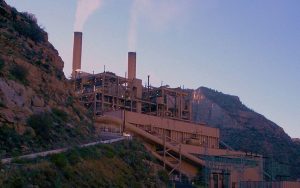
As of 2026, there is only 1 coal power plant in California, the Argus Cogeneration Plant that is capable of generating 63 MW. It is located northeast of Los Angeles.


This video shows how heat energy can be used to generate electricity.
Oil and Natural Gas
Conventional Oil and Natural Gas Extraction
Conventional oil and natural gas are extracted by drilling wells into underground reservoirs where fossil fuels have accumulated beneath a trap.
In many conventional reservoirs, natural gas accumulates above oil because it is less dense. However, some reservoirs contain mainly oil or mainly natural gas.
When a new well is drilled, natural underground pressure may initially force oil and gas to the surface. As pressure declines, water or gas may be injected into the reservoir to increase recovery. Additional techniques, such as steam or carbon dioxide injection, can further improve extraction from older wells.
Oil and natural gas are produced from both:
- Onshore wells located on land (figure \(\PageIndex{g}\))
- Offshore wells located beneath the ocean floor (figure \(\PageIndex{h}\))
Modern offshore drilling platforms can operate in water more than a mile deep.


Hydraulic Fracturing (Fracking)
Some fossil fuels occur in dense rock formations that do not allow oil or natural gas to flow easily. These resources can be extracted using hydraulic fracturing, commonly called fracking (figure \(\PageIndex{i}\)).
Fracking involves several steps:
- A well is drilled vertically and then horizontally through the oil- or gas-bearing rock layer.
- Steel casing and cement are installed to help isolate the well from surrounding rock layers and groundwater.
- Small perforating charges create openings in the casing.
- A mixture of water, sand, and chemical additives is injected into the well at very high pressure.
- The pressure fractures the rock, creating pathways for oil and natural gas to move through the formation.
- Sand, called proppant, helps keep the fractures open after the pressure is released.
- Oil and natural gas flow through the fractures and into the well, where they are brought to the surface.
Fracking has greatly increased oil and natural gas production, particularly from shale formations. However, the process requires large amounts of water and generates wastewater that must be managed carefully. Environmental concerns include habitat disturbance, methane leakage, groundwater contamination from improperly constructed wells or wastewater handling, and induced earthquakes associated primarily with deep wastewater injection.


Unconventional Oil Resources
Other unconventional fossil fuel resources require additional processing before use.
- Oil sands (also called tar sands) contain bitumen, a dense and highly viscous form of petroleum that must be heated or processed before it can be used.
- Oil shale contains kerogen, an organic material that can be combusted directly for energy or heated to convert kerogen into liquid and gaseous hydrocarbons.
(figure \(\PageIndex{j}\)). - Coal-bed methane is natural gas trapped within coal deposits.
Because these resources require more intensive extraction and processing, they generally have larger environmental footprints than conventional oil and natural gas.

Refining Crude Oil
The oil that comes from the ground, called crude oil, is a mixture of many different hydrocarbons. Before it can be used, it must be separated into useful products at a refinery.
The most important refining process is fractional distillation (figure \(\PageIndex{k}\)). Crude oil is heated, and its components separate according to their boiling points.
The heaviest hydrocarbons remain liquid and collect near the bottom of the distillation column, while lighter hydrocarbons rise higher before condensing.
This process produces products such as:
- Gasoline
- Diesel fuel
- Jet fuel
- Heating oil
- Lubricants
- Asphalt
Additional chemical processing can further modify these products to meet consumer demand (figure \(\PageIndex{l}\).

The video below explains the process of fractional distillation. The labeled distillation column at 3:00 shows heated crude oil (400 °C) separating into various petrochemicals. From bottom to top, they are bitumen (> 350 °C), diesel (250-350 °C), kerosene (160-250 °C), naphtha (70-160 °C), petrol (20-70 °C), and gas (< 20 °C).

Transporting Oil and Natural Gas
After extraction and refining, oil and natural gas are transported through extensive pipeline networks (figure \(\PageIndex{m}\)). Crude oil is transported to refineries, while refined fuels are distributed to storage facilities, airports, industries, and gas stations.
Natural gas is transported primarily through high-pressure pipelines that connect production areas with homes, businesses, and power plants.
The United States has an extensive network of interstate and intrastate natural gas pipelines.


Generating Electricity from Natural Gas (Fossil Gas, or Methane Gas)
Natural gas (Fossil gas) is one of the most widely used fuels for electricity generation.
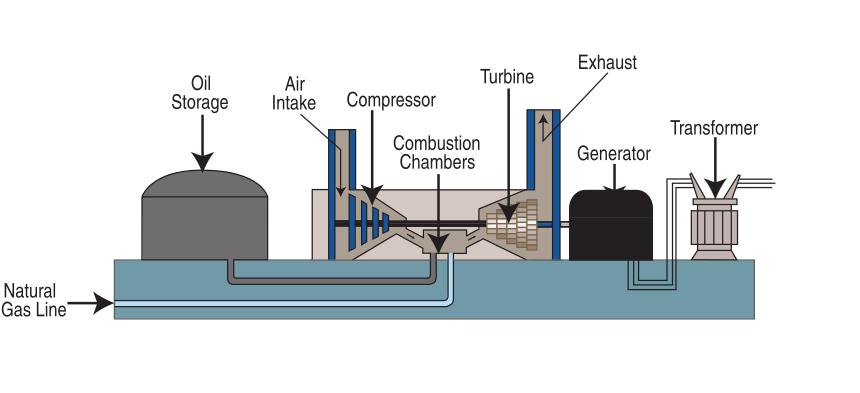
In a natural gas power plant, methane and compressed air are mixed in the combustion chamber and burned. to produce hot gases that spin a turbine connected to a generator (figure \(\PageIndex{n}\)). Some power plants also capture waste heat to produce additional steam and electricity, increasing efficiency.
Compared with coal, natural gas generally produces:
- Less carbon dioxide per unit of electricity
- Lower emissions of sulfur dioxide and particulate matter
- Greater flexibility for meeting changes in electricity demand
However, methane leakage during production and transportation can reduce some of these climate advantages because methane is a powerful greenhouse gas.

Although fossil fuels have fueled industrial development and modern societies, their extraction, transportation, and combustion can affect ecosystems and human health. Mining can alter landscapes and habitats, drilling can contaminate water and cause spills, and burning fossil fuels releases carbon dioxide and other pollutants that contribute to climate change and air pollution. These human health and environmental impacts must be weighed against the energy benefits provided by fossil fuels.
Attributions
This page was heavily revised and rewritten by Erin Rempala and contains adapted content from content originally authored by Melissa Ha and Rachel Schleiger and is licensed CC BY-NC-SA 4.0.
Modified by Melissa Ha from the following sources:
- Non-Renewable Energy Sources from Environmental Biology by Matthew R. Fisher (licensed under CC-BY(opens in new window))
- Fossil Fuels(opens in new window) and Mining(opens in new window) from An Introduction to Geology by Chris Johnson et al. (licensed under CC-BY-NC-SA(opens in new window))
- Chapter 4: Non-Renewable Energy(opens in new window) from Introduction to Environmental Science: 2nd Edition (2018) Biological Sciences Open Textbooks by Zehnder, Caralyn; Manoylov, Kalina; Mutiti, Samuel; Mutiti, Christine; VandeVoort, Allison; and Bennett, Donna (licensed under CC-BY-NC-SA(opens in new window)).
- Fossil Energy Study Guide: Natural Gas(opens in new window). 2014. U.S. Department of Energy. Accessed 01-12-2021.
- Fossil Energy Study Guide: Oil(opens in new window). 2013. U.S. Department of Energy. Accessed 01-12-2021.
This page titled 7.1.2: Mining, Processing, and Generating Electricity was last modified on Fri, 11 Sep 2026 17:14:34 GMT and is shared under a CC BY-NC-SA 4.0 license and was authored, remixed, and/or curated by Melissa Ha and Rachel Schleiger (ASCCC Open Educational Resources Initiative) .
The book could not be loaded just now.