Opening the book…
Hydropower
Hydropower (hydroelectric energy) is electricity generated from the movement of water. Like wind energy, hydropower is ultimately powered by the Sun. Solar energy drives the water cycle, causing water to evaporate from Earth's surface, condense in the atmosphere, and return as precipitation. Water stored at higher elevations then flows downhill under the force of gravity.
As moving water passes through a dam, river, or other hydropower system, it spins a turbine (figure \(\PageIndex{a}\)). The rotating turbine turns a generator, which converts the kinetic energy of moving water into electricity.
Hydropower generates electricity using the same basic principle as many other energy technologies, including wind turbines, coal- and natural-gas-fired power plants, nuclear power plants, and concentrated solar thermal facilities. In each case, a turbine spins a generator to produce electricity. The primary difference is the source of energy that turns the turbine.


Figure \(\PageIndex{a}\): Top: A water turbine. Moving water turns the blades of the turbine. The wicket gate controls the water flow. The moving water causes magnets in the rotor to spin and move electrons within the loops of wire in the stator, generating an electric current. Image by U.S. Army Corps of Engineers (public domain). Bottom: A propeller-type runner rated 28,000 hp (21 MW). Wtshymanski - own work by Wtshymanski http://en.wikipedia.org/wiki/Image:H...bineRunner.png (public domain).

Types of Hydropower
There are several ways to generate electricity from moving water, but all hydropower technologies rely on the same basic principle: flowing water spins a turbine connected to a generator.
The most familiar form of hydropower uses dams. A dam blocks a river, creating a reservoir that stores water at a higher elevation. When electricity is needed, water is released through a large pipe called a penstock, where its movement spins a turbine and generates electricity (figure \(\PageIndex{b}\)). Because the flow of water can be controlled, dam-based hydropower can provide electricity on demand and help stabilize electrical grids.
Another approach is run-of-the-river hydropower, in which turbines are placed directly in a river or in a channel that diverts part of the river's flow (figure \(\PageIndex{c}\)). Because these systems do not require large reservoirs, they generally have smaller environmental impacts than conventional dams. However, electricity production depends on natural river flow and may vary seasonally.
Other forms of hydropower harness energy from oceans. Tidal energy captures energy from the rise and fall of ocean tides or from tidal currents, while wave energy uses the movement of ocean waves to drive generators (figure \(\PageIndex{d}\)). Unlike most forms of hydropower, which are indirectly powered by solar energy through the water cycle, tidal energy is driven primarily by the gravitational attraction of the Moon and Sun.
Although these technologies differ in design and energy source, they all convert the kinetic energy of moving water into electricity.
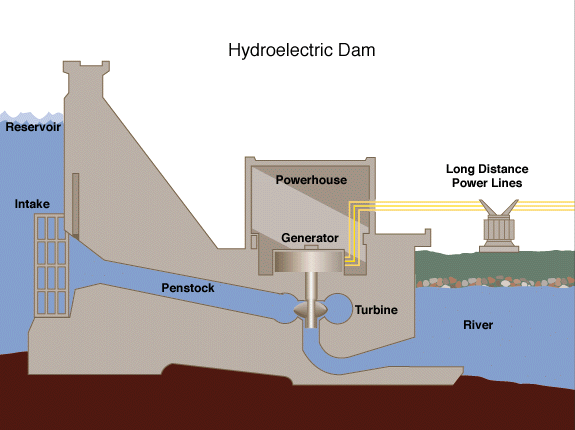
Figure \(\PageIndex{b}\): A section of a hydroelectric dam. Water in the reservoir passes through the intake into the penstock, which is a narrow channel. The moving water turns a turbine. This powers the generator in the powerhouse. The water continues down the river. Meanwhile electricity is distributed through long distance power lines. Image by Tennessee Valley Authority(opens in new window) (public domain).


Figure \(\PageIndex{c}\): A microhydropower system. Although there are several ways to harness the moving water to produce energy, these run-of-the-river systems, which do not require large storage reservoirs, are often used for microhydropower projects. For run-of-the-river hydro projects, a portion of a river’s water is diverted to a channel, pipeline, or pressurized pipeline (penstock) that delivers it to a waterwheel or turbine. In this image, water from the river moves through the intake then to the canal, forebay, penstock, and powerhouse, which contains the turbine. The moving water rotates the wheel or turbine, which spins a shaft. The motion of the shaft can be used for mechanical processes, such as pumping water, or it can be used to produce electricity. In this image, electrical lines connect the powerhouse to a nearby house.

Advantages and Disadvantages of Hydropower
Hydropower is one of the oldest and most widely used sources of renewable electricity. Because hydropower plants generate electricity without burning fuel, they produce little air pollution and low greenhouse gas emissions during operation. Reservoirs created by dams can also provide additional benefits, including flood control, water storage, irrigation, and recreational opportunities such as boating and fishing (figure \(\PageIndex{e}\).
Hydropower is generally a reliable source of electricity because water can be stored in reservoirs and released when energy is needed. However, electricity generation depends on water availability. During droughts, reservoir levels may decline, reducing the amount of electricity that can be produced. Hydropower is therefore most effective in regions with abundant rainfall, snowmelt, or mountainous terrain.
Despite these benefits, hydropower can have significant environmental impacts. Dams alter river ecosystems by changing water flow, depth, temperature, sediment transport, and water chemistry. These changes can affect aquatic habitats both upstream and downstream of a dam.
One of the most widely recognized impacts is the disruption of fish migration. Many fish species, including salmon, migrate upstream to reproduce. Dams can block these migrations and reduce access to spawning habitat. To address this problem, some dams include fish ladders, which provide routes for fish to move around barriers (figure \(\PageIndex{f}\). However, fish traveling downstream may still be injured or killed as they pass through turbines.
Reservoirs can also flood forests, wetlands, farmland, communities, and culturally significant sites. In some cases, dam construction has displaced human populations and altered local economies. When previously dry land is flooded, submerged vegetation decomposes under low-oxygen conditions, releasing methane, a potent greenhouse gas. As a result, although hydropower produces relatively low greenhouse gas emissions during operation, reservoirs can contribute to climate change, particularly in warm regions where decomposition rates are high.
Not all hydropower projects have the same impacts. Run-of-the-river systems typically cause less habitat flooding and ecosystem disruption than large dams because they use the natural flow of a river rather than storing large volumes of water in a reservoir.
Like all energy sources, hydropower involves trade-offs. It can provide reliable renewable electricity and valuable water-management benefits, but it can also alter ecosystems, affect biodiversity, and transform landscapes. Evaluating the sustainability of hydropower requires weighing these benefits and costs in the context of local environmental and societal needs.

Figure \(\PageIndex{f}\): The Grand Coulee Dam on the Columbia River in Washington state created Lake Roosevelt, which provides outdoor recreation such as fishing and swimming. However, it compromised salmon populations and flooded sacred sites for people of the Spokane Tribe. Image by U.S. Bureau of Reclamation (public domain).

Figure \(\PageIndex{f}\): Left: The fish ladder at John Day Lock and Dam along the Columbia River in Oregon allows adult fish to migrate upstream of the dam on their own. Right: Diagram of a fish ladder, which allows the passage of salmon over a dam. Salmon swim upstream to spawn (reproduce) and are able to swim up the steps of the ladder. The flow from the ladder attracts migrating salmon. At the turning pool, they rotate and then proceed up the next flight of the ladder until they are over the dam. Left image and caption (modified) from U.S. Army Corps of Engineers, and right image by NOAA Fisheries (public domain).
Attribution
This page was heavily revised and rewritten by Erin Rempala and contains adapted content from content originally authored by Melissa Ha and Rachel Schleiger and is licensed CC BY-NC-SA 4.0.
Modified by Melissa Ha from Renewable Energy(opens in new window) and Challenges and Impacts of Energy Use from Environmental Biology by Matthew R. Fisher (licensed under CC-BY(opens in new window))
This page titled 7.3.4: Hydropower was last modified on Fri, 11 Sep 2026 19:52:27 GMT and is shared under a CC BY-NC-SA 4.0 license and was authored, remixed, and/or curated by Melissa Ha and Rachel Schleiger (ASCCC Open Educational Resources Initiative) .
The book could not be loaded just now.