Opening the book…
Environmental Equity
Environmental equity means that no group should bear an unfair burden of environmental harms or receive fewer environmental benefits. Differences in resource consumption, pollution, and exposure to environmental hazards raise important questions about fairness and sustainability.
Environmental Racism and Environmental Justice
Environmental problems do not affect all people equally. During the 1980s, communities across the United States began organizing against the placement of hazardous waste facilities and other polluting industries near their homes. In 1987, civil rights activist and author, Dr. Benjamin Chavis introduced the term environmental racism to describe situations in which people of color and other marginalized communities face a disproportionate share of environmental hazards, such as pollution, toxic waste, and harmful industrial activities (figure \(\PageIndex{a}\)). Environmental racism can result from a combination of historical patterns of housing discrimination, economic inequality, political power, and land-use decisions.

Figure \(\PageIndex{a}\): MeetDrBen; cropped by Beyond My Ken (talk) 03:33, 14 February 2014 (UTC), CC BY-SA 3.0 <https://creativecommons.org/licenses/by-sa/3.0>, via Wikimedia Commons
These concerns helped inspire the environmental justice movement (figure \(\PageIndex{b}\)). Environmental justice is the principle that all people should receive equal protection from environmental and health hazards and have meaningful opportunities to participate in environmental decision-making. Environmental justice recognizes that environmental burdens, such as air pollution, contaminated water, and hazardous waste, have often fallen disproportionately on low-income communities, communities of color, and Tribal nations.One of the most influential leaders of this movement is Dr. Robert Bullard, who is often called the "father of environmental justice" because of his research and advocacy documenting environmental racism and promoting environmental equity throughout the United States.

Figure \(\PageIndex{b}\): Dr. Robert D. Bullard, Distinguised Professor and former Dean of the Barbara Jordan-Mickey Leland School of Public Affairs at Texas Southern University, October 2012. Image by David Brenner in Flickr(opens in new window) (CC-BY-SA-2.0).
One well-known example is the Flint Water Crisis in Michigan. In 2014, Flint changed its drinking water source to reduce costs, but the new water was not properly treated and caused lead from aging pipes to contaminate the drinking water supply. The crisis exposed 100,000 residents, including many children, to elevated levels of lead, a toxic metal than can cause brain damage, learning disabilities and other long-term health problems. Because Flint is a low-income, majority-Black community, many researchers and community advocates view the crisis as an example of environmental injustice. The case illustrates how environmental decisions can have unequal impacts on different communities and why fairness is an important consideration in environmental policy.
Indigenous Peoples and Environmental Justice
Indigenous peoples have lived on and cared for their lands for thousands of years and continue to play important roles in environmental stewardship today. However, colonization often displaced Indigenous communities from their ancestral lands and limited their ability to participate in decisions affecting natural resources. As a result, many environmental justice issues involve Indigenous rights, land access, cultural preservation, and self-determination.
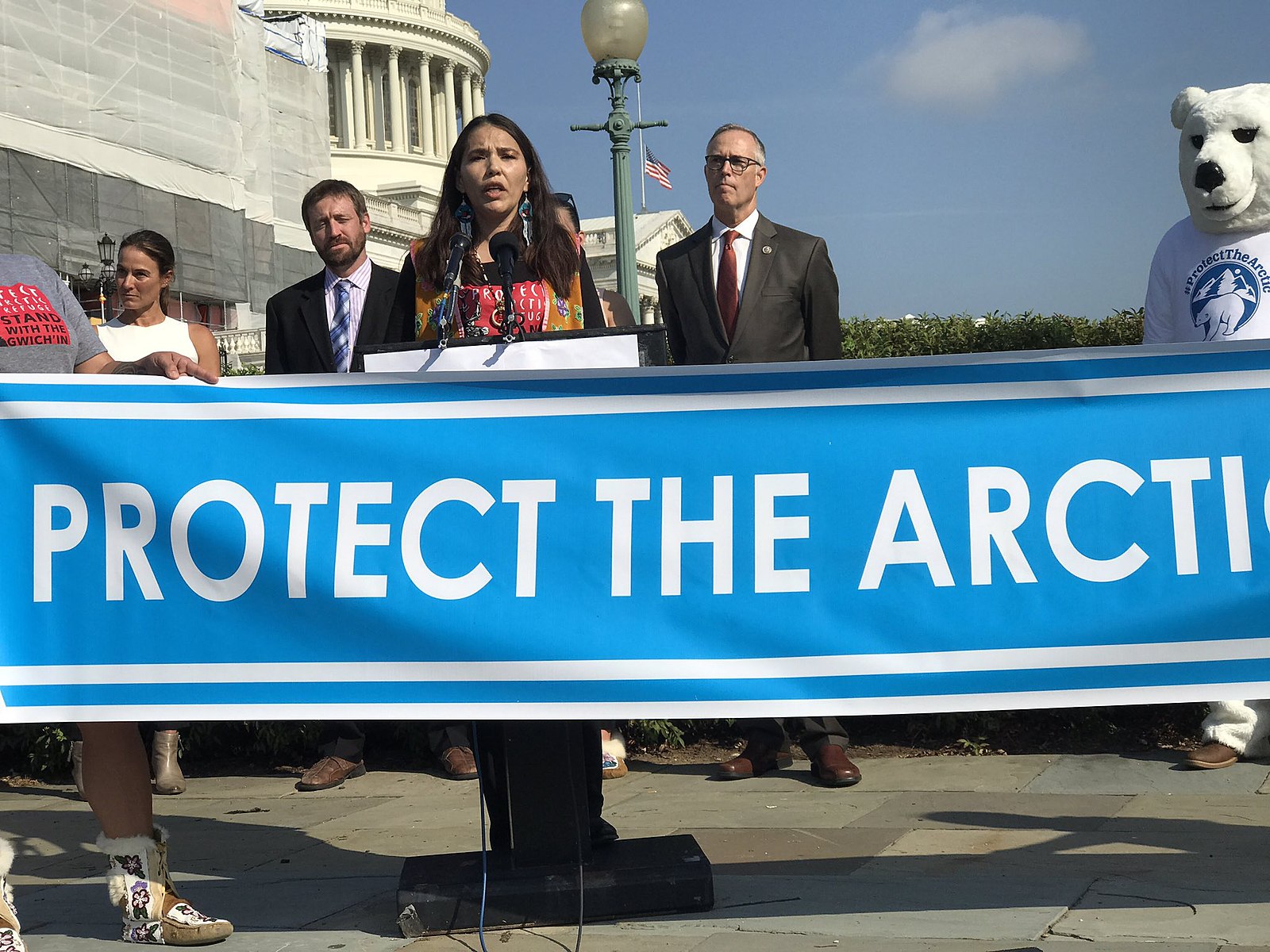
Environmental decisions can affect Indigenous communities in different ways. For example, some Indigenous groups, such as the Gwich’in of Alaska, oppose oil drilling near the Arctic National Wildlife Refuge because they believe it threatens important cultural traditions, wildlife, and ecosystems (figure \(\PageIndex{b}\)). At the same time, some Iñupiat communities, have supported oil development because of potential economic benefits. These differences highlight that Indigenous peoples are not a single group with one perspective. Environmental justice requires respecting Indigenous sovereignty and ensuring that Tribal nations can meaningfully participate in decisions that affect their lands, resources, and futures.

Just Transition
A just transition is the idea that society should move toward cleaner, more sustainable ways of producing energy, food, and other goods while also protecting workers and communities. Supporters argue that environmental solutions should improve both environmental and social conditions rather than create new inequalities. For example, communities that depend on fossil fuel industries may need job training, education, and economic support as society shifts toward renewable energy. A just transition seeks to create a future that is both environmentally sustainable and socially fair by ensuring that the benefits and responsibilities of environmental change are shared more equitably.
A Simplified Framework
Environmental justice is a complex field that includes many perspectives and approaches. This section introduces several key ideas that help explain how environmental benefits and burdens are distributed among people and communities, but it is not a complete overview of the field.
Attributions
This page was heavily revised and rewritten by Erin Rempala and contains adapted content originally authored by Melissa Ha and Rachel Schleiger is licensed CC BY-NC-SA 4.0.
Modified by Erin Rempala from:
- Haudenosaunee Confederacy. (n.d.). Values of the Haudenosaunee Confederacy. Retrieved July 20, 2026, from Haudenosaunee Confederacy.
- Climate Justice Alliance. (n.d.). Just transition. Retrieved July 20, 2026, from Climate Justice Alliance. (n.d.). Just transition. Retrieved July 20, 2026, from Climate Justice Alliance [climatejusticealliance.org]
- Wikipedia contributors. (2026, July 20). Flint water crisis. In Wikipedia. Retrieved July 20, 2026, from Flint Water Crisis [en.wikipedia.org]
- Wikipedia contributors. (n.d.). Haudenosaunee. In Wikipedia. Retrieved July 20, 2026, from Wikipedia: Haudenosaunee
Modified by Melissa Ha and Rachel Schleiger from Environmental Justice and Indigenous Struggles and Environment and Sustainability from Environmental Biology by Matthew R. Fisher (licensed under CC-BY(opens in new window))
This page titled 2.3: Environmental Justice and Equity was last modified on Tue, 28 Jul 2026 13:14:02 GMT and is shared under a CC BY-NC-SA 4.0 license and was authored, remixed, and/or curated by Erin Rempala.
The book could not be loaded just now.