Opening the book…
Levels of Biodiversity
Scientists often describe biodiversity at three levels:
- Genetic Diversity
- Species Diversity
- Ecosystem Diversity
Genetic Diversity
Genetic diversity is the variation in inherited traits within a species. High genetic diversity increases a population's ability to adapt to environmental change, resist disease, and survive other challenges. In contrast, populations with low genetic diversity are often more vulnerable to extinction.
Why Genetic Diversity Matters
Genetic diversity provides the raw material for evolution and adaptation. For example, crop breeders rely on genetic diversity to develop plant varieties that can resist pests, diseases, and changing climate conditions.
The Tasmanian devil illustrates the importance of genetic diversity. Because Tasmanian devils have very low genetic diversity, they are especially vulnerable to a contagious cancer called Devil Facial Tumor Disease, which has caused major population declines (figure \(\PageIndex{a}\)).
Conserving genetic diversity helps maintain biodiversity and increases the resilience of populations in a changing environment.

Species Diversity
Species diversity refers to the variety of species in a particular area and the relative abundance of each species. Ecosystems such as tropical rainforests and coral reefs often have very high species diversity.
Species diversity includes two components:
- Species richness – the number of different species in an area.
- Species evenness – how evenly individuals are distributed among those species.
For example, two communities may each contain three species (the same species richness). However, if one community is dominated by a single species while the other has similar numbers of individuals in each species, the second community has greater species evenness and higher overall species diversity (figure \(\PageIndex{b}\)).
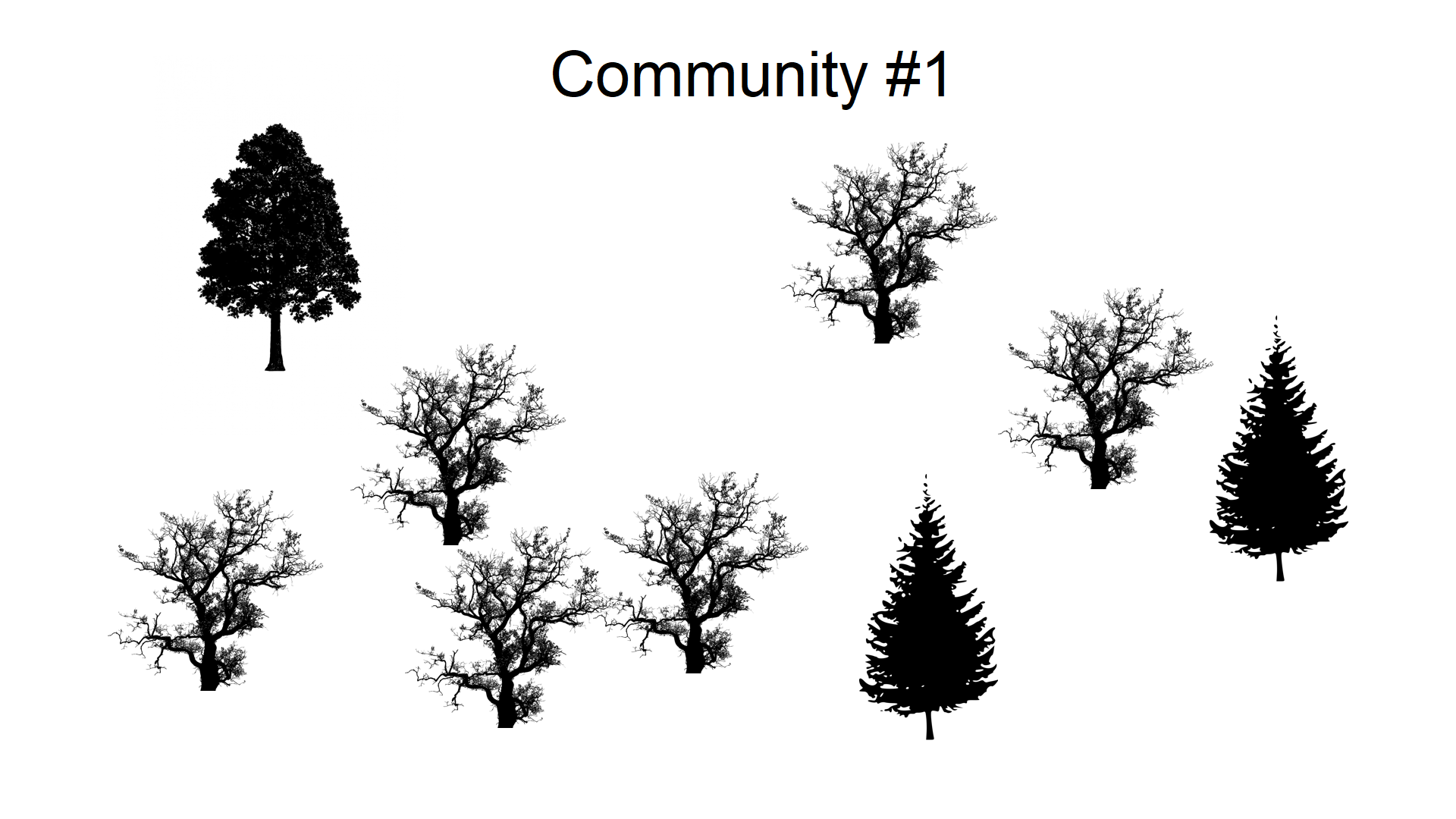

Figure \(\PageIndex{b}\): Two hypothetical tree communities have the same species richness, but community #2 (bottom) has a greater species evenness. Both communities have nine trees and three tree species. In community #1, one species is dominant, represented by six individuals. There are two individuals of a conifer species, and only one individual of the final species. In community #2, there are three individuals from each species. Images compiled by Melissa Ha from Alone tree George Hodan, Old Tree Silhouette, and Tree (all public domain).
Why Species Diversity Matters
Species perform different roles within ecosystems, helping to maintain ecosystem function and stability. Ecosystems with high species diversity often have more ecological interactions and are generally more resilient to environmental change and disturbance. Conserving species diversity also helps maintain important ecosystem services such as food production, pollination, water purification, and climate regulation.
How Many Species Live on Earth?
Scientists have identified and described about 1.5 million species, but many more remain unknown. Current estimates suggest that Earth may contain between 8 and 11 million species, though the exact number is uncertain.
Many undiscovered species live in biodiversity-rich habitats such as tropical rainforests, coral reefs, and deep-ocean ecosystems. Because habitat loss and other human activities are causing rapid biodiversity decline, some species may become extinct before they are even discovered.
Scientists cannot protect species they do not know exist. Identifying and studying Earth's biodiversity helps researchers understand ecosystems, discover new medicines, improve conservation efforts, and protect ecosystem services that support human well-being. The fact that millions of species may still be undiscovered highlights how much remains unknown about Earth's biodiversity and why conservation is important.
Ecosystem Diversity
Ecosystem diversity is the variety of ecosystems within a region or across Earth. Examples include forests, wetlands, grasslands, deserts, estuaries, chaparral, and coral reefs (figure \(\PageIndex{c}\)). Different ecosystems, such as coral reefs and prairies, support different communities of organisms and contribute to Earth's biodiversity.
Each ecosystem supports different species and ecological processes. When ecosystems are degraded or destroyed, biodiversity declines and important ecosystem functions may be lost. For example, North American prairies once covered much of the central United States and Canada. Today, most have been converted to agriculture and urban development, reducing biodiversity and many of the ecological processes that once maintained productive soils.


Ecosystem Goods and Services
Healthy ecosystems provide both ecosystem goods and ecosystem services that support human well-being.
Ecosystem goods are products obtained from nature, including:
- Food
- Fish and seafood
- Timber and paper products
- Fresh water
- Medicines
Ecosystem services are benefits provided by natural processes, including:
- Pollination of crops
- Soil formation and nutrient cycling
- Water purification
- Climate regulation
- Flood control
- Natural pest control
These goods and services support food production, economic activity, human health, and environmental sustainability.
Ecosystem Services and the Economy
Many ecosystem services have tremendous value, but they are often not included in traditional economic accounting. As a result, activities that damage ecosystems may appear profitable even when they cause the loss of valuable services such as pollination, water purification, flood protection, and climate regulation.
Economists describe this as a market failure, where the environmental costs and benefits of human activities are not fully reflected in prices. If the value of ecosystem services were included in economic decisions, conserving ecosystems would often provide greater long-term benefits than destroying them for short-term profits (figure \(\PageIndex{c}\)).

Why It Matters
Food production depends on many ecosystem services. Healthy soils recycle nutrients, pollinators help crops reproduce, and natural predators help control agricultural pests. In California, native pollinators can provide important pollination services when natural habitat is maintained near farms.
Loss of biodiversity can reduce these ecosystem services, making food production more difficult and expensive.
Protecting biodiversity helps maintain the ecosystem goods and services that support human societies, including food security, clean water, climate regulation, and long-term sustainability.
Why All Three Types of Biodiversity Matter
Conservation efforts seek to protect genetic, species, and ecosystem diversity because each contributes to the resilience and long-term sustainability of natural systems.
For example:
- Genetic diversity helps populations adapt to a changing environment.
- Species diversity supports ecosystem function.
- Ecosystem diversity provides a variety of habitats.
Together, these three levels of biodiversity help maintain healthy ecosystems and support human well-being.
Attributions
This page was heavily revised and rewritten by Erin Rempala and contains adapted content from:
- 9.1: Ecosystem Diversity by Melissa Ha and Rachel Schleiger is licensed CC BY-NC 4.0(opens in new window).
- 9.2: Species Diversity(opens in new window) by Melissa Ha and Rachel Schleiger is licensed CC BY-NC 4.0(opens in new window).
- 9.3: Genetic Diversity by Melissa Ha and Rachel Schleiger is licensed CC BY-NC 4.0(opens in new window).
Modified by Melissa Ha from the following sources:
- Biological from AP Environmental Science by University of California College Prep, University of California (licensed under CC-BY(opens in new window)). Download for free at CNX.
- Importance of Biodiversity from Environmental Biology by Matthew R. Fisher (licensed under CC-BY(opens in new window))
This page titled 5.3: Levels of Biodiversity was last modified on Tue, 28 Jul 2026 14:02:55 GMT and is shared under a CC BY-NC-SA 4.0 license and was authored, remixed, and/or curated by Erin Rempala.
The book could not be loaded just now.