Opening the book…
Major Threats to Biodiversity
Human activities are causing biodiversity to decline much faster than the natural background rate of extinction. As biodiversity decreases, ecosystems may become less resilient and less able to provide the goods and services that humans depend on.
The major threats to biodiversity are summarized in the acronym HIPPCO:
- Habitat loss and fragmentation
- Invasive species
- Pollution
- (Human) Population Growth
- Climate Change
- Overharvesting
Habitat Loss
Habitat loss is the leading cause of biodiversity decline. When forests, wetlands, grasslands, rivers, and other habitats are destroyed or fragmented, many species lose the resources they need to survive. Human activities such as agriculture, urban development, logging, mining, and road construction can reduce or eliminate habitat.
Habitat loss is the leading cause of biodiversity decline. When forests, wetlands, grasslands, rivers, and other habitats are destroyed or fragmented, many species lose the resources they need to survive. Human activities such as agriculture, urban development, logging, mining, and road construction can reduce or eliminate habitat. In Southern California, more than 90% of historic coastal wetlands have been lost to development. Remaining wetlands, such as the Tijuana River National Estuarine Research Reserve and the Kendall-Frost Marsh Reserve, provide critical habitat for fish, birds, and other wildlife and illustrate the importance of habitat conservation.
 Figure \(\PageIndex{a}\):] Tijuana Estuary. By Osbomb - [www.flickr.com/photos/osbornb/267928456/], CC BY 2.0, [commons.wikimedia.org/w/index.php?curid=15357086]
Consumer Choices and Habitat Conservation
Many everyday products, such as wood flooring, furniture, and building materials, can contribute to habitat loss if the wood comes from unsustainable or illegal logging. Illegal harvesting of tropical timber destroys forests, threatens biodiversity, and increases the risk of species extinction. Consumers can help reduce these impacts by choosing wood products certified by the Forest Stewardship Council (FSC) or by purchasing sustainably harvested domestic wood. Making informed purchasing decisions can help protect forests and the species that depend on them.

Figure \(\PageIndex{b}\): Forest Stewarship Council logo. By The logo may be obtained from Forest Stewardship Council., Fair use, [//en.wikipedia.org/w/index.php?curid=34259396]
Invasive Species
An invasive species is a non-native organism that spreads rapidly and harms native species or ecosystems. Invasive species may compete with native organisms for resources, prey on native species, introduce diseases, or alter habitats. For example, the accidental introduction of the brown tree snake (Boiga irregularis) to Guam after World War II caused severe declines in native wildlife (figure \(\PageIndex{b}\)). The snake preyed on birds, lizards, and other small animals, leading to the local extinction of many native species and dramatically altering the island's ecosystem. Today, the brown tree snake remains one of the world's most damaging invasive species.
Figure \(\PageIndex{b}\): The brown tree snake, Boiga irregularis, is an exotic species that has caused numerous extinctions on the island of Guam since its accidental introduction in 1950. (credit: NPS)
Pollution
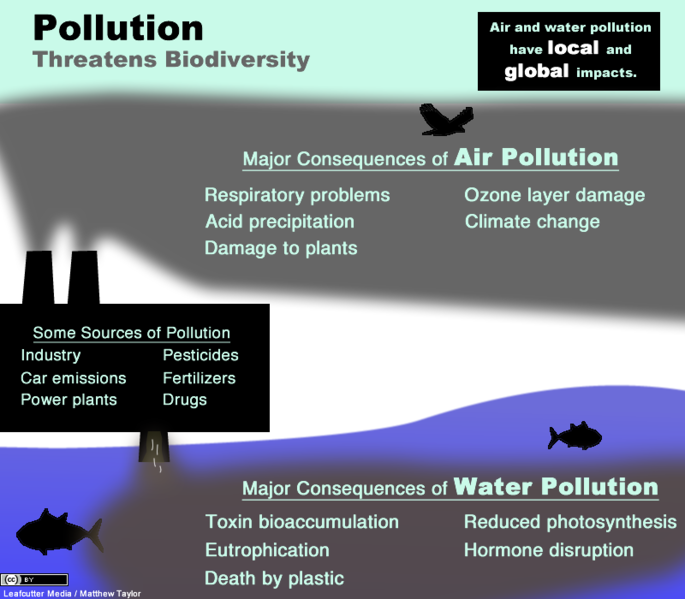
Pollution can harm ecosystems and reduce biodiversity (figure \(\PageIndex{c}\)). Common examples include:
- Plastic pollution in oceans
- Pesticides that harm pollinators
- Excess nutrients that create algal blooms
- Toxic chemicals that accumulate in food webs
Pollution can directly kill organisms, reduce reproduction and survival, or degrade habitat quality. For example, excess fertilizer runoff can trigger algal blooms that remove oxygen from the water, making it difficult for fish and other aquatic organisms to survive. Plastic pollution can injure or kill wildlife through entanglement or ingestion, while pesticides can unintentionally harm beneficial insects such as bees and butterflies. Because pollution affects both individual species and entire ecosystems, it is a major contributor to biodiversity loss worldwide.
In Southern California, urban runoff can carry fertilizers, pesticides, oil, trash, and other pollutants into rivers, wetlands, and coastal ecosystems, affecting biodiversity and ecosystem health.

Human Population Growth
Human population growth and increasing resource consumption drive many of the threats to biodiversity. As the human population grows, more land, water, energy, food, and natural resources are needed to support human activities. Forests may be cleared for agriculture and housing, more resources are harvested from ecosystems, pollutants are released into the environment, and greenhouse gas emissions increase. As a result, habitat loss, overharvesting, pollution, invasive species, and climate change are all closely linked to the growing demand for resources. Sustainable resource use and conservation efforts can help reduce these pressures while supporting both human well-being and biodiversity.
Climate Change
Human-caused (anthropogenic) climate change is altering temperatures, precipitation patterns, sea levels, and ecosystem conditions worldwide. As environmental conditions change rapidly, some species may be unable to adapt or move to suitable habitat quickly enough (figure \(\PageIndex{d}\)). Climate change can also increase the effects of other threats such as habitat loss, invasive species, and disease.
Overharvesting
Overharvesting occurs when organisms are removed from the environment faster than populations can recover.
Examples include:
- Overfishing of commercial fish species
- Hunting wildlife for bushmeat
- Excessive logging of forests]
- Collecting medicinal plants faster than they can regrow
Overharvesting can reduce populations, disrupt ecosystems, and increase the risk of extinction.
Summary
Most biodiversity loss today is caused by human activities. The major threats can be summarized using the acronym HIPPCO: habitat loss, invasive species, population growth, pollution, climate change, and overharvesting. Understanding these threats helps scientists, policymakers, and communities develop effective conservation strategies. By protecting habitats, reducing overharvesting, controlling invasive species, reducing pollution, addressing climate change, and using resources sustainably, people can help conserve biodiversity and support healthy ecosystems.
Attribution
This page was heavily revised and rewritten by Erin Rempala and contains adapted content originally authored by Openstax and is licensed CC BY-NC-SA 4.0.
This page titled 5.5: Threats to Biodiversity was last modified on Tue, 28 Jul 2026 14:15:19 GMT and is shared under a CC BY-NC-SA 4.0 license and was authored, remixed, and/or curated by Erin Rempala via source content that was edited to the style and standards of the LibreTexts platform.
The book could not be loaded just now.