Opening the book…
Laws and Policies that Protect Biodiversity
Conservation is supported by local, state, national, and international laws that help protect species and habitats.
Endangered Species Protection
In the United States, the Endangered Species Act (ESA) protects species that are at risk of extinction. Once a species is listed as threatened or endangered, government agencies develop plans to help protect and recover populations.
California also has its own California Endangered Species Act (CESA), which protects threatened and endangered species within the state.
A local example of endangered species protection is the San Diego fairy shrimp (Branchinecta sandiegonensis), a federally endangered species that depends on seasonal wetlands called vernal pools found in parts of San Diego County (figure \(\PageIndex{a}\).
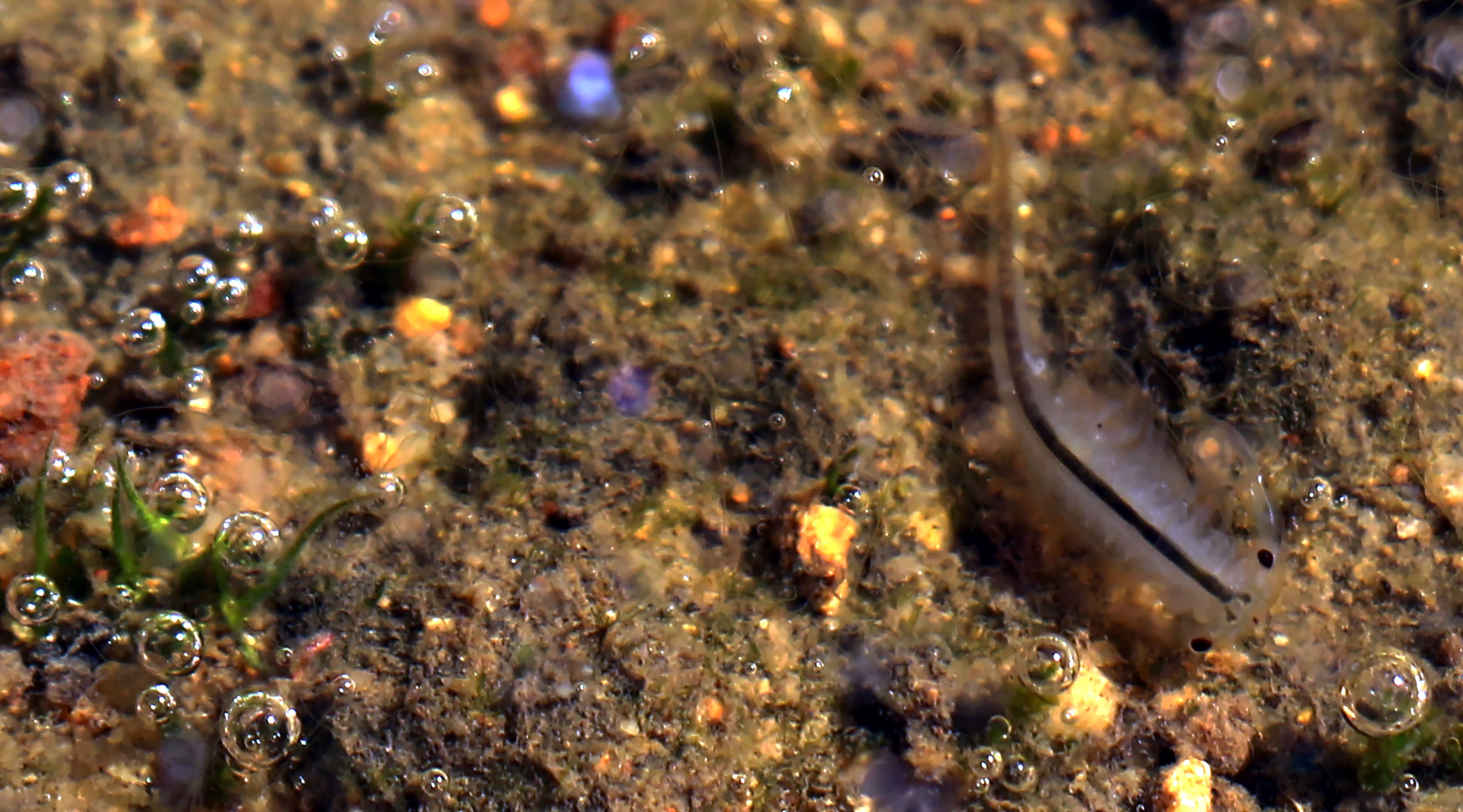


Figure \(\PageIndex{a}\): (Top) San Diego fairy shrimp. By USFWS Pacific Southwest, Photo by Joanna Gilkeson/USFWS. - Flickr, CC BY 2.0, [commons.wikimedia.org/w/index.php?curid=61531108][. Middle image: A vernal pool complex between mima mounds in San Diego County. By Pacific Southwest Region USFWS from Sacramento, US - A network of vernal pools flow between mima mounds, Public Domain, [commons.wikimedia.org/w/index.php?curid=68988382]. Bottom Image: Public Affairs Specialist for the U.S. Fish and Wildlife Service, Joanna Gilkeson, takes photos of federally endangered San Diego fairy shrimp in a vernal pool in Otay Mesa, California. Vernal pools are shallow seasonal ponds, and vernal pool species are uniquely adapted to changes in water availability. Image by USFWS [Maideline Sanchez] (public domain).
Marine Protection
The Marine Mammal Protection Act protects whales, dolphins, seals, sea lions, and other marine mammals from hunting, harassment, and other harmful activities.
California also protects marine biodiversity through a network of Marine Protected Areas (MPAs). For example, the South La Jolla State Marine Reserve protects marine habitats near La Jolla Cove and helps conserve kelp forests, fish populations, and other marine life.
International Conservation
Some species are threatened by international trade. The Convention on International Trade in Endangered Species (CITES) is an international agreement that regulates or prohibits trade in certain plants and animals to reduce the risk of extinction.
Summary
Laws and policies are important conservation tools, but they work best when combined with habitat protection, ecosystem restoration, sustainable resource use, and public support for conservation efforts.
Attributions
This page was heavily revised and rewritten by Erin Rempala and contains adapted content originally authored by Melissa Ha and Rachel Schleiger and is licensed CC BY-NC-SA 4.0.
Modified by Melissa Ha from the following sources:
- Preserving Biodiversity from Environmental Biology by Matthew R. Fisher (licensed under CC-BY(opens in new window))
- Threatened and Endangered Species by California Department of Fish and Wildlife (public domain)
- Marine Mammal Protection by NOAA Fisheries (public domain)
This page titled 5.9: Policies Protecting Biodiversity was last modified on Tue, 28 Jul 2026 14:40:46 GMT and is shared under a CC BY-NC-SA 4.0 license and was authored, remixed, and/or curated by Erin Rempala.
The book could not be loaded just now.