Opening the book…
The Nuclear Fuel Cycle
Uranium used in nuclear power plants must be mined, processed, and enriched before it can be used as fuel. The nuclear fuel cycle describes the stages through which nuclear fuel passes from extraction to disposal (figure \(\PageIndex{a}\)).
The process begins with uranium mining, in which uranium-containing rock is extracted from the ground. The ore is then processed to concentrate the uranium into a material called yellowcake. Next, the uranium is chemically processed and enriched to increase the proportion of uranium-235, the isotope most commonly used in nuclear reactors. The enriched uranium is manufactured into small ceramic pellets that serve as nuclear fuel.
After the fuel has been used in a nuclear reactor, it becomes spent fuel. Although it can no longer efficiently sustain nuclear reactions, it remains radioactive and must be stored, reprocessed, or disposed of safely. Managing radioactive waste is one of the major challenges associated with nuclear energy.
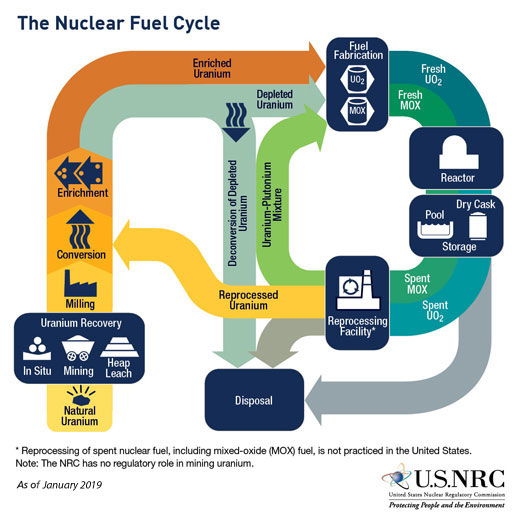 Figure \(\PageIndex{a}\): The nuclear fuel cycle begins with uranium mining and processing, followed by fuel fabrication and use in a nuclear reactor. After use, spent fuel may be stored, reprocessed, or disposed of as radioactive waste. Image by U.S. NRC (public domain)
Nuclear Reactors
The processed uranium fuel is formed into small ceramic pellets and sealed inside metal tubes called fuel rods (figure \(\PageIndex{b}\)). Thousands of fuel rods are bundled together to form the reactor core, where nuclear fission occurs. A single uranium fuel pellet contains approximately the same amount of usable energy as a ton of coal.

Inside the reactor core, uranium-235 nuclei absorb neutrons and split in a process called nuclear fission. Each fission reaction releases energy and additional neutrons, which can trigger further fission reactions. This series of self-sustaining reactions is called a chain reaction (figure \(\PageIndex{c}\)).


To prevent the chain reaction from occurring too rapidly, reactors use control rods made of neutron-absorbing materials such as boron. Inserting control rods into the reactor core absorbs more neutrons and slows the reaction. Withdrawing the rods allows more fission reactions to occur and increases heat production. By carefully adjusting the position of the control rods, operators can regulate the amount of energy produced.
Generating Electricity from Nuclear Energy
A nuclear reactor contains the reactor core and the equipment needed to convert the energy released during fission into electricity (figure \(\PageIndex{d}\)). The reactor core is surrounded by water, which serves two important functions. First, it transfers heat away from the fuel rods. Second, it slows down neutrons, making them more likely to cause additional fission reactions.
The heat produced by nuclear fission converts water into steam. The steam turns a turbine connected to a generator, producing electricity. After passing through the turbine, the steam is cooled, condensed back into liquid water, and reused. In this way, nuclear power plants operate similarly to coal- or natural gas-fired power plants; the primary difference is that heat is produced by nuclear fission rather than by burning fuel.
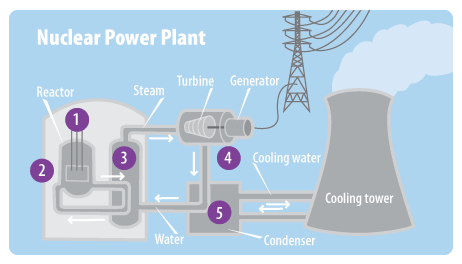 Figure \(\PageIndex{d}\): In a nuclear power plant, heat from nuclear fission is used to produce steam, which turns a turbine connected to a generator. Afterward, the steam is cooled and recycled. Image and caption (modified) by EPA (public domain).
Types of Nuclear Reactors
Most commercial nuclear power plants use either pressurized water reactors (PWRs) or boiling water reactors (BWRs). Both designs use heat from nuclear fission to generate steam and electricity, but they differ in how water is circulated and heated within the system.
In a pressurized water reactor, water surrounding the reactor core is kept under high pressure so that it does not boil (figure \(\PageIndex{e}\)). Instead, it transfers heat to a separate water system, where steam is produced to drive a turbine. Keeping the reactor water separate from the steam-producing water reduces the spread of radioactive materials beyond the reactor core.
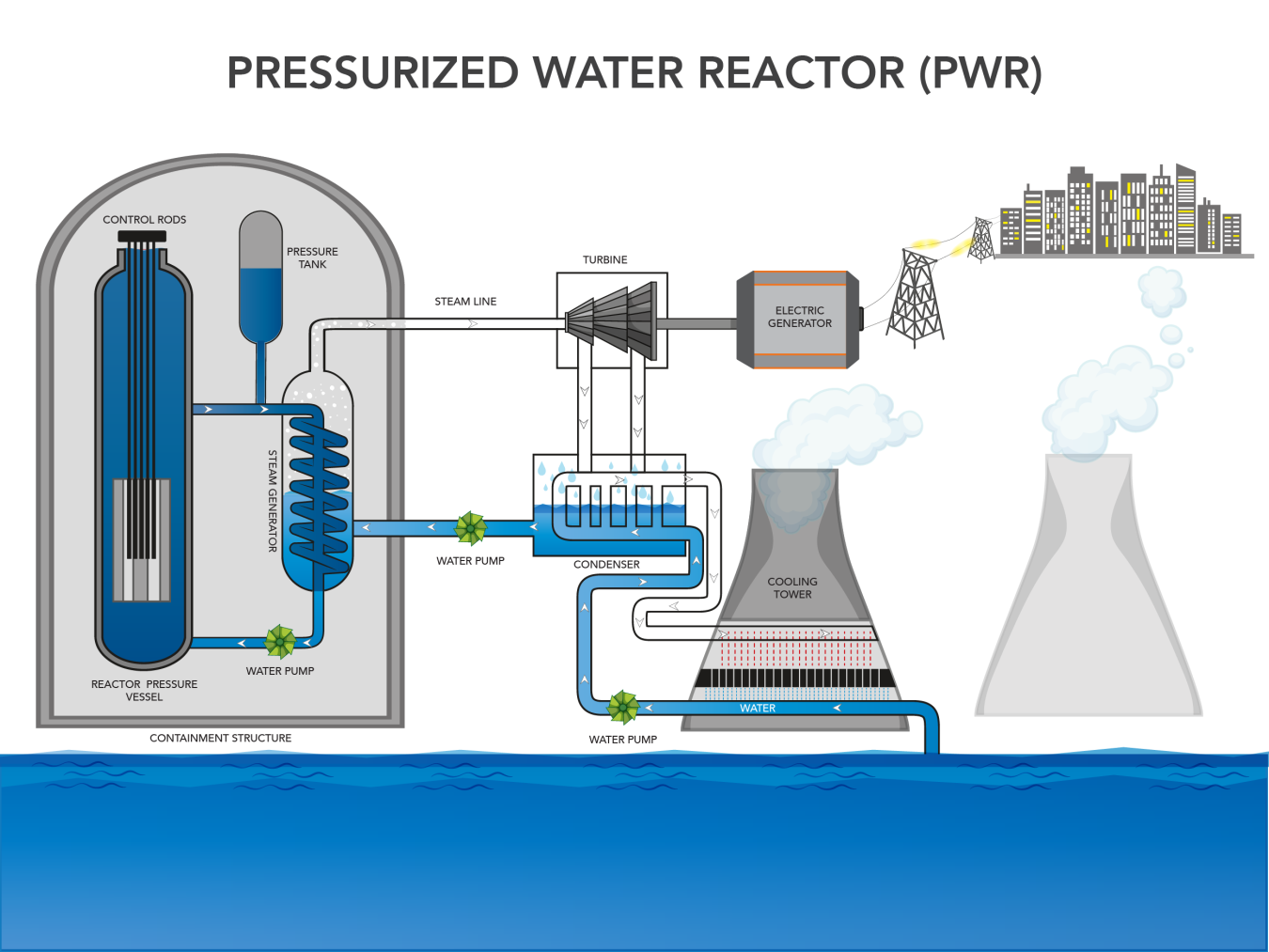 Figure \(\PageIndex{e}\): There are three separate streams of water in a pressurized water reactor. The first stream is associated with the reactor core in the reactor pressure vessel. The second stream is associated with the steam generator. The third stream is from an external source and is used to condense the steam. The reactor pressure vessel contains control rods and fuel rods (not labeled). The pressure tank regulates water pressure. Hot water from the reactor moves to the steam generator, where it heats water in the second stream to produce steam. Steam from the steam generator moves through the steam line and turns a turbine, powering the electric generator. Steam cools in the condenser, and the cooled water is then pumped back into the steam generator. The reactor pressure vessel, pressure tank, and steam generator are all in a containment structure. Water from an external source is used to cool steam in the condenser. The water from the external source cools in the cone-shaped cooling tower. Image byDOE [ Office of Nuclear Energy] (public domain).
Boiling Water Reactor
The reactor Boiling water reactors operate somewhat differently because water in contact with the reactor core is allowed to boil directly, producing steam that drives the turbine (figure \(\PageIndex{f}\)). Despite these design differences, both reactor types generate electricity from the heat released during nuclear fission.
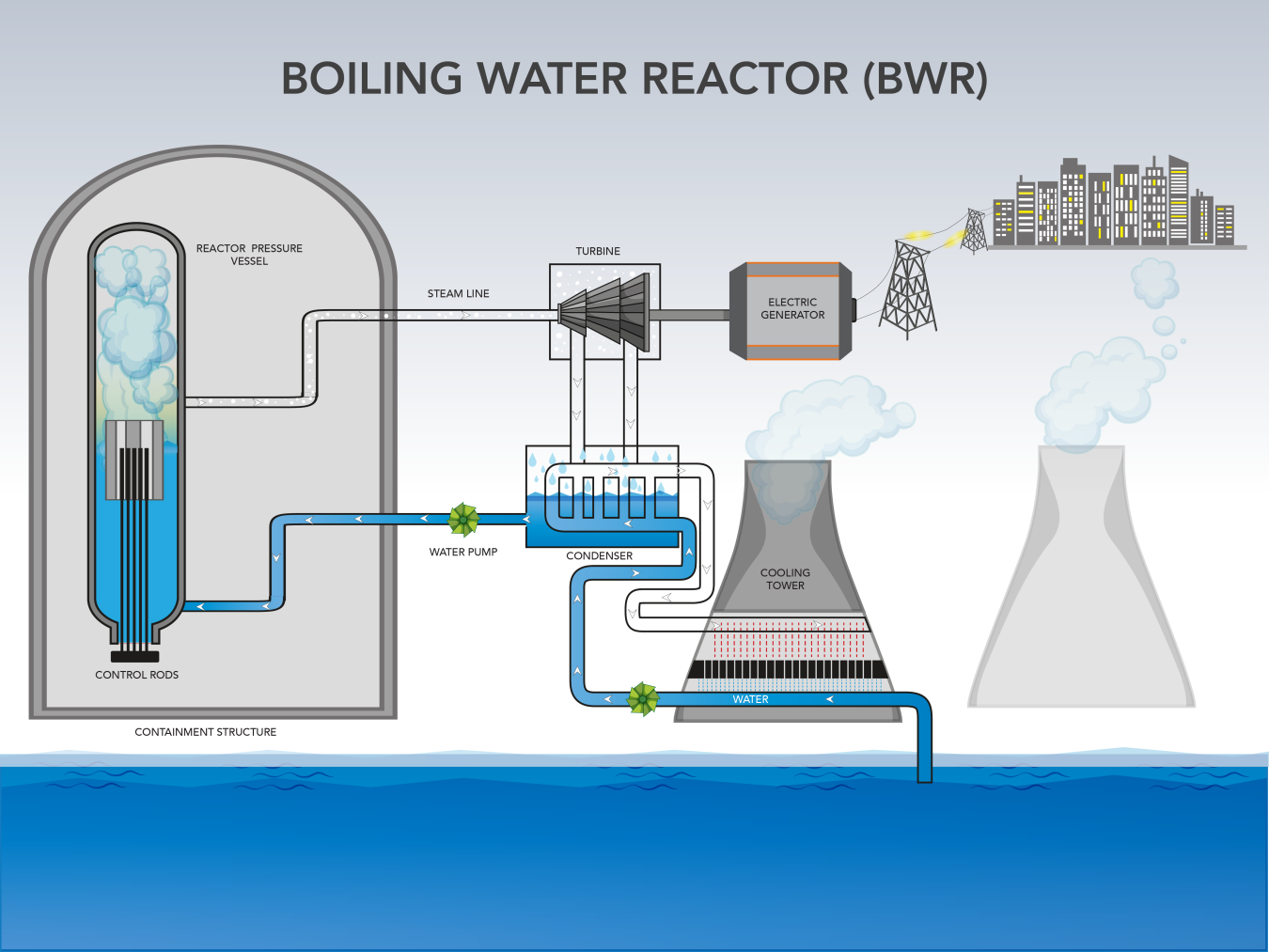 Figure \(\PageIndex{f}\): A boiling water reactor has two streams of water. In the first stream, the same water that bathes the reactor core in the reactor pressure vessel and turns to steam and turns a turbine. The third stream is from an external source and is used to condense the steam. The reactor pressure vessel contains control rods and fuel rods (not labeled). It is within a larger containment structure. When water is heated by the reactor, it evaporates to steam. This moves through the steam line and turns a turbine, powering the electric generator. Steam cools in the condenser, and the cooled water is then pumped back into the reactor pressure vessel. Water from an external source is used to cool steam in the condenser. The water from the external source cools in the cone-shaped cooling tower. Image by Office of Nuclear Energy (DOE) [ Office of Nuclear Energy] (public domain).
Attribution
This page was heavily revised and rewritten by Erin Rempala and contains adapted content from content originally authored by Melissa Ha and Rachel Schleiger and is licensed CC BY-NC-SA 4.0.
Modified by Melissa Ha from the following sources:
- Non-renewable Energy Sources from AP Environmental Science by University of California College Prep (CC-BY). Download for free at CNX.
- Stages of the Nuclear Fuel Cycle. 2020. U.S. NRC. Accessed 01-16-2021 (public domain).
- Nuclear explained: The nuclear fuel cycle. 2020. U.S. Energy Information Administration. Accessed 01-16-2021 (public domain).
This page titled 7.2.2: Generating Electricity with Nuclear Energy was last modified on Fri, 11 Sep 2026 17:39:02 GMT and is shared under a CC BY-NC-SA 4.0 license and was authored, remixed, and/or curated by Melissa Ha and Rachel Schleiger (ASCCC Open Educational Resources Initiative) .
The book could not be loaded just now.