Opening the book…
Chapter Overview
Understanding the intricate structure and multifaceted functions of skeletal tissue provides a foundation for studying how the body maintains stability and mobility. This knowledge is essential for exploring how the skeletal system interacts with other systems to support overall health and function. As you delve into this chapter, consider how skeletal tissue not only shapes the body but also plays a dynamic role in our everyday life.
Major Functions of Bones and the Musculoskeletal System
The major functions of the bones are body support, facilitation of movement, protection of internal organs, storage of minerals and fat, and hematopoiesis. Together, the muscular system and skeletal system are known as the musculoskeletal system.
Classification of Bones by Shape
Bones can be classified according to their shapes. Long bones, such as the femur, are longer than they are wide. Short bones, such as the carpals, are approximately equal in length, width, and thickness. Flat bones are thin, but are often curved, such as the ribs. Irregular bones such as those of the face have no characteristic shape. Sesamoid bones, such as the patellae, are small and round, and are located in tendons.
Gross Structure of Long and Flat Bones
A hollow medullary cavity filled with yellow marrow runs the length of the diaphysis of a long bone. The walls of the diaphysis are compact bone. The epiphyses, which are wider sections at each end of a long bone, are filled with spongy bone and red marrow. The epiphyseal plate, a layer of hyaline cartilage, is replaced by osseous tissue as the organ grows in length. The medullary cavity has a delicate membranous lining called the endosteum. The outer surface of bone, except in regions covered with articular cartilage, is covered with a fibrous membrane called the periosteum. Flat bones consist of two layers of compact bone surrounding a layer of spongy bone.
Bone Markings: Articulations, Projections, and Holes
Bone markings depend on the function and location of bones. Articulations are places where two bones meet. Projections stick out from the surface of the bone and provide attachment points for tendons and ligaments. Holes are openings or depressions in the bones.
Bone Matrix and Bone Cells
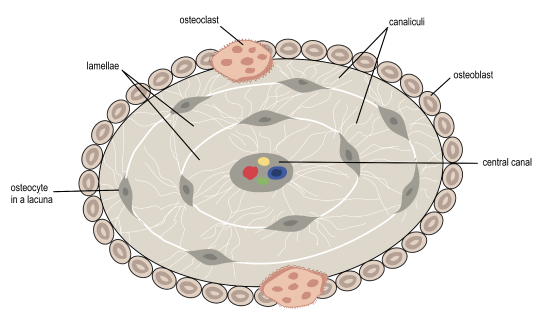
Bone matrix consists of collagen fibers and organic ground substance, primarily hydroxyapatite formed from calcium salts. Osteogenic cells develop into osteoblasts. Osteoblasts are cells that make new bone. They become osteocytes, the cells of mature bone, when they get trapped in the matrix. Osteoclasts engage in bone resorption.
Compact Bone, Spongy Bone, and Bone Vascularization
Compact bone is dense and composed of osteons, while spongy bone is less dense and made up of trabeculae. Blood vessels and nerves enter the bone through the nutrient foramina to nourish and innervate bones.
Ossification: Intramembranous and Endochondral Bone Formation
All bone formation is a replacement process. Embryos develop a cartilaginous skeleton and various membranes. During development, these are replaced by bone during the ossification process. In intramembranous ossification, bone develops directly from sheets of mesenchymal connective tissue. In endochondral ossification, bone develops by replacing hyaline cartilage.
Bone Growth, Modeling, and Remodeling
Activity in the epiphyseal plate enables bones to grow in length. Modeling allows bones to grow in diameter. Remodeling occurs as bone is resorbed and replaced by new bone.
Osteogenesis Imperfecta: A Disorder of Bone Formation
Osteogenesis imperfecta is a genetic disease in which collagen production is altered, resulting in fragile, brittle bones.
Fracture Types and Methods of Bone Repair
Fractured bones may be repaired by closed reduction or open reduction. Fractures are classified by their complexity, location, and other features. Common types of fractures are transverse, oblique, spiral, comminuted, impacted, greenstick, open (or compound), and closed (or simple). Healing of fractures begins with the formation of a hematoma, followed by internal and external calli. Osteoclasts resorb dead bone, while osteoblasts create new bone that replaces the cartilage in the calli. The calli eventually unite, remodeling occurs, and healing is complete.
Nutritional and Hormonal Regulation of Bone Health
Mechanical stress stimulates the deposition of mineral salts and collagen fibers within bones. Calcium, the predominant mineral in bone, cannot be absorbed from the small intestine if vitamin D is lacking. Vitamin K supports bone mineralization and may have a synergistic role with vitamin D. Magnesium and fluoride, as structural elements, play a supporting role in bone health. Omega-3 fatty acids reduce inflammation and may promote production of new osseous tissue. Growth hormone increases the length of long bones, enhances mineralization, and improves bone density. Thyroxine stimulates bone growth and promotes the synthesis of bone matrix. The sex hormones (estrogen and testosterone) promote osteoblastic activity and the production of bone matrix, are responsible for the adolescent growth spurt, and promote closure of the epiphyseal plates. Osteoporosis is a disease characterized by decreased bone mass that is common in aging adults.
Calcium-Regulating Hormones and Their Effects on Bone
Calcitriol stimulates the digestive tract to absorb calcium and phosphate. Parathyroid hormone (PTH) stimulates osteoclast proliferation and resorption of bone by osteoclasts. Vitamin D plays a synergistic role with PTH in stimulating the osteoclasts. Additional functions of PTH include promoting reabsorption of calcium by kidney tubules and indirectly increasing calcium absorption from the small intestine. Calcitonin inhibits osteoclast activity and stimulates calcium uptake by bones.
Calcium Homeostasis and Its Systemic Effects
Calcium homeostasis, i.e., maintaining a blood calcium level of about 10 mg/dL, is critical for normal body functions. Hypocalcemia can result in problems with blood coagulation, muscle contraction, nerve functioning, and bone strength. Hypercalcemia can result in lethargy, sluggish reflexes, constipation and loss of appetite, confusion, and coma. Calcium homeostasis is controlled by PTH, vitamin D, and calcitonin and the interactions of the skeletal, endocrine, digestive, and urinary systems.
To achieve the chapter objectives, you are expected to actively engage with the material. Learning the tissues is not a passive process - your understanding will grow as you interact with the content, peers, and instructor, regularly checking your thinking against feedback and revisiting concepts until you can explain and apply them on your own.
By the end of this chapter, students should be able to:
- Describe the major functions of the skeletal system (support, protection, movement, mineral and triglyceride storage, blood cell formation, hormone production).
- Differentiate between the axial and appendicular skeleton and list major bones in each.
- Classify bones by shape and give examples; identify major structural features of a long bone and distinguish compact from spongy bone (including red vs. yellow marrow).
- Use correct anatomical terminology to name common bone markings and relate them to their functions.
- Compare and contrast bone cells (osteogenic cells, osteoblasts, osteocytes, osteoclasts) and describe the composition of bone matrix (organic vs. inorganic) and how it contributes to strength and flexibility.
- Explain the organization of compact bone into osteons and the structure of spongy bone with trabeculae and marrow spaces.
- Distinguish between intramembranous and endochondral ossification and describe how long bones grow in length and thickness, including the role of the epiphyseal plate.
- Describe bone remodeling (deposition and resorption), the stages of fracture repair, and the influence of mechanical stress and disuse on bone (Wolff’s law).
- Discuss the roles of key hormones (PTH, calcitonin, sex hormones, growth hormone, vitamin D) in regulating blood calcium levels and bone metabolism.
- Define osteopenia, osteoporosis, and other common skeletal pathologies, and summarize major risk factors, prevention strategies, treatment approaches, and age-related changes in bone.
- 6.1: Understanding Bone- Composition, Cells, and Skeletal Organization
- Bone, or osseous tissue, is a hard, dense connective tissue that forms most of the adult skeleton, the support structure of the body. In the areas of the skeleton where bones move (for example, the ribcage and joints), cartilage, a semi-rigid form of connective tissue, provides flexibility and smooth surfaces for movement. The skeletal system is the body system composed of bones and cartilage.
- 6.2: Bone Classification
- The 206 bones that compose the adult skeleton are divided into five categories based on their shapes. Their shapes and their functions are related such that each categorical shape of bone has a distinct function.
- 6.3: Bone Anatomy
- Bone tissue (osseous tissue) differs greatly from other tissues in the body. Bone is hard and many of its functions depend on that characteristic hardness. Later discussions in this chapter will show that bone is also dynamic in that its shape adjusts to accommodate stresses. This section will examine the gross anatomy of bone first and then move on to its histology.
- 6.4: Bone Formation and Development
- In the early stages of embryonic development, the embryo’s skeleton consists of fibrous membranes and hyaline cartilage. By the sixth or seventh week of embryonic life, the actual process of bone development, ossification (osteogenesis), begins. There are two osteogenic pathways—intramembranous ossification and endochondral ossification—but bone is the same regardless of the pathway that produces it.
- 6.5: Fractures - Bone Repair
- A fracture is a broken bone and heal whether or not a physician resets it in its anatomical position. If the bone is not reset correctly, the healing process will keep the bone in its deformed position. When a broken bone is manipulated and set into its natural position without surgery, the procedure is called a closed reduction. Open reduction requires surgery to expose the fracture and reset the bone. Some fractures can be minor and others are quite severe and result in grave complications.
- 6.6: Bones and Calcium Homeostasis
- Calcium is not only the most abundant mineral in bone, it is also the most abundant mineral in the human body. Calcium ions are needed not only for bone mineralization but for tooth health, regulation of the heart rate and strength of contraction, blood coagulation, contraction of smooth and skeletal muscle cells, and regulation of nerve impulse conduction. The normal level of calcium in the blood is about 10 mg/dL.
Thumbnail: Examples of bone markings. (CC BY 4.0; via OpenStax).
6: Bone Tissue and Skeletal System Introduction is shared under a CC BY 4.0 license and was authored, remixed, and/or curated by LibreTexts.
The book could not be loaded just now.