Opening the book…
In 1979, researchers at Genentech Inc. and City of Hope Hospital succeeded in cloning the human insulin gene into E.coli bacterial cells using the cloning plasmid pBR322. While the expression of this hormone was low, work at Genentech and at Eli Lilly eventually succeeded in increasing the yields of recombinant human insulin made by bacteria. Such work made it possible for a whole host of powerful therapeutic proteins to be made by bacteria. In 1982, recombinant human insulin was approved by the FDA for use by diabetics. In 1983, the drug Humulin (i.e., "human insulin") entered the market. Today, genetically modified E.coli and yeast strains, like Saccharomyces cerevisiae, are the principal sources for the therapeutic production of recombinant human insulin. However, continued genetic engineering research has created transgenic plants for the production of other recombinant proteins. Plants may represent a better option than bacteria and yeast due to their cost effectiveness, ease of production, and absence of human pathogens. For example, recombinant human insulin has been successfully expressed and produced in oilseeds of the plant Arabidopsis thaliana. In the future, transgenic seeds may act as "warehouses" for the stockpiling of critical therapeutic compounds like insulin.
Introduction to the Principles of Genetic Engineering
Genetic engineering is the modification and manipulation of an organism’s genetic information through the use of laboratory technologies. Genetic engineering alters an organism’s genome through the introduction or removal of DNA, or by modifying the sequence of existing genes. Genetic changes may only be a single nucleotide in the DNA sequence, or the replacement of an entire gene. Genetic engineering is a key component of the biotechnology and is used in many settings, including research, medicine, agriculture, and industry. For more information about biotechnology, refer to Chapter 1: Introduction to Biotechnology.
Genetic engineering is often confused with breeding. In breeding, an organism (i.e., animal and plants) with a desired characteristic, known as the phenotype, is bred to another so that this characteristic is passed on to their offspring. Specific offspring, exhibiting a desired combination of parental characteristics, will be selected and bred again to either perpetuate their phenotype or improve upon the organism. In contrast, genetic engineering takes a gene directly from one organism and delivers it to another. This approach is much faster and can be used to manipulate any gene from any organism.
Video: Genetic Engineering
Genetic engineering is at the heart of biotechnology. This section will introduce you to some of the principles and tools of genetic engineering. At the end of this section, you will be able to:
- Explain the difference between genetic engineering and breeding
- List the "tools" used in genetic engineering
- Define DNA cloning and recombinant DNA
- List the major components of a plasmid
- Explain the difference between cloning and expression plasmids
- Define cosmids, and BACs
- Explain restriction enzymes and how they work
The “Tools” of Genetic Engineering
Genetic engineering utilizes several techniques in order to study and manipulate the genome of an organism. Examples of these techniques include:
- DNA cloning (i.e., recombinant DNA technology)
- Restriction digests
- Electrophoresis (DNA and protein)
- Sequencing
- PCR
- Northern, Southern, and Western blotting
- Immunofluorescence
- Transfection
- Transformation
- ELISA assays
- In vitro expression assays
The foundation of genetic engineering is the production of recombinant DNA (rDNA). rDNA is created by combining DNA from different sources - often from different species - into a single piece of DNA that can be inserted into a host organism. rDNA is produced through a lab technique known as DNA cloning, or cloning. In a typical cloning protocol, a piece of DNA (usually a gene) is inserted into a bacterial plasmid to produce rDNA (Figure \(\PageIndex{1}\)). This rDNA can then be introduced into a bacterial cell so that it can be amplified by the host's replication machinery, or studied for its effect on the cell. The rDNA can also be introduced into a variety of eukaryotic cells (e.g. yeast, insect, mammalian) to study its functional effects. Because this approach is at the heart of genetic engineering, genetic engineering is often called recombinant DNA (rDNA) technology.


Plasmids, Cosmids, and BACs
DNA cloning requires the use of a DNA construct known as a vector. The vectors used in DNA cloning are plasmids, cosmids, artificial chromosomes, and viruses. Choosing which vector to use for DNA cloning will depend on a variety of factors, such as the size of the DNA being cloned.
The most common type of vector used in DNA cloning is the plasmid. As introduced in Chapter 3, a plasmid is a small, circular piece of DNA found outside of the bacterial chromosome. While plasmids have been identified in yeast, the term plasmid is usually refers to bacterial plasmids. Biotechnology researchers use commercially available plasmids for many uses. These plasmids are derived from naturally occurring ones, but have been genetically engineered themselves so that they can be used in biotechnology protocols.
Plasmids can be classified into two categories:
- Cloning plasmids: also known as cloning vectors; used to amplify the gene product in bacterial cells
- Expression plasmids: used for the transcription and translation of the gene product in a specific cell type (e.g. eukaryotic cells)
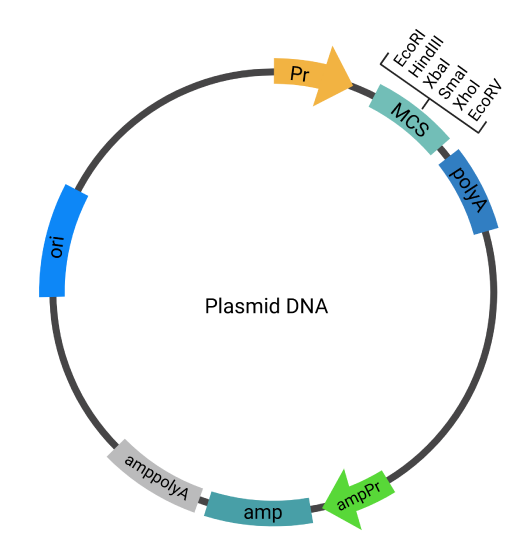
Whether the plasmid is to be used for cloning or for expression, it typically has the following major components (Figure \(\PageIndex{2}\)):
- Origin of replication (ori): allows the vector to replicate within the host bacterial cell and controls the level of replication by the host cell's replication machinery
- Selection marker(s): a gene that when expressed helps select for the organism containing the plasmid; usually is a gene that confers antibiotic resistance; plasmids may have more than one selectable marker
- Multi-cloning site (MCS): a series of restriction sites that allows the target DNA to be inserted into the plasmid
Cloning plasmids are relatively simple in construction, containing the three components listed above. In contrast, expression plasmids are more complex because they must be constructed to allow for gene expression (i.e. transcription and translation) by the host cell. For example, the MCS in expression plasmids is flanked by a promoter sequence positioned upstream of the MCS and a polyadenylation site which is positioned downstream (Figure \(\PageIndex{2}\)). These sequences allow for continuous transcription of the gene that is inserted into the MCS. However, some expression plasmids contain promoter sequences that will only allow for transcription if a specific growth condition is employed, such as a specific temperature or the use of an inducing chemical. These promoters are called conditional promoters. Additional regulatory sequences are also found in expression plasmids that allow for protein translation in the host cell. Examples of such sequences would include a transcription initiation site, a ribosome binding site (RBS), and a start codon. Finally, some cloning and expression plasmids may contain "reporter genes" that facilitate the identification of host cell containing the plasmid.
The size of a plasmid can range from a few thousand kilobase pairs (kbps or kb) to 100 kb. Typical cloning plasmids are approximately 3000 to 7000 base pairs (bp) and can accommodate DNA inserts up to approximately 15,000 bp. As such, plasmids are suitable for cloning smaller DNA fragments such as genes or small gene clusters. For larger pieces of DNA, researchers can opt to use cosmids or artificial chromosomes.
Cosmids are hybrid molecules that combine the features of a plasmid and a bacteriophage. They contain plasmid sequences such as the origin of replication, the MCS, and selection markers, but also contain several regions of bacteriophage DNA. Because they contain bacteriophage DNA, they can be packaged into bacteriophage particles and replicate via the lytic cycle of the bacteriophage. Cosmids are larger than plasmids and can carry DNA inserts ranging from 30,000 to 45,000 base pairs, so they are used when larger DNA fragments need to be cloned. The presence of bacteriophage DNA helps stabilize larger pieces of DNA, making these vectors more stable than plasmids. Therefore, cosmids are particularly useful for constructing genomic libraries, mapping genes, and isolating large DNA fragments.
A bacterial artificial chromosome (BAC) is used to clone extremely large pieces of DNA (e.g. 100,000 to about 300,000 bp). The BACs, with their inserted DNA, can be introduced into bacterial cells. As with cosmids, BACs are used in constructing genomic libraries. Yeast and human versions of the BAC also exist (YAC and HAC, respectively).
Restriction enzymes
The insertion of DNA into a MCS requires the "opening" of the DNA with a restriction enzyme. A restriction enzyme (or restriction endonuclease) is a bacterial endonuclease that recognizes a specific sequence of DNA and "cuts" the DNA helix at specific points within that sequence. As such, think of a restriction enzyme as a "molecular scissor". The DNA sequence recognized by a restriction enzyme is a restriction sequence and its physical location in the DNA is called the restriction site. These two terms are often used interchangeably, but they are not the same thing. The restriction sequence is unique to the restriction enzyme. It range from 4 bp to 12 bp in size, and is said to be palindromic, meaning it reads the same in one DNA strand going left to right as it does in the other DNA strand going right to left.
All restriction enzymes make two incisions to cut open the DNA helix, one is through a phosphodiester bond on the "sense" DNA strand, and the other is through the a phosphodiester bond on the "anti-sense" strand. Restriction enzymes may cut the restriction sequence in an offset manner to create "overhangs" or "sticky ends" or they may cut the DNA helix in an aligned way to produce "blunt ends" (Figure \(\PageIndex{3}\)). The way a restriction enzyme cuts the DNA helix will determine how it is inserted into a vector, like a plasmid.
 Figure \(\PageIndex{3}\): Sticky vs. Blunt ends. Restriction enzymes may cut the DNA of a restriction sequence (red arrows and lines) to produce overhangs known as "sticky ends" or blunted ends known as "blunt ends". The sticky end is a single-stranded DNA overhang (e.g., TTAA and AATT) that forms because the restriction enzyme cuts two DNA strands at different locations. Sticky ends can form hydrogen bonds with complementary DNA sequences (e.g. AATT and TTAA) to reform double-stranded DNA. The blunt end has no overhangs because both DNA strands are cut at the same position (Sticky vs Blunt Ends by Patricia Zuk, CC BY 4.0)
Restriction enzymes are part of a bacterium's defense mechanism. Bacteria infected with bacteriophage DNA use their restriction enzymes to cut the "phage" DNA, rendering it harmless. As such, restriction enzymes are isolated from bacteria. The first restriction enzyme to be studied was isolated from E.coli bacteria and was named EcoRI. "Eco" indicated the bacteria the enzyme was isolated from (i.e. E.coli). "R" stood for the strain of E.coli and the Roman numeral "I" indicated it was a type I restriction enzyme. A similar nomenclature scheme is used today to identify all restriction enzymes currently available. To date, over 3,000 restriction enzymes have been isolated and studied, and more than 800 of these are available commercially. A few commonly used restriction enzymes are given in the Table \(\PageIndex{1}\) below.
| Enzyme | Source | Restriction Site | Cut |
|---|---|---|---|
| BamHI | Bacillus amyloliquefaciens | 5'GGATCC 3'CCTAGG |
5'---G GATCC---3' 3'---CCTAG G---5' |
| BglII | Bacillus globigii | 5'AGATCT 3'TCTAGA |
5'---A GATCT---3' 3'---TCTAG A---3' |
| EcoRI | Escherichia coli | 5'GAATTC 3'CTTAAG |
5'---G AATTC---3' 3'---CTTAA G---5' |
| EcoRV | Escherichia coli | 5'GATATC 3'CTATAG |
5'---GAT ATC---3' 3'---CTA TAG--5' |
| HindIII | Haemophilus influenzae | 5'AAGCTT 3'TTCGAA |
5'---A AGCTT---3' 3'---TTCGA A---5' |
| KpnI | Klebsiella pneumoniae | 5'GGTACC 3'CCATGG |
5'---GGTAC C---3' 3'---C CATGG---5' |
| NotI | Nocardia otitidis | 5'GCGGCCGC 3'CGCCGGCG |
5'---GC GGCCGC---3' 3'---CGCCGG CG---5' |
| PstI | Providencia stuartii | 5'CTGCAG 3'GACGTC |
5'---CTGCA G---3' 3'---G ACGTC---5' |
| SacI | Streptomyces achromogenes | 5'GAGCTC 3'CTCGAG |
5'---GAGCT C---3' 3'---C TCGAG---5' |
| SmaI | Serratia marcescens | 5'CCCGGG 3'GGGCCC |
5'---CCC GGG---3' 3'---GGG CCC---5' |
| StuI | Streptomyces tubercidicus | 5'AGGCCT 3'TCCGGA |
5'---AGG CCT---3' 3'---TCC GGA---5' |
| XbaI | Xanthomonas badrii | 5'TCTAGA 3'AGATCT |
5'---T CTAGA---3' 3'---AGATC T---5' |
| XhoI | Xanthomonas holcicola | 5'CTCGAG 3'GAGCTC |
5'---C TCGAG---3' 3'---GAGCT C---5' |
Genetic engineering manipulates and modifies the DNA of an organism using specific "tools" or techniques.
Some major concepts to remember are:
- The genome of a organism can be manipulated in the laboratory through genetic engineering
- Genetic engineering differs from breeding, which selectively crosses specific organisms to produce desired traits in their offspring
- Genetic engineering utilizes many different "tools"
- DNA cloning is at the heart of genetic engineering
- Genetic engineering is also known as recombinant DNA technology
- Plasmids are small, circular pieces of DNA used in cloning
- Cosmids and bacterial artificial chromosomes (BACs) are also used in cloning for large pieces of DNA
- Restriction enzymes are endonucleases that "cut" the DNA helix at specific sequences called restriction sites
- Each restriction enzyme has a unique restriction site
- Restriction enzymes either produce DNA overhangs called "sticky ends" or blunted ends called "blunt ends"
Glossary
Ampicillin resistance gene (ampR) - a selectable marker gene that provides resistance to the antibiotic, ampicillin; commonly found in plasmids
Bacterial Artificial Chromosome (BAC) - a genetically engineered DNA molecule used to clone large sequences of DNA in bacteria
Bacteriophage - a virus that infects bacteria; often used as a vector in recombinant DNA
Base pair (bp) - a unit of DNA length; consist of two complementary nucleotides (A-T or C-G)
Blunt end - produced when a restriction enzyme cuts double-stranded DNA in the middle of a restriction sequence; produces no overhangs
Cloning plasmid - a plasmid used to carry foreign DNA into a host cell for replication
Cosmid - a hybrid plasmid that contains sequences from a bacteriophage and is used to clone large DNA sequences
DNA cloning - the process of making multiple, identical copies of a piece of DNA by inserting the DNA sequence into a plasmid and transforming bacteria with this plasmid
Endonuclease - an enzyme that breaks (i.e. cuts) a phosphodiester bond found within a DNA sequence
Expression plasmid - a plasmid used for expression (i.e. transcription and translation) of an inserted piece of DNA in a host cell
Genetic engineering - the direct modification of an organism’s DNA using biotechnology; often done to introduce new traits, to improve resistance to disease, or to produce beneficial products
Kilobase pair (kb) - a unit of DNA length that is 1,000 base pairs long
Plasmid - a small, circular piece of double-stranded DNA found outside of the bacterial chromosome; used in DNA cloning procedures; often used as a vector to introduce foreign DNA into cells
Polyadenylation sequence - a sequence of DNA that regulates the addition of the poly-A tail to mRNA; also called a poly-A sequence
Promoter sequence (promoter) - a sequence of DNA where the RNA polymerase binds; determines the site of transcription initiation
Recombinant DNA (rDNA) - DNA that is created in a laboratory by combining genetic material from different sources
Recombinant plasmid - a type of artificial DNA created by inserting a foreign DNA fragment into a plasmid
Restriction enzyme - an enzyme that cuts double-stranded DNA at a specific sequence; produces either a blunt end or a sticky end; also called a restriction endonuclease
Restriction sequence - the sequence of DNA cut by a restriction enzyme
Restriction site - the physical location of a restriction sequence in a DNA sequence
Selectable marker - a gene included in a plasmid that allows for the identification of successfully transformed cells; often an antibiotic resistance gene
Sticky end - a short, single-stranded overhang on a DNA fragment created by a restriction enzyme that cuts the DNA helix at different locations within the restriction sequence
Transformation - the process of inserting DNA into a bacterial host cell
Vector - a piece of DNA used to transport foreign genetic material into a host cell; includes plasmids, cosmids, BACs, and YACs
Yeast Artificial Chromosome (YAC) - a genetically engineered DNA molecule used to clone large sequences of DNA in yeast
4.1: Principles of Genetic Engineering is shared under a CC BY 4.0 license and was authored, remixed, and/or curated by LibreTexts.
The book could not be loaded just now.