Opening the book…
Amorphous silica \(\left(\text{SiO}_{2} \cdot n \ \text{H}_{2}\text{O}\right)\) is also referred to as amorphous opal (opal-A). Amorphous silica forms in a variety of settings as dissolved silica molecules \(\left(\text{SiO}_{2} \ (aq)\right)\) combine (i.e., polymerize) and precipitate. During diagenesis, amorphous silica precipitates can gradually transform into more stable silica polymorphs and ultimately the mineral quartz (Kastner et al., 1977; Mizutani, 1977).
Dissolved silica necessary to form amorphous silica originates from dissolution of silicate minerals where those minerals are undersaturated. If those solutions eventually become supersaturated with respect to amorphous silica, microorganisms can help precipitation occur by providing nucleation surfaces.
As an example, numerous studies have investigated potential roles of microorganisms in the formation of siliceous hot-spring deposits known as sinters (Campbell et al., 2015). In these systems, high temperature water dissolves silicate minerals in the subsurface. Following discharge at the surface, the hot spring water cools, decreasing the amount of dissolved silica that it can hold and ultimately causing amorphous silica to become supersaturated (Guidry and Chafetz, 2002) (Fig. \(12.4; 12.5\text{A}\)). Thus, abiotic processes drive precipitation of amorphous silica from hot springs (Campbell et al., 2015). However, laboratory and field studies indicate that biomass generated by hot spring microorganisms helps nucleate amorphous silica precipitates and also affects the structure of the sinter deposits (Campbell et al., 2015; Konhauser et al., 2004). Similar roles of microorganisms have also been observed in non-hydrothermal settings (Sauro et al., 2018).
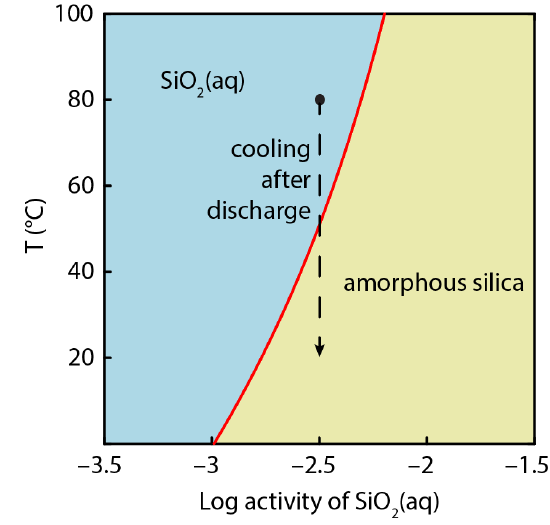
https://commons.wikimedia.org/wiki/File:Silica_speciation.png

In addition to this passive role, amorphous silica precipitation can also be biologically controlled. Some microorganisms actively take up dissolved silica and use it to form structures composed of amorphous silica. Examples include diatoms and radiolarians (Fig. \(12.5\text{B, C}\)) as well as some bacteria and fungi (Baines et al., 2012; Ehrlich and Newman, 2009).
Diatoms are a group of algae that live in fresh and marine systems and silicify their cell walls to form structures known as frustules. Diatoms are considered to be the most important silicifiers in modern marine environments (Hendry et al., 2018). Diatoms lower silica concentrations in shallow ocean water and transport it along with other nutrients into the deep ocean as they settle (Buesseler, 1998). Diatom growth also influences the flux of silica from terrestrial environments to the oceans (Ehrlich and Newman, 2009). In the Amazon River estuary, for example, Milliman and Boyle (1975) estimated that diatoms remove 25% of the dissolved silica from the river water, which is then deposited landward into the river system rather than into the adjacent ocean sediment. Silica supersaturation in the external environment is not necessary for frustule formation because diatoms can induce supersaturation internally. They do this by actively pumping dissolved silica from the external environment into a membrane bound vesicle where amorphous silica can become supersaturated and precipitate (Hildebrand et al., 2018).

Image sources: (A) Jake Lowenstern, https://www.usgs.gov/media/images/silica-sinter-amorphous-form-silicon-dioxide-forms ; (B) Kostas Tsobanoglou, https://commons.wikimedia.org/wiki/File:Diatoms-HCMR.jpg ; (C) https://en.Wikipedia.org/wiki/Radiolaria#/media/File:Cladococcus_abietinus.jpg


This page titled 12.1.2: Amorphous silica was last modified on Sun, 31 Mar 2024 22:37:17 GMT and is shared under a CC BY-SA 4.0 license and was authored, remixed, and/or curated by Matthew F Kirk via source content that was edited to the style and standards of the LibreTexts platform.
The book could not be loaded just now.