Opening the book…
Touch
In contrast to the special senses (such as vision, hearing, balance, taste and smell), which have specialized sense organs that gather sensory information and change it into nerve impulses, touch is a general sense. General senses are all associated with the sense of touch and lack special sense organs. Instead, sensory information about touch is gathered by the skin and other body tissues, all of which have important functions besides gathering sensory information. Whether the senses are special or general, however, all of them depend on cells called sensory receptors.
Touch is the ability to sense pressure, vibration, temperature, pain, and other tactile stimuli. These types of stimuli are detected by mechanoreceptors, thermoreceptors, and nociceptors all over the body, but most noticeably in the skin. These receptors are especially concentrated on the tongue, lips, face, palms of the hands, and soles of the feet. Various types of tactile receptors in the skin are shown in Figure \(\PageIndex{1}\).
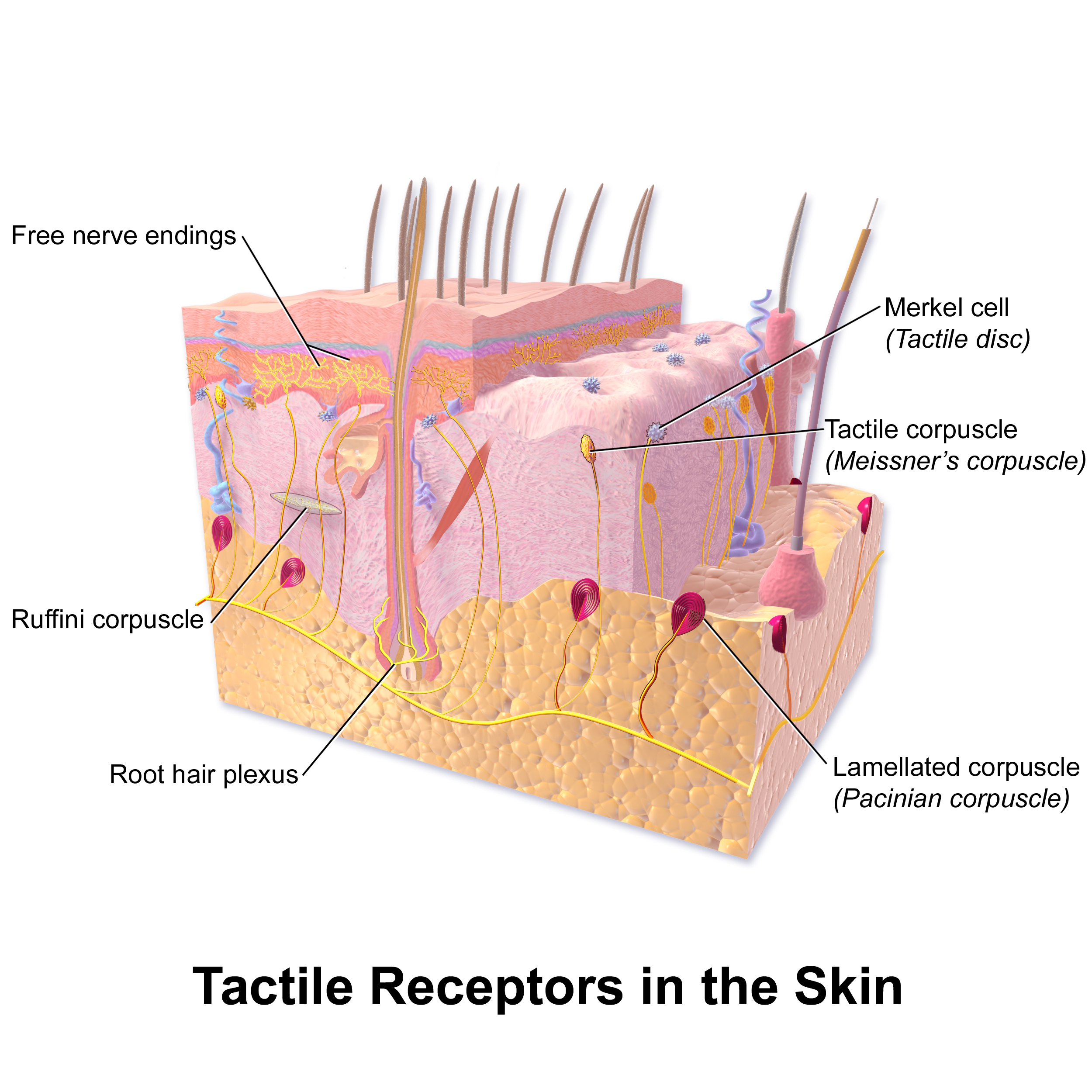
Figure \(\PageIndex{1}\): Tactile receptors in the skin include free nerve endings, Merkel cells, Meissner’s corpuscles, Pacinian corpuscles, root hair plexuses, and Ruffini corpuscles. Each type of sensory receptor responds to a different kind of tactile stimulus. For example, free nerve endings generally respond to pain and temperature variations, whereas Merkel cells are associated with the sense of light touch and the discrimination of shapes and textures.
7.5: Touch is shared under a CC BY-NC-SA license and was authored, remixed, and/or curated by LibreTexts.
The book could not be loaded just now.