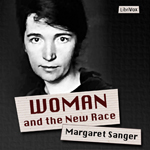
Woman and the New Race
"Woman and the New Race" by Margaret Sanger is a social and political treatise written during the early 20th century, specifically in the aftermath of World War I. The book explores themes related to women's rights, reproductive health, and the implications of overpopulation on society. It advocates for women's freedom and autonomy through the control of their reproductive choices, arguing that true freedom for women is inherently linked to their ability to limit births and raise future generations in healthier conditions. At the start of the book, Sanger outlines the historical context of women's societal roles, emphasizing the detrimental impact of enforced motherhood on women's health and social status. She discusses the “vicious circle” of overpopulation, where women, bound to traditional roles and often subjected to inadequate conditions, unconsciously perpetuate societal and familial burdens. The opening chapters emphasize the urgent need for birth control as a means of achieving both personal empowerment and broader social reform, positing that enlightened reproductive choices can lead to healthier families and ultimately a more stable society. Sanger sets the stage for her argument by highlighting the voices of women who are trapped in cycles of poverty and helplessness, advocating for both knowledge and practical access to contraceptive methods as vital paths to transformation.
Summary written by Project Gutenberg, by machine.
- Language
- English
- On Project Gutenberg since
- 1 August 2005
- Read in the last 30 days
- 918 times at Project Gutenberg
Listen to it
More by Margaret Sanger
See all: More by Margaret Sanger
Margaret Sanger: an autobiography.
Debate on birth control. Margaret Sanger and Winter Russell
The Pivot of Civilization
The Case for Birth Control: A Supplementary Brief and Statement of Facts

What Every Girl Should Know
Family Limitation
Magnetation Methods of Birth Control
What Every Mother Should Know; or, How Six Little Children Were Taught The Truth