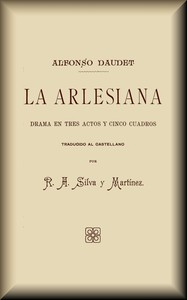
La arlesiana
Translated by R. A. Silva y Martínez
Human-made only is on in this browser, so Project Gutenberg's machine summaries are left out. Settings.
"La arlesiana" by Alphonse Daudet is a play written in the late 19th century. Set in the Camargue, it follows the young farmer Federico, consumed by love for an unseen woman from Arles, while his mother Rosa, grandfather Francisco, the shepherd Baltasar, and his shy admirer Viveta struggle to save him from obsession and dishonor. Themes of rural honor, passion, and family duty drive the drama. The opening of the play presents the Castelet farm awaiting news about Federico’s proposed marriage to the Arlesian girl. A horse-keeper, Mitifio, arrives with letters proving the woman has been his mistress, shattering the household; Federico reads them and collapses in despair. By the Vaccarès lagoon, Rosa fears her son’s suicidal thoughts, Baltasar counsels hard duty, and Viveta—urged by Rosa—confesses her love, only to be rebuffed by the anguished Federico. Later, Rosa proposes accepting the Arlesian to save him, but Federico rejects that path and turns to Viveta for healing love; amid San Eloy festivities and a tender reunion of the elders Baltasar and Reinalda, Federico pledges himself to Viveta and returns the letters—just as Mitifio bursts in demanding them back, leaving the moment on edge.
AI-generated Summary written by Project Gutenberg, by machine.
- Language
- Spanish (Español)
- On Project Gutenberg since
- 4 January 2026
- Read in the last 30 days
- 344 times at Project Gutenberg
More by Alphonse Daudet
See all: More by Alphonse Daudet
Widger's Quotes and Images from Fromont and Risler by Alphonse Daudet

The Nabob, Vol. 2 (of 2)

Tartarin de Tarascon
Lettres de mon moulin

Letters from My Windmill
Contes de lundi
Artists' Wives
Tartarin de Tarascon

Le Petit Chose (Histoire d'un Enfant)
Lettres de mon moulin
Robert Helmont: Diary of a Recluse, 1870-1871
Tartarin of Tarascon

The Nabob

Jack
The Nabob, Vol. 1 (of 2)
Le petit chose
Dix contes modernes des meilleurs auteurs du jour
Cartas de mi molino
The Immortal; Or, One of the "Forty."