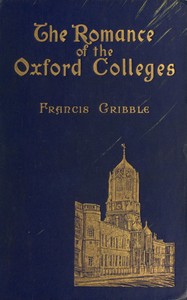
The romance of the Oxford colleges
"The romance of the Oxford colleges" by Francis Henry Gribble is a historical account written in the early 20th century. It offers lively, anecdote-rich sketches of Oxford’s colleges, foregrounding human-interest stories, famous alumni, and traditions rather than dates or architectural detail. Aimed at curious visitors and general readers, it tours each college through memorable episodes that link university life to wider English history. The opening of the book sets out its aim to be neither history nor guidebook but a collection of the stories outsiders most want to hear, then launches into brisk, illustrated chapters. University College begins by dismissing the Alfred the Great legend in favor of William of Durham and moves quickly to Percy Shelley’s notoriety: his “Stinks Man” experiments, alliance with Hogg, impish baby-on-Magdalen-Bridge episode, the provocative pamphlet The Necessity of Atheism, the shop-window scandal, and his expulsion for refusing to answer the dons—framed more as defiant prank than firm atheism. Balliol follows from its penitential founding to Adam Smith’s scathing verdict on slothful eighteenth‑century teaching, Southey’s Pantisocracy dream with Coleridge, rough “rags,” reforms under Parsons and Jenkyns (amid comic anecdotes), and the long central portrait of Jowett—formidable tutor, reformer, talker, and enigmatic churchman whose influence radiated across public life. Merton is shown as the first true corporate college, heroic in the 1354 St Scholastica’s Day riot, gleaming in Elizabethan days under Savile and Bodley, then glittering through the Civil War as the Queen’s residence before sliding into later frivolity and garden scandals, with vignettes of Mandell Creighton and the youthful Lord Randolph Churchill. Exeter appears as the West Country and Whig-leaning college, producing “Parson Jack” Russell the pugilistic parson, Colonel Peard “Garibaldi’s Englishman,” the Protestant-spirited Froude whose Nemesis of Faith was theatrically b
Summary written by Project Gutenberg, by machine.
- Language
- English
- On Project Gutenberg since
- 15 November 2025
- Read in the last 30 days
- 318 times at Project Gutenberg