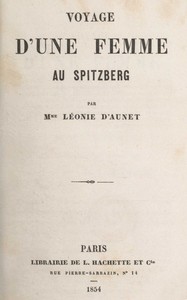
Voyage d'une femme au Spitzberg
"Voyage d'une femme au Spitzberg" by Léonie d' Aunet is an epistolary travel narrative written in the mid-19th century. It follows a determined woman traveler who joins a scientific expedition toward the Arctic, documenting her overland and sea journey through northern Europe en route to Spitzbergen. The focus is on landscapes, cities, customs, art, and the distinctive perspective of a female explorer breaking convention. The opening of the work unfolds through letters: first from aboard a steamer, the narrator explains how a salon conversation with the polar explorer Gaimard sparked her plan to accompany her husband on a northern scientific voyage, outlines an ambitious itinerary, and begins traveling through Holland with sharp, lively portraits of Rotterdam, The Hague’s museums, Amsterdam, Saardam, and the hyper-clean Broek. She then races across the North Sea and the Baltic to Hamburg, Kiel, and Copenhague, braving seasickness, collecting folklore (a Falster “miracle”), and visiting Thorwaldsen’s studio, the treasure-filled Rosenborg, and a Scandinavian antiquities museum. Crossing the Sund at Helsingør to Helsingborg, she describes the practical challenges of Swedish travel, the austere west coast towns, and the more vigorous Gothembourg before pushing on toward Norway. At the start of the second letter she arrives in Christiania, sketching the port’s timber trade and the scenery, and closes with the vivid anecdote of the famed Norwegian bandit Ouli-Eiland, whose brazen career meets an unexpected turn when the fortress governor wins his parole by appealing to his honor.
Summary written by Project Gutenberg, by machine.
- Language
- French (Français)
- On Project Gutenberg since
- 5 November 2025
- Read in the last 30 days
- 217 times at Project Gutenberg