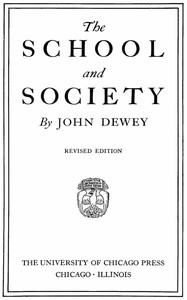
The school and society
by John Dewey
"The School and Society" by John Dewey is an educational work published in 1899. Based on three influential lectures, it establishes a foundational framework for progressive education that responds to the Industrial Revolution's transformation of childhood learning. Dewey argues that modern schools must replace the practical, hands-on education children once received working alongside parents. He proposes making collaborative experimentation central to schoolwork, designing student-centered classrooms around children's natural interests rather than passive listening, and integrating manual training with academic subjects to reconnect theory with meaningful practice.
Summary written by Project Gutenberg, by machine.
- Language
- English
- On Project Gutenberg since
- 5 September 2024
- Read in the last 30 days
- 729 times at Project Gutenberg
More by John Dewey
See all: More by John Dewey
How We Think

Democracy and Education: An Introduction to the Philosophy of Education
Human Nature and Conduct: An introduction to social psychology
Leibniz's New Essays Concerning the Human Understanding: A Critical Exposition
The School and Society

The public and its problems

Moral Principles in Education

Reconstruction in Philosophy

The Child and the Curriculum

Essays in Experimental Logic

Ethics
Schools of to-morrow

Creative Intelligence: Essays in the Pragmatic Attitude

The Influence of Darwin on Philosophy, and other essays in contemporary thought
Psychology and Social Practice

Letters from China and Japan

China, Japan and the U.S.A.

Studies in Logical Theory

German philosophy and politics