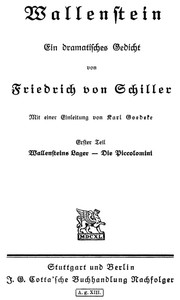
Wallensteins Lager
"Wallensteins Lager" by Friedrich Schiller is a dramatic prologue written in 1799. It serves as the opening to Schiller's Wallenstein trilogy, set during the Thirty Years' War in 1633. The play depicts life in the military camp of the powerful general Albrecht von Wallenstein, capturing the voices of common soldiers who praise their commander's leadership and the freedoms he grants them. Tensions rise when troops learn the emperor plans to transfer part of the army to Spanish Habsburg command, setting the stage for the conflict that unfolds in the trilogy's subsequent plays.
Summary written by Project Gutenberg, by machine.
- Language
- German (Deutsch)
- On Project Gutenberg since
- 1 September 2004
- Read in the last 30 days
- 727 times at Project Gutenberg
More by Friedrich Schiller
See all: More by Friedrich Schiller
Aesthetical Essays of Friedrich Schiller
Philosophical Letters of Friedrich Schiller
The Illustrated Works of Friedrich Schiller

The Works of Frederick Schiller

The Poems of Schiller — Third period

The Poems of Schiller — Second period

Briefe Schillers und Goethes an A. W. Schlegel

The Poems of Schiller — First period

The Poems of Schiller — Suppressed poems
Die Räuber: Ein Schauspiel

The Robbers

Mary Stuart: A Tragedy

Wilhelm Tell
Literary and Philosophical Essays: French, German and Italian

Don Carlos: A Play
The Thirty Years War — Complete

The Maid of Orleans: A Tragedy

The Death of Wallenstein

Love and Intrigue: A Tragedy

History of the Revolt of the Netherlands — Complete
More from the shelf “DE Drama”
See all: More from the shelf “DE Drama”
Faust: Der Tragödie erster Teil

Faust: Eine Tragödie [erster Teil]
Reigen: Zehn Dialoge

Faust: Der Tragödie zweiter Teil

Woyzeck

Der Zerbrochene Krug

Nathan der Weise: Ein Dramatisches Gedicht, in fünf Aufzügen
Rosmersholm: Schauspiel in vier Aufzügen

Iphigenie auf Tauris
The Flying Dutchman (Der Fliegende Hollaender): Romantic Opera in Three Acts

Jedermann: Das Spiel vom Sterben des reichen Mannes

Hamburgische Dramaturgie

Gespenster: Ein Familiendrama in drei Aufzügen
Der König Candaules: Drama in drei Akten

Emilia Galotti

Kabale und Liebe: Ein bürgerliches Trauerspiel

Fräulein Julie: Naturalistisches Trauerspiel

Romeo und Julia

Torquato Tasso