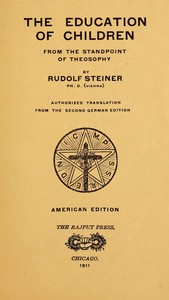
The Education of Children from the Standpoint of Theosophy
Edited by Max Gysi
"The Education of Children from the Standpoint of Theosophy" by Rudolf Steiner is a philosophical treatise on the intersection of educational methods and the principles of Theosophy, written in the early 20th century. The book explores the nature of the child from a spiritual perspective, positing that education should be grounded in an understanding of human development that transcends conventional materialism. Steiner's work seeks to inform educational practices with insights gained from Theosophical philosophy, emphasizing the significance of holistic growth in children. In this work, Steiner outlines a framework for education that acknowledges the layered nature of human beings. He discusses the physical, etheric, astral, and egoic principles that constitute a person, specifically examining how these aspects evolve through different life stages. Steiner emphasizes key developmental milestones, suggesting that education should evolve with the child, using methods such as imitation for younger children and fostering hero-worship and authority figures in later years. He argues for an environment rich in beauty and inspiration to cultivate the child’s physical and spiritual well-being, ultimately advocating for an approach to education that intertwines moral, emotional, and intellectual growth.
Summary written by Project Gutenberg, by machine.
- Language
- English
- On Project Gutenberg since
- 20 September 2017
- Read in the last 30 days
- 665 times at Project Gutenberg
More by Rudolf Steiner
See all: More by Rudolf Steiner
An Outline of Occult Science
The Way of Initiation; or, How to Attain Knowledge of the Higher Worlds
Christianity as Mystical Fact, and the Mysteries of Antiquity
The Philosophy of Spiritual Activity
The Spiritual Guidance of Man and of Mankind
Mystics of the Renaissance and their relation to modern thought, including Meister Eckhart, Tauler, Paracelsus, Jacob Boehme, Giordano Bruno, and others
Four Mystery Plays
Friedrich Nietzsche: Ein Kämpfer gegen seine Zeit
Die Philosophie der Freiheit: Grundzüge einer modernen Weltanschauung
Goethes Weltanschauung

Die Kernpunkte der sozialen Frage in den Lebensnotwendigkeiten der Gegenwart und Zukunft
Yhteiskunnallisen kysymyksen ydinkohdat