Kansalaissota Ranskassa
by Karl Marx
Introduction by Friedrich Engels
"Kansalaissota Ranskassa" by Karl Marx is a historical account written in the late 19th century. The work analyzes the events surrounding the Paris Commune of 1871, focusing on the class struggles that characterized this revolutionary uprising of the working class against the existing government. It examines the political context of the time, particularly the effects of the Franco-Prussian War and the aftermath of Louis Bonaparte's regime. The opening of the text introduces the reader to the aftermath of the Franco-Prussian War, leading to a surge in revolutionary sentiment among the Parisian working class. Marx emphasizes the inherent class struggles and contradictions that developed during this period, as workers sought to assert their rights in the face of governmental neglect and oppression. Friedrich Engels, who writes the introduction, highlights the necessity of analyzing the Commune within the greater context of the ongoing international struggle for workers' rights, framing it as a critical moment in history reflecting the deeper societal conflicts of the time. This portion sets the stage for a detailed examination of the events, decisions, and ideologies that influenced the Paris Commune and its eventual fate.
Summary written by Project Gutenberg, by machine.
- Language
- Finnish (Suomi)
- On Project Gutenberg since
- 21 August 2017
- Read in the last 30 days
- 427 times at Project Gutenberg
More by Karl Marx
See all: More by Karl Marx
Der Briefwechsel zwischen Friedrich Engels und Karl Marx 1844 bis 1883, Erster Band

The Communist Manifesto
A Contribution to the Critique of Political Economy

Manifesto of the Communist Party

The Eighteenth Brumaire of Louis Bonaparte

Revolution and Counter-Revolution; Or, Germany in 1848

Secret Diplomatic History of The Eighteenth Century
El capital: Resumido y acompañado de un estudio sobre el Socialismo científico

Το κεφάλαιον
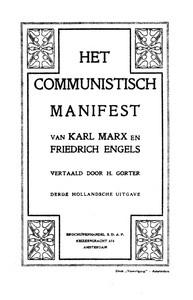
Het communistisch manifest