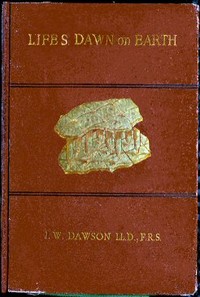
Life's Dawn on Earth
Being the history of the oldest known fossil remains, and their relations to geological time and to the development of the animal kingdom
"Life's Dawn on Earth" by Sir John William Dawson is a scientific publication written in the late 19th century. The book explores the history of the oldest known fossil remains, specifically focusing on Eozoon canadense, a fossil discovered in the Laurentian rocks of Canada. Dawson discusses the significance of this discovery in relation to geological time and the development of the animal kingdom, emphasizing the early stages of life on Earth as a captivating subject for both scientists and the general public. The opening of the work introduces Eozoon canadense, framing it as humanity's earliest connection to animal life and a representation of life's origins. Dawson reflects on the intrigue surrounding the beginnings of life, addressing questions about the first creatures and their evolutionary relationships with later forms. He also mentions the historical misconceptions about the Laurentian rocks being devoid of life, highlighting the excitement within the geological community following the discovery of organic remains within these ancient formations. The author aims to present a comprehensive and accessible account of Eozoon and its geological context, which outlines the book's intention to educate readers about the dawn of life and its implications for understanding Earth's biological history.
Summary written by Project Gutenberg, by machine.
- Language
- English
- On Project Gutenberg since
- 25 December 2015
- Read in the last 30 days
- 602 times at Project Gutenberg
More by John William Dawson, Sir
See all: More by John William Dawson, Sir
The Story of the Earth and Man
The Chain of Life in Geological Time

The Origin of the World According to Revelation and Science
Some Salient Points in the Science of the Earth

The Geological History of Plants

The Meeting-Place of Geology and History
Facts and fancies in modern science