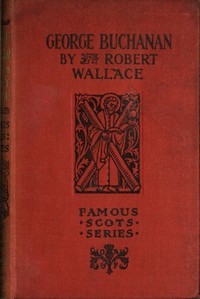
George Buchanan
by Robert Wallace, John Campbell Smith
Illustrated by Joseph Brown
"George Buchanan" by Robert Wallace and John Campbell Smith is a historical account written in the late 19th century. The work delves into the life and influence of George Buchanan, notable as a political thinker, scholar, and literary figure from Scotland during the Renaissance. The book highlights Buchanan's importance in the struggle for political liberty against tyranny and his contributions to literature and education. The opening of the text sets the stage for Buchanan's remarkable legacy, beginning with a reflection on a significant historical event—the beheading of Lord William Russell—paired with the burning of Buchanan’s and Milton’s political writings by the University of Oxford. It establishes Buchanan as a pivotal figure in the defense of the principles of liberty and governance by the people, and introduces his dual role as both a fierce political critic and a celebrated poet of his time. The author notes Buchanan's profound influence on later political movements and his esteem among contemporaries, as well as his active engagement in the political turmoil of his era, solidifying his place in the history of liberal thought.
Summary written by Project Gutenberg, by machine.
- Language
- English
- On Project Gutenberg since
- 17 April 2014
- Read in the last 30 days
- 692 times at Project Gutenberg
More by Robert Wallace
See all: More by Robert Wallace
More from the shelf “Famous Scots Series”
See all: More from the shelf “Famous Scots Series”
Andrew Melville

James Watt
Robert Louis Stevenson
John Knox
Thomas Chalmers
King Robert the Bruce
Thomas Carlyle
James Frederick Ferrier
Sir William Wallace
Fletcher of Saltoun
James Boswell
Robert Burns
The 'Blackwood' Group
Sir Walter Scott
Norman Macleod
Hugh Miller
Allan Ramsay

Kirkcaldy of Grange
The Balladists