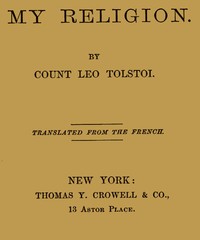
My Religion
Translated by Huntington Smith
Human-made only is on in this browser, so Project Gutenberg's machine summaries are left out. Settings.
"My Religion" by Count Leo Tolstoy is a philosophical treatise written in the late 19th century. The work explores Tolstoy's personal journey towards an understanding of Christianity, emphasizing the fundamental teachings of Jesus, particularly the doctrine of non-resistance to evil. In it, Tolstoy seeks to distill the essence of Jesus' messages, arguing for a life grounded in love, humility, and self-denial, contrasting it against the moral failings he observes in established religious practices. At the start of the book, Tolstoy reflects on his past nihilism and how his newfound faith transformed his understanding of right and wrong. He expresses a deep sense of dissatisfaction with dogmatic interpretations of Christianity as perpetuated by organized religion, feeling they dilute the core tenets of Jesus' teachings. The opening showcases his inner turmoil over the contradictions he perceives within the Church's doctrines, leading him to seek clarity in the Gospels. Through his personal revelations, he articulates a vision of Christianity that is accessible, practical, and fundamentally rooted in the principle of not resisting evil, setting the stage for his broader philosophical exploration throughout the text.
AI-generated Summary written by Project Gutenberg, by machine.
- Language
- English
- On Project Gutenberg since
- 22 September 2013
- Read in the last 30 days
- 1,019 times at Project Gutenberg
More by Leo Tolstoy, graf
See all: More by Leo Tolstoy, graf
Index of the Project Gutenberg Works of Leon Tolstoy
The Journal of Leo Tolstoi (First Volume—1895-1899)
Tolstoy on Shakespeare: A Critical Essay on Shakespeare
Tolstoy on art
Leo Tolstoin kertomuksia

War and Peace
Deux générations
Anna Karenina
What Is Art?
What Men Live By, and Other Tales
"The Kingdom of God Is Within You"

The Kreutzer Sonata and Other Stories

Resurrection

Master and Man
The forged coupon, and other stories
The Kingdom of God is Within You; What is Art?
Anna Karenina, 1. Band

A Letter to a Hindu
Fables for Children, Stories for Children, Natural Science Stories, Popular Education, Decembrists, Moral Tales