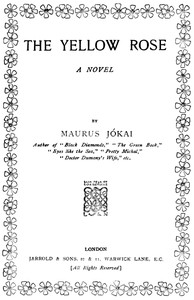
The yellow rose
by Mór Jókai
Translated by Beatrice Danford
"The Yellow Rose" by Mór Jókai is a novel written in the late 19th century. The narrative unfolds in the vast Hungarian plains, focusing on the intertwined lives of herdsmen and a maiden known as "The Yellow Rose." Central to the story are Sándor Decsi, a csikós (horseherd) embroiled in a romantic entanglement, and Klári, the innkeeper's daughter, whose innocent love leads to a grave misunderstanding. At the start of the novel, the scene is set on the Hortobágy, where Sándor rides through the grassy expanse, showcasing a vibrant connection to his environment. Meanwhile, the narrative introduces Klári, a young woman of notable beauty, who is intricately linked to the legendary yellow rose, a flower that symbolizes her allure and the complexities of her romance with Sándor. As her feelings lead her to make a fateful decision involving a magical root, the tension between love, jealousy, and misfortune begins to unfold, hinting at the dramatic developments to come. The opening establishes the novel's themes of love, betrayal, and the struggle for personal desires amidst societal expectations.
Summary written by Project Gutenberg, by machine.
- Language
- English
- On Project Gutenberg since
- 10 January 2011
- Read in the last 30 days
- 674 times at Project Gutenberg
More by Mór Jókai
See all: More by Mór Jókai
Tales From Jókai
Debts of Honor

Manasseh: A Romance of Transylvania

The Day of Wrath

A Hungarian Nabob
The Corsair King

Told by the death's head
The nameless castle

Black Diamonds: A Novel

The Slaves of the Padishah

The Golden Age in Transylvania
Halil the Pedlar: A Tale of Old Stambul

Eyes Like the Sea: A Novel

The Baron's Sons: A Romance of the Hungarian Revolution of 1848
'Midst the Wild Carpathians
Timar's Two Worlds
The Green Book; Or, Freedom Under the Snow: A Novel
The Poor Plutocrats

In Love With the Czarina, and Other Stories