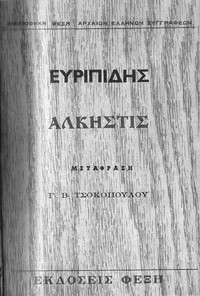
Άλκηστις
by Euripides
Translated by George B. Tsokopoulos
"Άλκηστις" by Euripides is a tragedy first performed in 438 BCE at the Great Dionysia festival in Athens. The play tells the story of Alcestis, a devoted wife who willingly sacrifices her life to save her husband Admetus, the king of Pherae. This unique work occupies an unusual position in Greek drama, serving as the fourth play in a tetralogy where a satyr play would normally appear. It explores themes of marital devotion, self-sacrifice, and the role of women in ancient society through its heroine's extraordinary choice.
Summary written by Project Gutenberg, by machine.
- Language
- Greek (Ελληνικά)
- On Project Gutenberg since
- 31 January 2009
- Read in the last 30 days
- 530 times at Project Gutenberg
More by Euripides
See all: More by Euripides
Medea of Euripides

The Tragedies of Euripides, Volume I.

The Bacchae of Euripides

The Trojan Women of Euripides

The Electra of Euripides
Obras dramáticas de Eurípides (1 de 3)
Obras dramáticas de Eurípides (2 de 3)

The Rhesus of Euripides

The Trojan women of Euripides

The Iphigenia in Tauris of Euripides
Obras dramáticas de Eurípides (3 de 3)

Euripides' Elektra

Alcestis

Hippolytus; The Bacchae

Book of illustrations : Ancient Tragedy
Hecuba and other plays

Ιφιγένεια εν Αυλίδι
Ανδρομάχη

Ορέστης