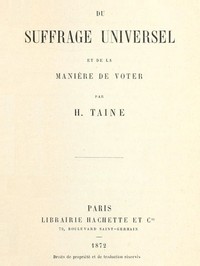
The French Revolution - Volume 2
Notes by Svend Rom · Translated by John Durand
"The French Revolution - Volume 2" by Hippolyte Taine is a historical account likely written in the late 19th century. This volume specifically delves into the Jacobin Conquest during the French Revolution, exploring the rise of the Jacobins, their political ideology, and their influence over the tumultuous events that characterized this era. The opening of the volume serves as an introduction to the Jacobin movement and sets the tone for Taine's analysis of the political landscape of revolutionary France. It discusses the Jacobins' establishment as a revolutionary party, their theories of popular sovereignty, and how they manipulated public sentiment to gain power. The author highlights the formation of the Jacobin ideology, characterized by a strong belief in popular sovereignty and a concurrent disdain for established authority. Taine portrays the Jacobins as a significant and often chaotic force in the revolution, noting their tactics, motivations, and the complexities within their ranks as they sought to reshape society amidst the upheaval.
Summary written by Project Gutenberg, by machine.
- Language
- English
- On Project Gutenberg since
- 22 June 2008
- Read in the last 30 days
- 1,850 times at Project Gutenberg
More by Hippolyte Taine
See all: More by Hippolyte Taine
The French Revolution - Volume 3
The Modern Regime, Volume 1
The Ancient Regime

Histoire de la Littérature Anglaise (Volume 4 de 5)
The Modern Regime, Volume 2

Histoire de la Littérature Anglaise (Volume 2 de 5)

The French Revolution - Volume 1
A Tour Through the Pyrenees

History of English Literature Volume 2 (of 3)
History of English Literature Volume 3 (of 3)
The Philosophy of Art
History of English Literature Volume 1 (of 3)

Histoire de la Littérature Anglaise (Volume 5 de 5)
The Origins of Contemporary France, Complete Table of Contents

Histoire de la Littérature Anglaise (Volume 1 de 5)

Histoire de la Littérature Anglaise (Volume 3 de 5)

Voyage aux Pyrénées

Le positivisme anglais: Etude sur Stuart Mill