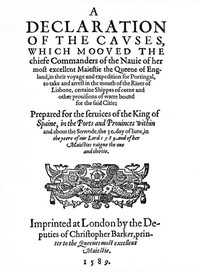
A Declaration of the Causes, which mooved the chiefe Commanders of the Nauie of her most excellent Maiestie the Queene of England, in their voyage and expedition for Portingal, to take and arrest in the mouth of the Riuer of Lisbone, certaine Shippes of corne and other prouisions of warre bound for the said Citie
Prepared for the seruices of the King of Spaine, in the Ports and Prouinces within and about the Sownde, the 30. day of Iune, in the yeere of our Lord 1589. and of her Maiesties raigne the one and thirtie
by England and Wales. Sovereign
Human-made only is on in this browser, so Project Gutenberg's machine summaries are left out. Settings.
"A Declaration of the Causes, which mooved the chiefe Commanders of the Nauie of her most excellent Maiestie the Queene of England" is a historical document likely written in the late 16th century. The text outlines the rationale behind the actions of the commanders of the English fleet during their military engagement against the ships supplying the King of Spain during a time of hostility. This declaration serves as both a justification for military action and a defense against accusations of breaching international law. The document articulates the political and military context surrounding England's conflict with Spain, specifically detailing the threats posed by the Spanish King and his attempts to undermine Queen Elizabeth I. It addresses various conspiracies against the Queen, highlighting the animosity felt towards England from Spain, as well as concerns over trade and neutrality upheld by the Hanse Towns. The authors argue for the legality of their maritime actions, asserting that their seizures of ships were necessary for England's self-defense against a common enemy, ultimately portraying a strong commitment to national sovereignty and the protection of Protestantism in a turbulent religious landscape.
AI-generated Summary written by Project Gutenberg, by machine.
- Language
- English
- On Project Gutenberg since
- 25 June 2006
- Read in the last 30 days
- 476 times at Project Gutenberg
More from the shelf “Pirates, Buccaneers, Corsairs, etc.”
See all: More from the shelf “Pirates, Buccaneers, Corsairs, etc.”
Treasure Island

Plague Ship

Famous Sea Fights, from Salamis to Tsu-Shima

Captain Canot; Or, Twenty Years of an African Slaver

Captain Blood

The Expedition to Borneo of H.M.S. Dido

Privateering and Piracy in the Colonial Period
Plotting in pirate seas

The Story of the Barbary Corsairs

Thrilling Narratives of Mutiny, Murder and Piracy

On the Trail of the Space Pirates

The Lady and the Pirate

The Iron Pirate: A Plain Tale of Strange Happenings on the Sea

Famous Privateersmen and Adventurers of the Sea

The Pirates' Who's Who

The Frozen Pirate

The Pirate of Panama: A Tale of the Fight for Buried Treasure

The Shanty Book, Part I, Sailor Shanties

The Buccaneers in the West Indies in the XVII Century