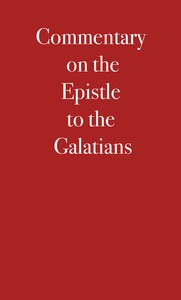
Commentary on the Epistle to the Galatians
Translated by Theodore Graebner
"Commentary on the Epistle to the Galatians" by Martin Luther is a theological treatise written in the early 16th century. It presents a detailed exegesis of St. Paul's letter to the Galatians, focusing particularly on the doctrine of justification by faith alone, which is a central tenet of Lutheran theology. This commentary serves as both a defense of Paul’s teachings against those who would distort them and an exploration of the implications of faith in Christ for salvation. The opening of this commentary sets the stage for Luther's exploration of the key themes in Paul's letter. Luther begins by explaining the context behind Paul's writing, detailing the influence of Judaizers who challenged the Galatian believers with a distorted version of the Gospel that emphasized adherence to the Law. He introduces the importance of Paul's authority as an apostle, reiterating that his teachings come by revelation from Jesus Christ. Luther's tone is passionate and urgent, as he emphasizes the perils of straying from the foundational beliefs of Christianity. The opening thus establishes a framework for understanding the nature of faith, grace, and the impact of the Gospel on both individual believers and the church as a whole.
Summary written by Project Gutenberg, by machine.
- Language
- English
- On Project Gutenberg since
- 1 December 1998
- Read in the last 30 days
- 2,566 times at Project Gutenberg
Listen to it
More by Martin Luther
See all: More by Martin Luther
Disputation of Doctor Martin Luther on the Power and Efficacy of Indulgences

Concerning Christian Liberty; with Letter of Martin Luther to Pope Leo X.
Selections from the Table Talk of Martin Luther

Works of Martin Luther, with Introductions and Notes (Volume I)

Works of Martin Luther, with Introductions and Notes (Volume II)

Luther's Little Instruction Book: The Small Catechism of Martin Luther

Dr. Martin Luther's Deutsche Geistliche Lieder

Lessons in the Small Catechism of Dr. Martin Luther
Commentary on Genesis, Vol. 1: Luther on the Creation

Commentary on Genesis, Vol. 2: Luther on Sin and the Flood

Martin Luther's Large Catechism, translated by Bente and Dau
Mémoires de Luther écrits par lui-même, Tome I
Mémoires de Luther écrits par lui-même, Tome II

Martin Luthers Geistliche Lieder

A Treatise on Good Works

The Smalcald Articles

An Open Letter on Translating

The Epistles of St. Peter and St. Jude Preached and Explained

Epistle Sermons, Vol. 2: Epiphany, Easter and Pentecost

Epistle Sermons, Vol. 3: Trinity Sunday to Advent
More from the shelf “Christianity”
See all: More from the shelf “Christianity”
The Confessions of St. Augustine

The Pilgrim's Progress from this world to that which is to come

The First Book of Adam and Eve

Jesus the Christ

The Imitation of Christ

Doctrina Christiana
Orthodoxy

The Book of Mormon

Summa Theologica, Part I (Prima Pars)
Heretics

Hymns for Christian Devotion

The Story of a Soul (L'Histoire d'une Âme): The Autobiography of St. Thérèse of Lisieux

Summa Theologica, Part I-II (Pars Prima Secundae)

Summa Theologica, Part II-II (Secunda Secundae)

Deuterocanonical Books of the Bible

Grace Abounding to the Chief of Sinners

The Standard Oratorios: Their Stories, Their Music, And Their Composers
The Gospel of Luke, an exposition
Disputation of Doctor Martin Luther on the Power and Efficacy of Indulgences