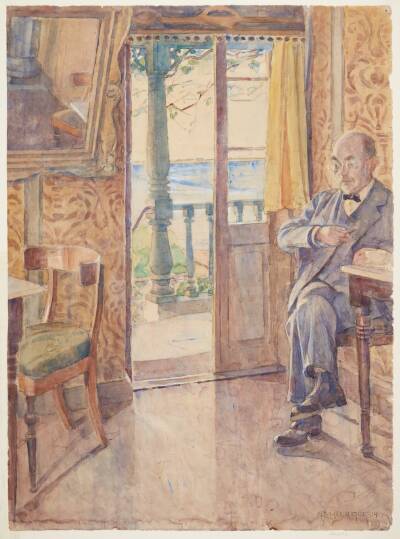
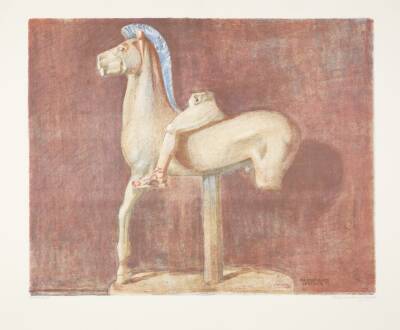
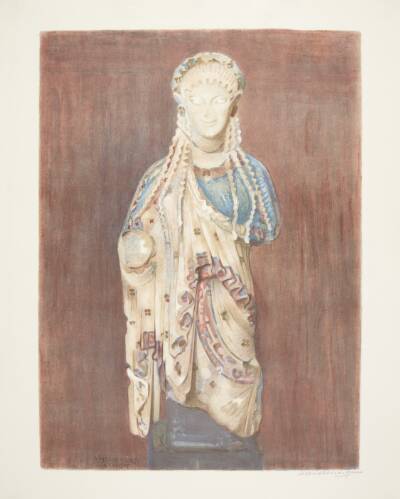
Etruskisk sarkofag i Louvre
Marie Henriques (Danish, 1866–1944)
1928
- Medium
- Watercolour
- Classification
- Watercolour
- Dimensions
- height 66 cm, width 51 cm
- Culture
- Danish
- Museum
- SMK – National Gallery of Denmark
- Rights
- Public Domain Mark: SMK waives its rights in this photograph, as the museum states it.
- Who can see it
- Teens profiles and older: its museum says too little about what it shows to place it for younger viewers. How works are placed
View at the SMK – National Gallery of Denmark
About this work
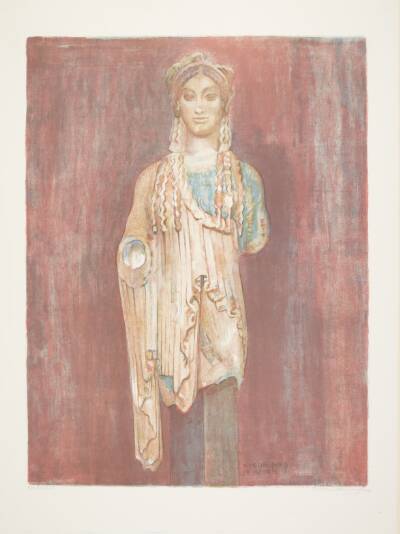
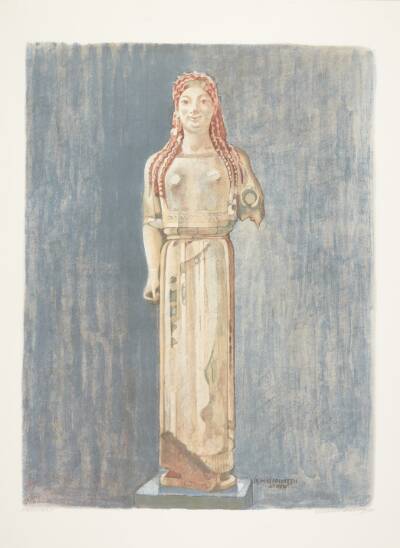
Marie Henriques found the subject mat- ter for these watercolours on two trips abroad. From the Louvre in Paris, we see an archaic, Etruscan terracotta sarcophagus dated 520–510 BCE, and from a visit to the collection of antiquities in Berlin she has depicted an archaic, Greek marble kore dated 570 BCE, now in the Pergamonmuseum. Henriques’s fascination with depicting sculpture was awakened on a trip to Stockholm in 1909, where she studied the sculpture of Saint George and the Dragon in the city’s cathedral, Storkyrkan. Concurrently with this, she had come across depictions of polychrome archaic Greek sculptures that caught her interest. These finds had been excavated on the Acropolis during the 1880s, and in 1910 Henriques set out for her first visit to Greece together with the archaeologist Frederik Poulsen. The special feature of these sculptures was the clear remains of colour still visible on them, a trait which caused a stir among contemporary archaeologists. Most excavated sculptures had emerged the colour of limestone or marble, and the white sculpture had long been seen as the ideal. The remnants of colour on the polychrome pieces meant that no casts could be made…