Window mode follows your eyes with your camera, in this browser only: no picture or position leaves your device.
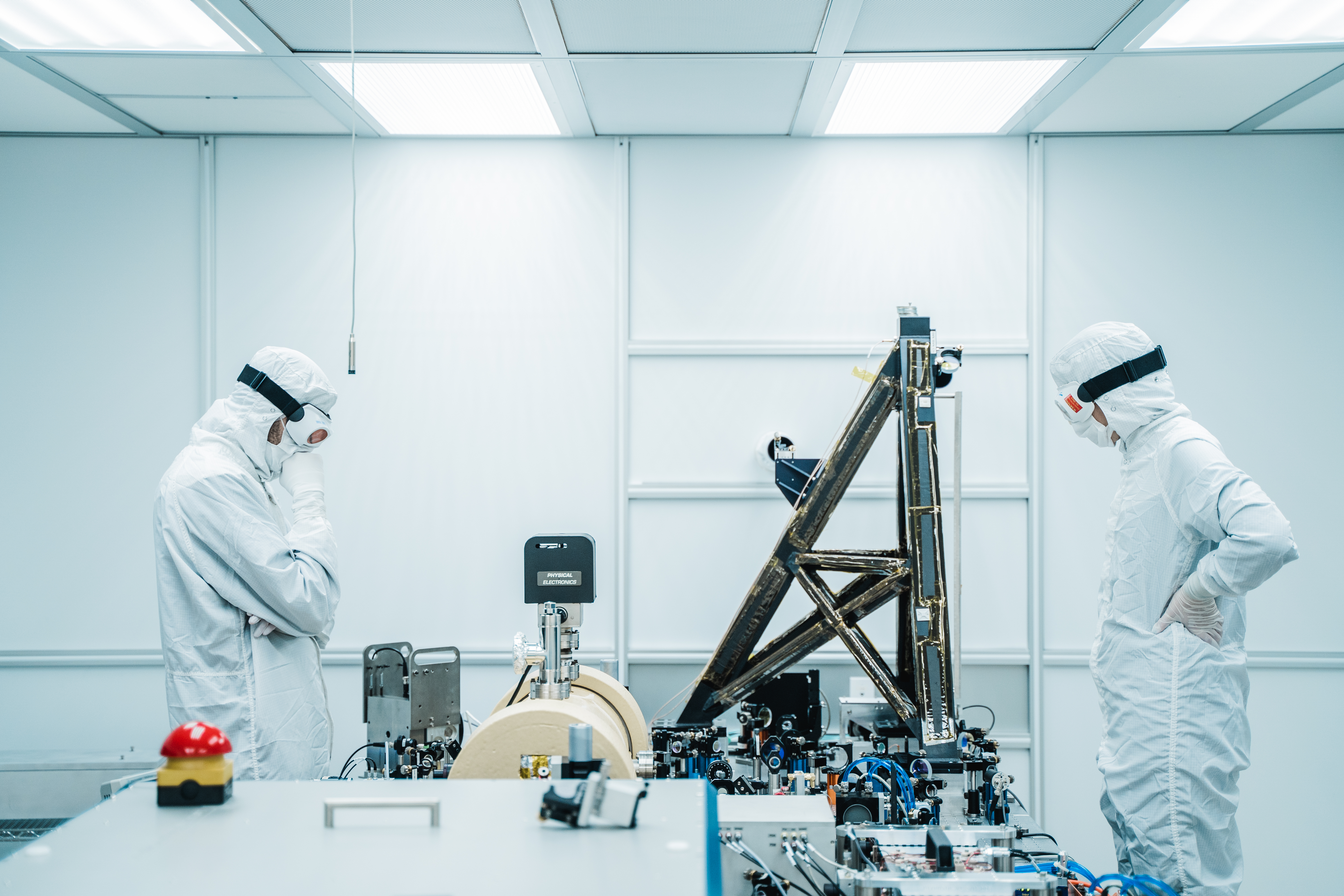
Baffled LIGO Scientists
2019-10-05
- Classification
- Photograph
- Museum
- Wikimedia Commons
- Rights
- CC BY 4.0, as the museum states it.
- Who can see it
- Teens profiles and older: its museum says too little about what it shows to place it for younger viewers. How works are placed
About this work
My name is Nutsinee Kijbunchoo and I'm a physics PhD student based at the National Australian University, Canberra, Australia. My advisor sent me to LIGO Hanford, one of the two U.S. based gravitational-wave detectors located in the middle of Washington desert to help out with the squeezed light commission and upgrade during the third observing run break (it means we stopped listening to black hole and neutron star collisions). On a rare day that I didn't have to work at my own corner, I followed Georgia Mansell (MIT postdoc) and Jason Oberling (site detector engineer) into the Pre-Stabilized Laser (PSL) enclosure. Inside the PSL is where the laser that uses to detect gravitational waves generates. It is literally where it all begins. The system is capable of outputting 70-80 W of laser power so the room needs to be clean as dust and bugs can cause damage to the coatings. While I was watching Georgia and Jason work I snapped this photo as the two were baffled by the low amount of light coupling into the new fiber coupler they just installed. Just like all equipment, LIGO too needs to be maintained constantly.