Window mode follows your eyes with your camera, in this browser only: no picture or position leaves your device.
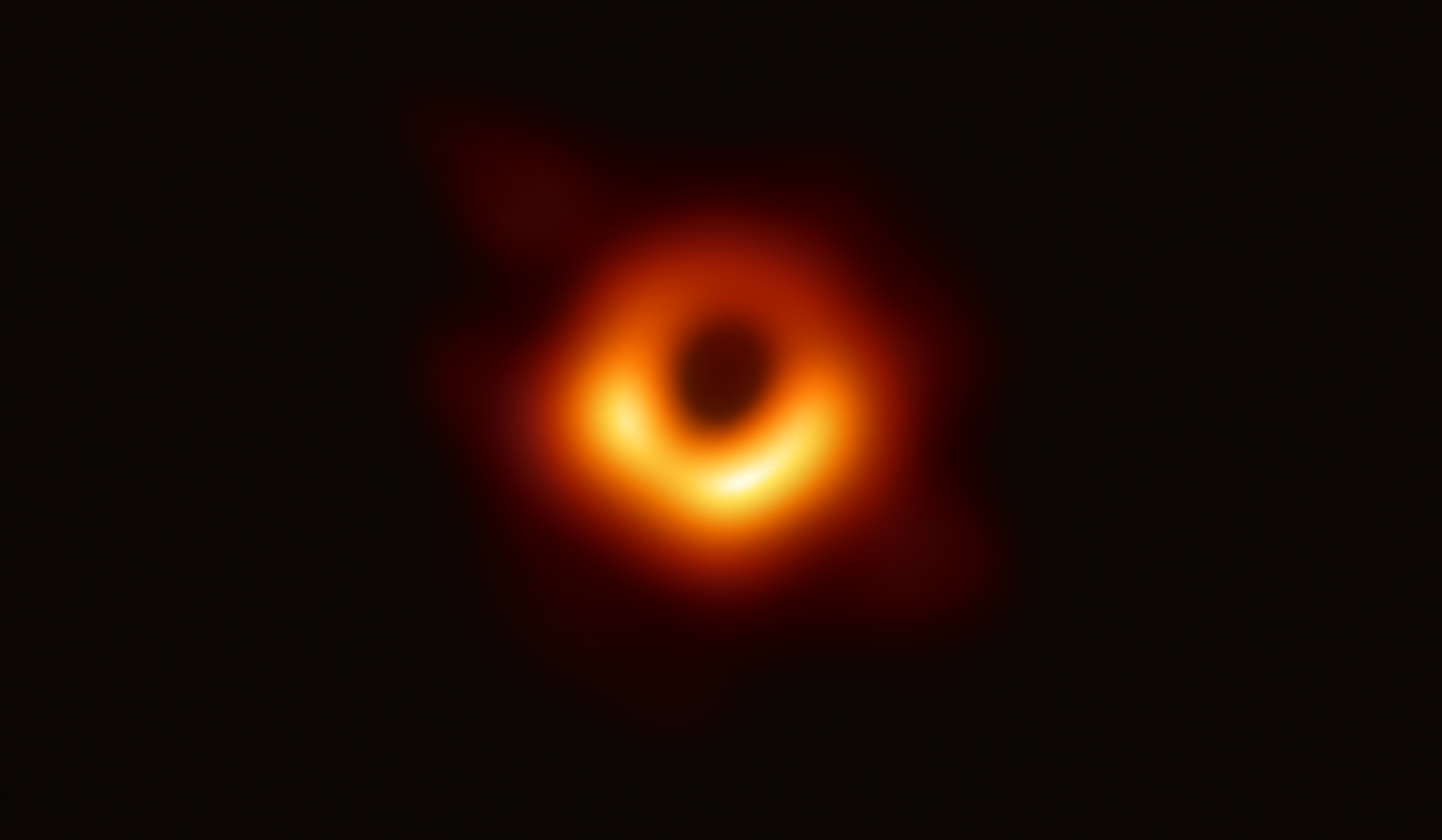
Black hole - Messier 87
circa April 2017; released 10 April 2019
- Classification
- Photograph
- Museum
- Wikimedia Commons
- Credit line
- https://www.eso.org/public/images/eso1907a/; JPG saved from full size TIFF and converted with maximum quality level 12 in Photoshop 2019.
- Rights
- CC BY 4.0, as the museum states it.
- Who can see it
- Teens profiles and older: its museum says too little about what it shows to place it for younger viewers. How works are placed
About this work
The Event Horizon Telescope (EHT) — a planet-scale array of eight ground-based radio telescopes forged through international collaboration — was designed to capture images of a black hole. In coordinated press conferences across the globe, EHT researchers revealed that they succeeded, unveiling the first direct visual evidence of the supermassive black hole in the centre of Messier 87 and its shadow. In this image of M87* taken on 11 April 2017 (a representative example of the images collected in a global 2017 EHT campaign), the shadow of a black hole is the closest we can come to an image of the black hole itself, a completely dark object from which light cannot escape. The black hole’s boundary — the event horizon from which the EHT takes its name — is around 2.5 times smaller than the shadow it casts and measures just under 40 billion km across. While this may sound large, this ring is only about 40 microarcseconds across — equivalent to measuring the length of a credit card on the surface of the Moon. Although the telescopes making up the EHT are not physically connected, they are able to synchronize their recorded data with atomic clocks — hydrogen masers — which precisely…