Window mode follows your eyes with your camera, in this browser only: no picture or position leaves your device.
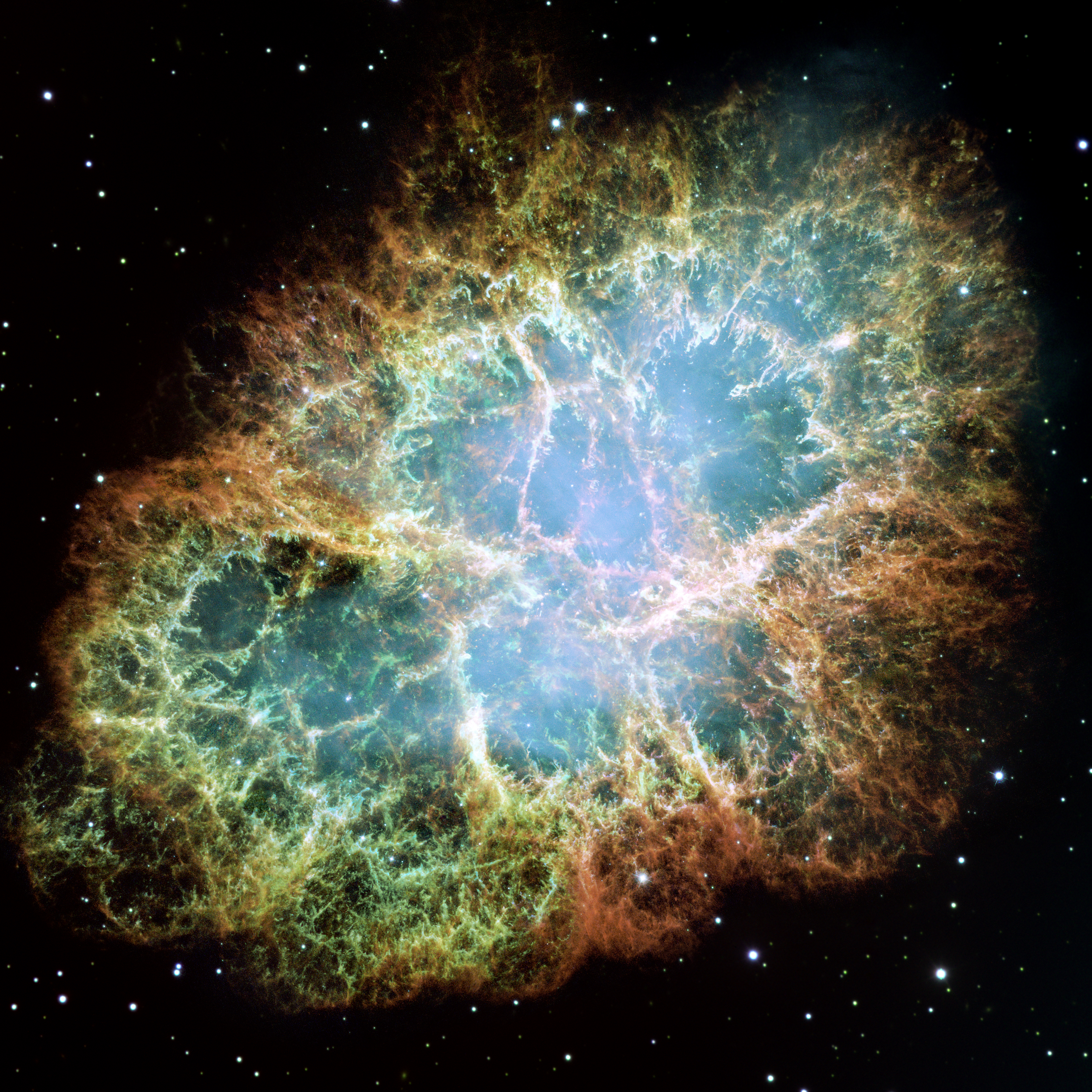
Crab Nebula
NASA, ESA, J. Hester and A. Loll (Arizona State University)
2005-12-01
- Classification
- Photograph
- Museum
- Wikimedia Commons
- Credit line
- A Giant Hubble Mosaic of the Crab Nebula
- Rights
- Public domain, as the museum states it.
- Who can see it
- Kids profiles and older: it shows nature, places, still life or a children's book. How works are placed
About this work
This is a mosaic image, one of the largest ever taken by NASA's Hubble Space Telescope, of the Crab Nebula, a six-light-year-wide expanding remnant of a star's supernova explosion. Japanese and Chinese astronomers recorded this violent event in 1054 CE.
The orange filaments are the tattered remains of the star and consist mostly of hydrogen. The rapidly spinning neutron star embedded in the center of the nebula is the dynamo powering the nebula's eerie interior bluish glow. The blue light comes from electrons whirling at nearly the speed of light around magnetic field lines from the neutron star. The neutron star, like a lighthouse, ejects twin beams of radiation that appear to pulse 30 times a second due to the neutron star's rotation. A neutron star is the crushed ultra-dense core of the exploded star.
The Crab Nebula derived its name from its appearance in a drawing made by Irish astronomer Lord Rosse in 1844, using a 36-inch telescope. When viewed by Hubble, as well as by large ground-based telescopes such as the European Southern Observatory's Very Large Telescope, the Crab Nebula takes on a more detailed appearance that yields clues into the spectacular demise of a star,…