Window mode follows your eyes with your camera, in this browser only: no picture or position leaves your device.
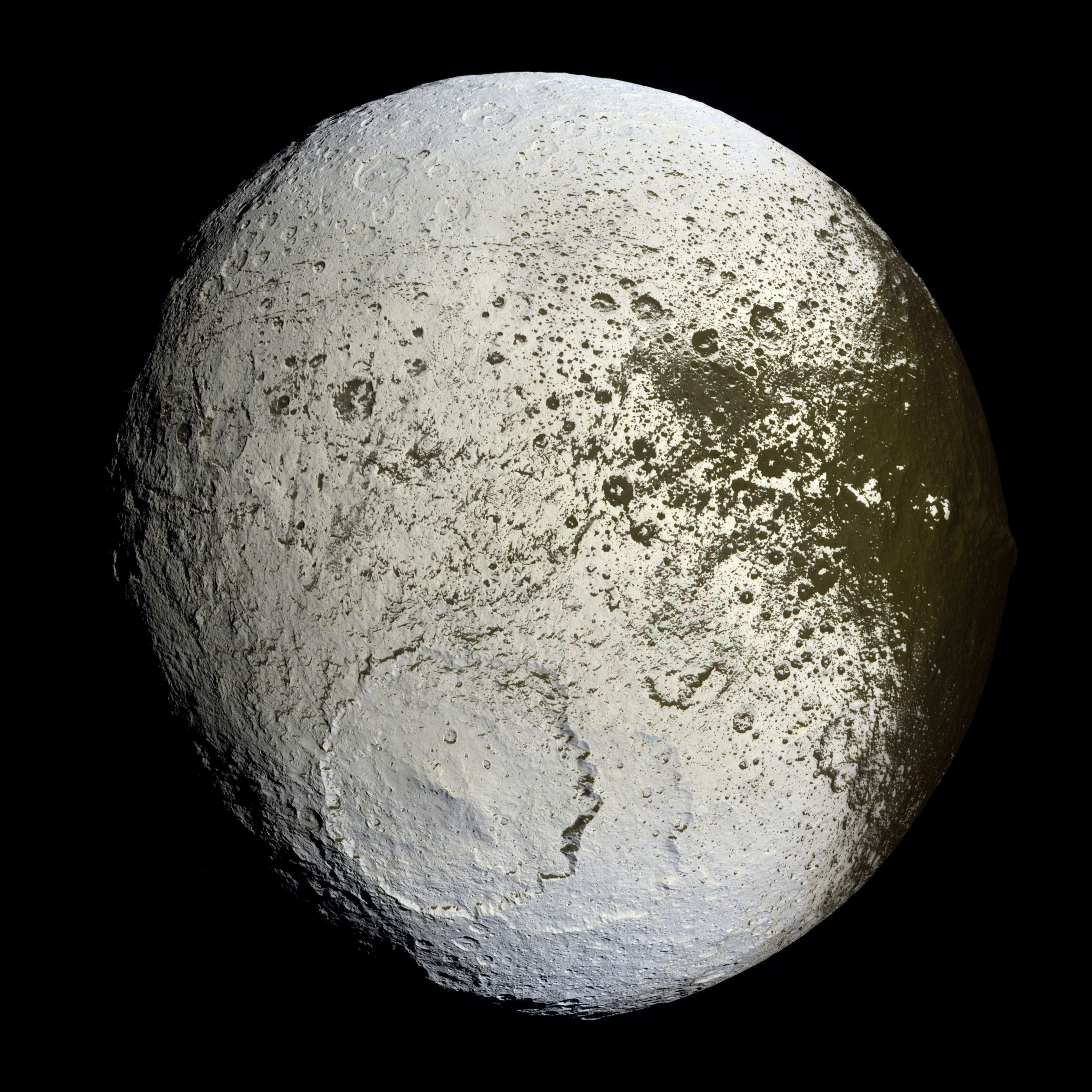
Iapetus as seen by the Cassini probe - 20071008
NASA / JPL / Space Science Institute
2007-10-08
- Classification
- Photograph
- Museum
- Wikimedia Commons
- Credit line
- PIA08384: The Other Side of Iapetus
- Rights
- Public domain, as the museum states it.
- Who can see it
- Tweens profiles and older: its subjects are known and suit older children. How works are placed
About this work
Iapetus as seen by the Cassini probe.
Original NASA caption: Cassini captures the first high-resolution glimpse of the bright trailing hemisphere of Saturn's moon Iapetus.
This false-color mosaic shows the entire hemisphere of Iapetus (1,468 kilometers, or 912 miles across) visible from Cassini on the outbound leg of its encounter with the two-toned moon in Sept. 2007. The central longitude of the trailing hemisphere is 24 degrees to the left of the mosaic's center.
Also shown here is the complicated transition region between the dark leading and bright trailing hemispheres. This region, visible along the right side of the image, was observed in many of the images acquired by Cassini near closest approach during the encounter.
Revealed here for the first time in detail are the geologic structures that mark the trailing hemisphere. The region appears heavily cratered, particularly in the north and south polar regions. Near the top of the mosaic, numerous impact features visible in NASA Voyager 2 spacecraft images (acquired in 1981) are visible, including the craters Ogier and Charlemagne.
The most prominent topographic feature in this view, in the bottom half of the mosaic,…