Window mode follows your eyes with your camera, in this browser only: no picture or position leaves your device.
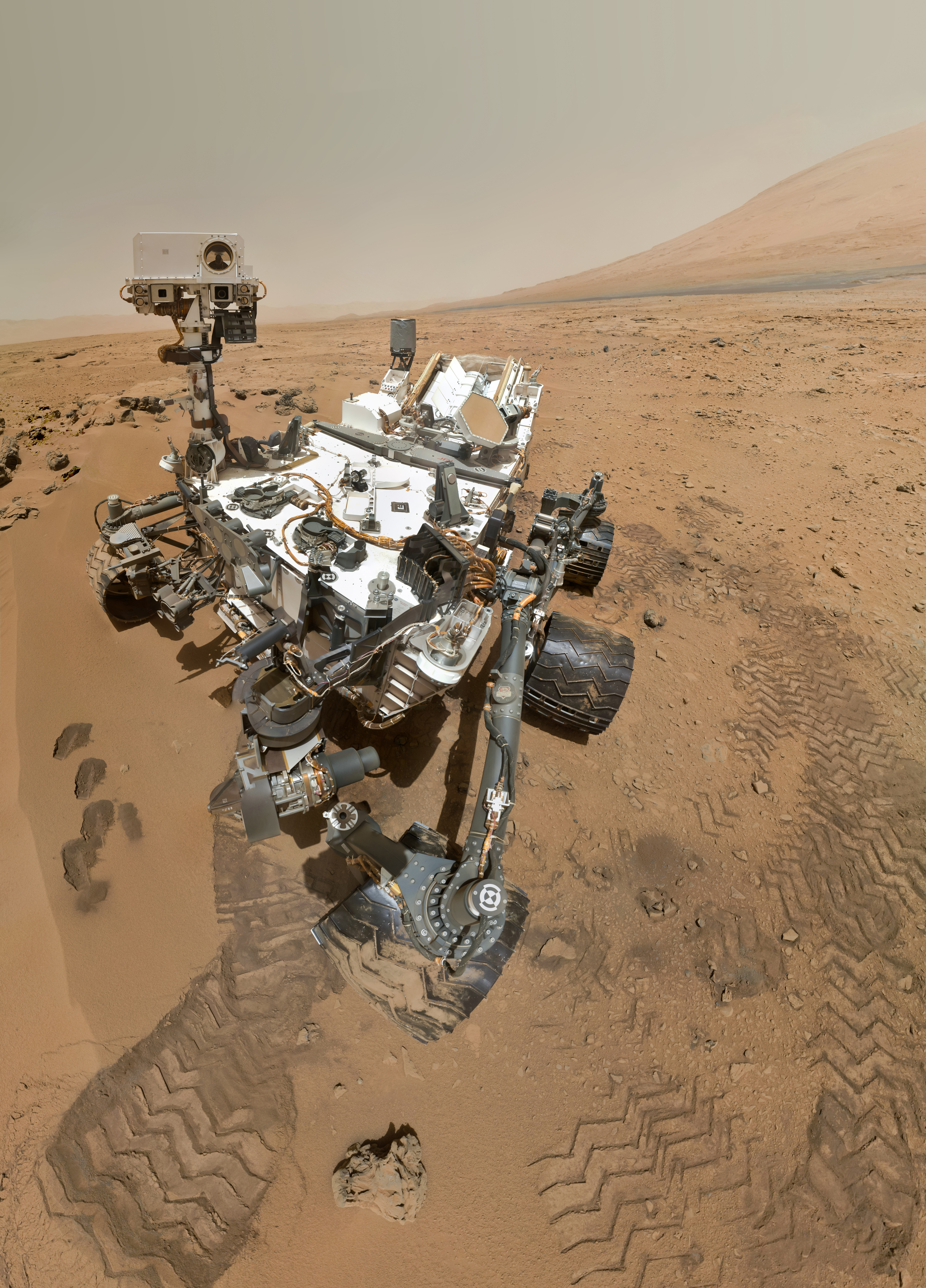
PIA16239 High-Resolution Self-Portrait by Curiosity Rover Arm Camera
NASA/JPL-Caltech/Malin Space Science Systems
Taken on 31 October 2012
- Classification
- Photograph
- Museum
- Wikimedia Commons
- Credit line
- http://photojournal.jpl.nasa.gov/catalog/PIA16239
- Rights
- Public domain, as the museum states it.
- Who can see it
- Tweens profiles and older: its subjects are known and suit older children. How works are placed
About this work
On Sol 84 (Oct. 31, 2012), NASA's Curiosity rover used the Mars Hand Lens Imager (MAHLI) to capture this set of 55 high-resolution images, which were stitched together to create this full-color self-portrait.
The mosaic shows the rover at "Rocknest," the spot in Gale Crater where the mission's first scoop sampling took place. Four scoop scars can be seen in the regolith in front of the rover.
The base of Gale Crater's 3-mile-high (5-kilometer) sedimentary mountain, Mount Sharp, rises on the right side of the frame. Mountains in the background to the left are the northern wall of Gale Crater. The Martian landscape appears inverted within the round, reflective ChemCam instrument at the top of the rover's mast.
Self-portraits like this one document the state of the rover and allow mission engineers to track changes over time, such as dust accumulation and wheel wear. Due to its location on the end of the robotic arm, only MAHLI (among the rover's 17 cameras) is able to image some parts of the craft, including the port-side wheels.
This high-resolution mosaic is a more detailed version of the low-resolution version created with thumbnail images, at PIA16238.
JPL manages the Mars…