Window mode follows your eyes with your camera, in this browser only: no picture or position leaves your device.
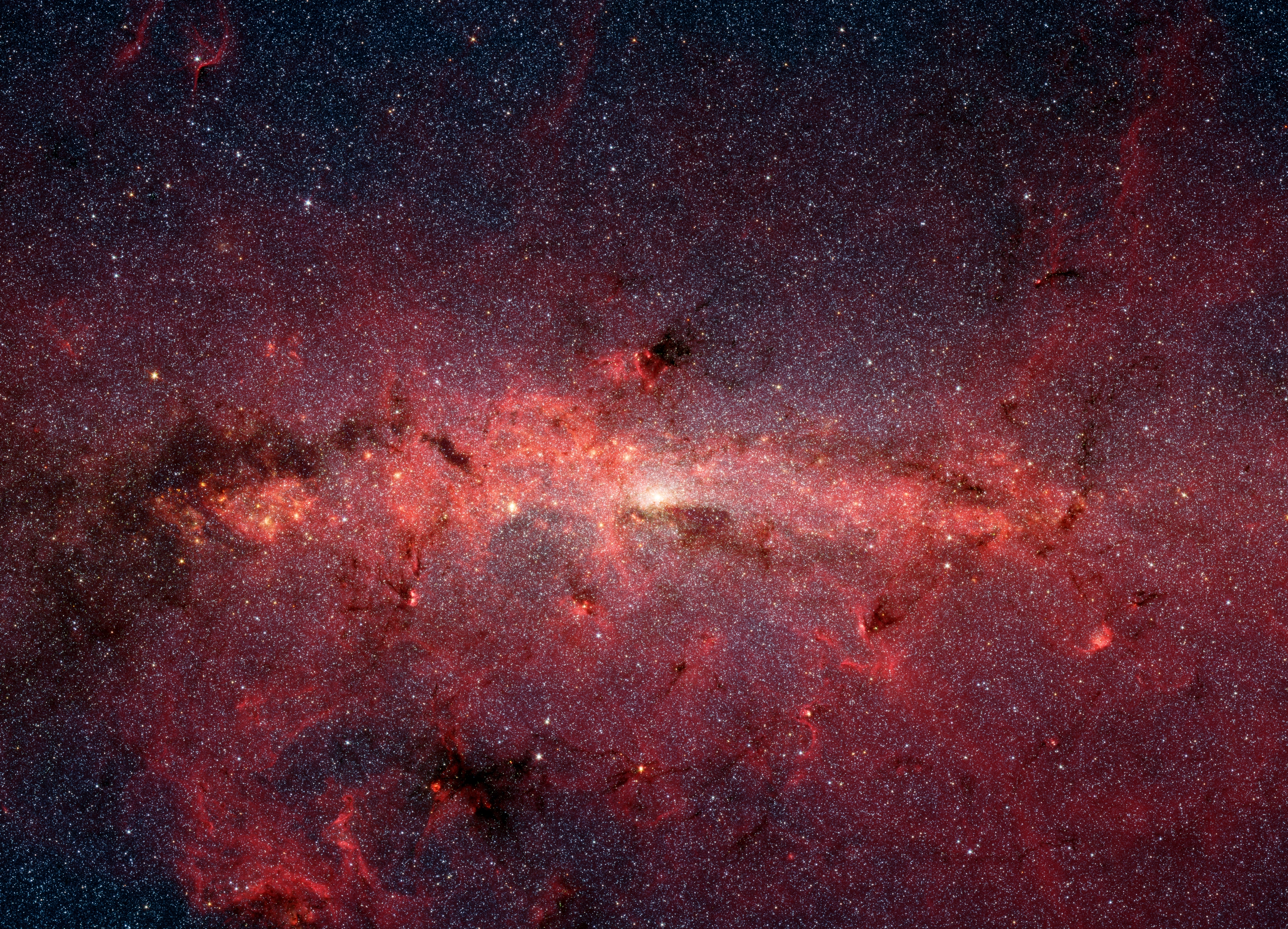
Milky Way IR Spitzer
Credit: NASA/JPL-Caltech/S. Stolovy (Spitzer Science Center/Caltech)
released January 10, 2006
- Classification
- Photograph
- Museum
- Wikimedia Commons
- Credit line
- http://www.spitzer.caltech.edu/images/1540-ssc2006-02a-A-Cauldron-of-Stars-at-the-Galaxy-s-Center
- Rights
- Public domain, as the museum states it.
- Who can see it
- Teens profiles and older: its museum says too little about what it shows to place it for younger viewers. How works are placed
About this work
The center of our Milky Way galaxy is hidden from the prying eyes of optical telescopes by clouds of obscuring dust and gas. But in this stunning vista, the Spitzer Space Telescope's infrared cameras penetrate much of the dust, revealing the stars of the crowded galactic center region. The upcoming James Webb Space Telescope will offer a much-improved infrared view, teasing out fainter stars and sharper details.
The center of our galaxy is a crowded place: A black hole weighing 4 million times as much as our Sun is surrounded by millions of stars whipping around it at breakneck speeds. This extreme environment is bathed in intense ultraviolet light and X-ray radiation. Yet much of this activity is hidden from our view, obscured by vast swaths of interstellar dust.
NASA’s James Webb Space Telescope is designed to view the universe in infrared light, which is invisible to the human eye, but is very important for looking at astronomical objects hidden by dust. After its launch, Webb will gather infrared light that has penetrated the dusty veil, revealing the galactic center in unprecedented detail.