Window mode follows your eyes with your camera, in this browser only: no picture or position leaves your device.
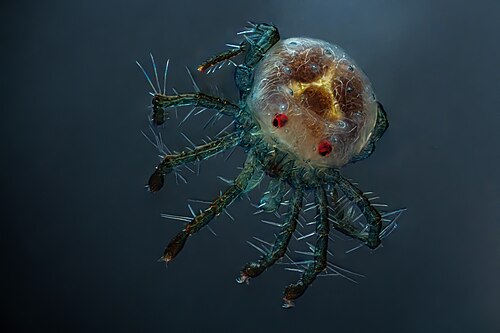
Karpvähiline0424
2024-04-11
- Classification
- Photograph
- Museum
- Wikimedia Commons
- Rights
- CC BY 4.0, as the museum states it.
- Who can see it
- Kids profiles and older: it shows nature, places, still life or a children's book. How works are placed
About this work
A freshwater ostracod of genus Heterocypris (Heterocypris sp.) photographed under a microscope using an 8x objective. The specimen was collected from a pond in Rakvere, Estonia, in April 2024. The image clearly shows the characteristic bivalved carapace of the ostracod, which is semi-transparent with a greenish-yellow coloration. The fine setae along the edge of the carapace and the characteristic antennae are particularly well visible. The antennae extending from the carapace are important locomotory organs for ostracods.
The specimen was photographed against a black background, which excellently highlights the semi-transparent structure of the animal's carapace and its delicate appendages. The lighting technique used differs from conventional transmitted microscope illumination - instead, reflected light from a photographic speedlight flash was used. This lighting solution allows for exceptional detail in revealing the object's surface texture and transparent structures.
The image was created using focus stacking technique, which allows achieving great depth of field even in microscopic photography. This technique is particularly important when photographing microorganisms,…