Window mode follows your eyes with your camera, in this browser only: no picture or position leaves your device.
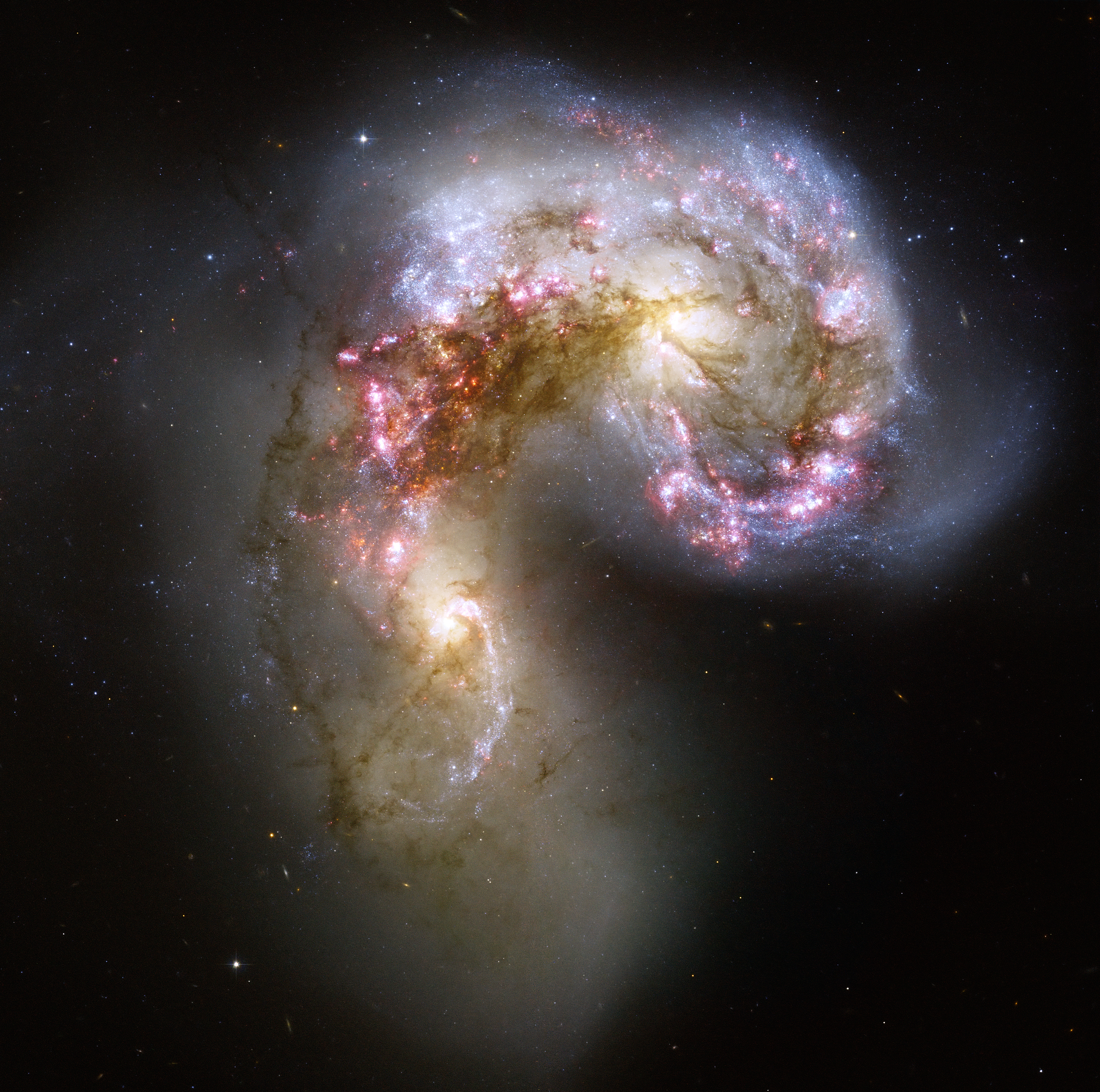
Antennae galaxies xl
NASA, ESA, and the Hubble Heritage Team (STScI/AURA)-ESA/Hubble Collaboration
2006-10-16
- Classification
- Photograph
- Museum
- Wikimedia Commons
- Credit line
- http://www.spacetelescope.org/images/heic0615a/ http://hubblesite.org/newscenter/archive/releases/2006/46/image/a/ (direct link)
- Rights
- Public domain, as the museum states it.
- Who can see it
- Teens profiles and older: its museum says too little about what it shows to place it for younger viewers. How works are placed
About this work
Original caption from NASA: “This NASA Hubble Space Telescope image of the Antennae galaxies (NGC 4038 & 4039) is the sharpest yet of this merging pair of galaxies. During the course of the collision, billions of stars will be formed. The brightest and most compact of these star birth regions are called super star clusters.” “ The two spiral galaxies started to interact a few hundred million years ago, making the Antennae galaxies one of the nearest and youngest examples of a pair of colliding galaxies. Nearly half of the faint objects in the Antennae image are young clusters containing tens of thousands of stars. The orange blobs to the left and right of image center are the two cores of the original galaxies and consist mainly of old stars criss-crossed by filaments of dust, which appear brown in the image. The two galaxies are dotted with brilliant blue star-forming regions surrounded by glowing hydrogen gas, appearing in the image in pink.”